' fill='white'%3e %3cg id='%e7%bc%96%e7%bb%84-7' transform='translate(0.000000%2c 86.000000)'%3e %3cg id='%e7%bc%96%e7%bb%84-2' transform='translate(80.533981%2c 22.000000)'%3e %3cpath d='M41.7832962%2c0 C41.9459106%2c0 42.0882746%2c0.0866854658 42.1666825%2c0.216359069 C43.8289923%2c2.66540836 44.7676281%2c5.46271319 44.7676281%2c8.43208061 C44.7676281%2c18.1345746 34.7460532%2c26 22.383814%2c26 C10.0215749%2c26 0%2c18.1345746 0%2c8.43208061 C0%2c5.46716016 0.935826425%2c2.67378733 2.58829888%2c0.223985685 C2.67109477%2c0.0916264068 2.81687473%2c0 2.9840593%2c0 C3.23130408%2c0 3.43173558%2c0.200393004 3.43173558%2c0.447590303 C3.43173558%2c0.475056669 3.42926112%2c0.501945205 3.42452292%2c0.528045226 L3.41810883%2c0.550292077 C3.37800671%2c0.861741908 3.3575721%2c1.17661276 3.3575721%2c1.49443092 C3.3575721%2c7.98336 11.2132389%2c12.5742305 22.383814%2c12.5742305 C33.5543891%2c12.5742305 41.410056%2c7.98336 41.410056%2c1.49443092 C41.410056%2c1.17865223 41.3898828%2c0.865783153 41.3502888%2c0.556288325 C41.3402868%2c0.521941442 41.3356199%2c0.48531078 41.3356199%2c0.447590303 C41.3356199%2c0.200393004 41.5360514%2c0 41.7832962%2c0 Z' id='logo%e5%a4%87%e4%bb%bd-6'%3e%3c/path%3e %3cpath d='M75.1559425%2c3.74404927 C75.7071421%2c3.74404927 76.2394493%2c3.66184338 76.7416414%2c3.50883715 L74.281987%2c20.8666902 C74.0430787%2c22.5662954 73.2732628%2c23.0518969 71.8929033%2c23.0518969 L70.459453%2c23.0518969 C69.2649111%2c23.0518969 68.6278221%2c22.458384 68.2561868%2c20.893668 L66.1591022%2c11.9909739 C66.1060114%2c11.7481731 66.1060114%2c11.6942174 65.9998299%2c11.6942174 C65.8936484%2c11.6942174 65.867103%2c11.7481731 65.8140123%2c11.9909739 L63.7169276%2c20.893668 C63.3452924%2c22.458384 62.7082033%2c23.0518969 61.5136614%2c23.0518969 L60.0802112%2c23.0518969 C58.6998516%2c23.0518969 57.9300358%2c22.5662954 57.6911274%2c20.8666902 L55.2123917%2c3.37406084 C55.8253692%2c3.61307396 56.491017%2c3.74404927 57.1867652%2c3.74404927 C57.7974457%2c3.74404927 58.3849364%2c3.64314414 58.9339751%2c3.4568446 L60.8234817%2c19.3829078 C60.8500271%2c19.6257086 60.8500271%2c19.7875757 60.9562086%2c19.7875757 C61.0623901%2c19.7875757 61.0623901%2c19.6257086 61.1154808%2c19.3829078 L63.3983831%2c9.91367858 C63.5576554%2c9.26620991 63.9292906%2c8.69967483 65.0707418%2c8.69967483 L66.9023727%2c8.69967483 C68.0438238%2c8.69967483 68.4154591%2c9.26620991 68.5747313%2c9.91367858 L70.8576336%2c19.3829078 C70.9107244%2c19.6257086 70.9107244%2c19.7875757 71.0169059%2c19.7875757 C71.1230874%2c19.7875757 71.1230874%2c19.6257086 71.1496327%2c19.3829078 L73.0551401%2c3.32292288 C73.7026096%2c3.59432921 74.4120718%2c3.74404927 75.1559425%2c3.74404927 Z' id='Combined-Shape'%3e%3c/path%3e %3cpath d='M85.0594095%2c7.43171536 C89.1473973%2c7.43171536 91.3772089%2c10.2643908 91.3772089%2c14.2840921 L91.3772089%2c15.7948523 C91.3772089%2c16.2264981 91.2179366%2c16.4692988 90.8463013%2c16.4692988 L82.1925089%2c16.4692988 L82.1925089%2c16.5502324 C82.1925089%2c18.1149484 82.829598%2c19.9764208 85.377954%2c19.9764208 C87.3157664%2c19.9764208 89.1473973%2c19.8145536 90.2623031%2c19.7066422 L90.3419392%2c19.7066422 C90.607393%2c19.7066422 90.819756%2c19.8415315 90.819756%2c20.1113101 L90.819756%2c21.8918489 C90.819756%2c22.3234947 90.7401198%2c22.5123397 90.2623031%2c22.5932733 C88.5368537%2c22.9170076 87.501584%2c23.0518969 85.1125002%2c23.0518969 C82.4579627%2c23.0518969 78.6885194%2c21.5950924 78.6885194%2c16.2804538 L78.6885194%2c14.2840921 C78.6885194%2c10.0755457 80.997967%2c7.43171536 85.0594095%2c7.43171536 Z M85.0594095%2c10.5071915 C83.4135962%2c10.5071915 82.2190543%2c11.6942174 82.2190543%2c13.8254684 L82.2190543%2c13.9333799 L87.8466739%2c13.9333799 L87.8466739%2c13.8254684 C87.8466739%2c11.7211953 86.7052228%2c10.5071915 85.0594095%2c10.5071915 Z' id='Combined-Shape'%3e%3c/path%3e %3cpath d='M97.88151%2c2.98826245 L97.8808258%2c7.62056039 C98.8630047%2c7.48567108 99.7920929%2c7.43171536 100.429182%2c7.43171536 C104.702987%2c7.43171536 106.773527%2c9.99461216 106.773527%2c14.2031585 L106.773527%2c16.2804538 C106.773527%2c20.4890001 104.702987%2c23.0518969 100.429182%2c23.0518969 C98.7302779%2c23.0518969 96.7393747%2c22.7821183 95.0935614%2c22.3504725 C94.4830178%2c22.1886054 94.3768363%2c22.0267382 94.3768363%2c21.6220703 L94.3758373%2c3.08694115 C94.884566%2c3.24434375 95.4244809%2c3.32900525 95.9838525%2c3.32900525 C96.6506785%2c3.32900525 97.2898545%2c3.20869291 97.88151%2c2.98826245 Z M100.429182%2c10.3453244 C99.7920929%2c10.3453244 98.6240964%2c10.4262579 97.8808258%2c10.5341694 L97.8808258%2c19.9494429 C98.385188%2c20.0573544 99.4735484%2c20.1382879 100.429182%2c20.1382879 C102.712084%2c20.1382879 103.269537%2c18.4926384 103.269537%2c16.2804538 L103.269537%2c14.2031585 C103.269537%2c11.9909739 102.712084%2c10.3453244 100.429182%2c10.3453244 Z' id='Combined-Shape'%3e%3c/path%3e %3cpath d='M111.502687%2c8.72457747 C112.045508%2c8.72457747 112.570006%2c8.64485191 113.065463%2c8.49629404 L113.064781%2c16.5232546 C113.064781%2c19.3289521 114.073505%2c19.9764208 115.613137%2c19.9764208 L115.772409%2c19.9764208 C117.312041%2c19.9764208 118.320765%2c19.3289521 118.320765%2c16.5232546 L118.320226%2c8.4334735 C118.872544%2c8.62226395 119.463958%2c8.72457747 120.078886%2c8.72457747 C120.689352%2c8.72457747 121.276644%2c8.62374317 121.825517%2c8.43756894 L121.824755%2c16.5232546 C121.824755%2c22.4044283 117.338586%2c23.0518969 115.772409%2c23.0518969 L115.526483%2c23.0512514 C113.88817%2c23.0271041 109.560791%2c22.2994073 109.560791%2c16.5232546 L109.560465%2c8.36700801 C110.164542%2c8.59813531 110.819085%2c8.72457747 111.502687%2c8.72457747 Z' id='Combined-Shape'%3e%3c/path%3e %3cpath d='M128.780182%2c3.03790128 L128.779643%2c22.269539 C128.779643%2c22.5662954 128.56728%2c22.836074 128.275281%2c22.836074 L125.806561%2c22.836074 C125.514562%2c22.836074 125.275653%2c22.5662954 125.275653%2c22.269539 L125.275475%2c3.04219481 C125.82418%2c3.22824247 126.411273%2c3.32900525 127.021522%2c3.32900525 C127.63645%2c3.32900525 128.227864%2c3.22669173 128.780182%2c3.03790128 Z' id='Combined-Shape'%3e%3c/path%3e %3cpath d='M134.372549%2c3.32900525 C134.939348%2c3.32900525 135.48617%2c3.24208064 136.000812%2c3.08063296 L135.999985%2c22.269539 C135.999985%2c22.5662954 135.787622%2c22.836074 135.495623%2c22.836074 L133.026903%2c22.836074 C132.734904%2c22.836074 132.495995%2c22.5662954 132.495995%2c22.269539 L132.495929%2c2.99605058 C133.081688%2c3.21152525 133.713619%2c3.32900525 134.372549%2c3.32900525 Z' id='Combined-Shape'%3e%3c/path%3e %3c/g%3e %3c/g%3e %3c/g%3e %3c/g%3e%3c/svg%3e)



Singapore investors have more ways than ever to access US markets, yet US stock trading fees extend well beyond the headline commission rate. From foreign exchange conversion spreads and regulatory levies to custody arrangements and platform charges, understanding the full cost picture helps you evaluate platforms more accurately. This guide breaks down every fee layer relevant to Singapore-based investors and explains how Webull Singapore approaches each one.
Key Takeaways
US stock commissions have become highly competitive, but FX conversion spreads, regulatory levies, and custody fees add to your true cost
All brokers operating in Singapore must hold a Capital Markets Services (CMS) Licence issued by MAS
Client assets are protected through SFA-mandated segregation, not a government-backed compensation scheme
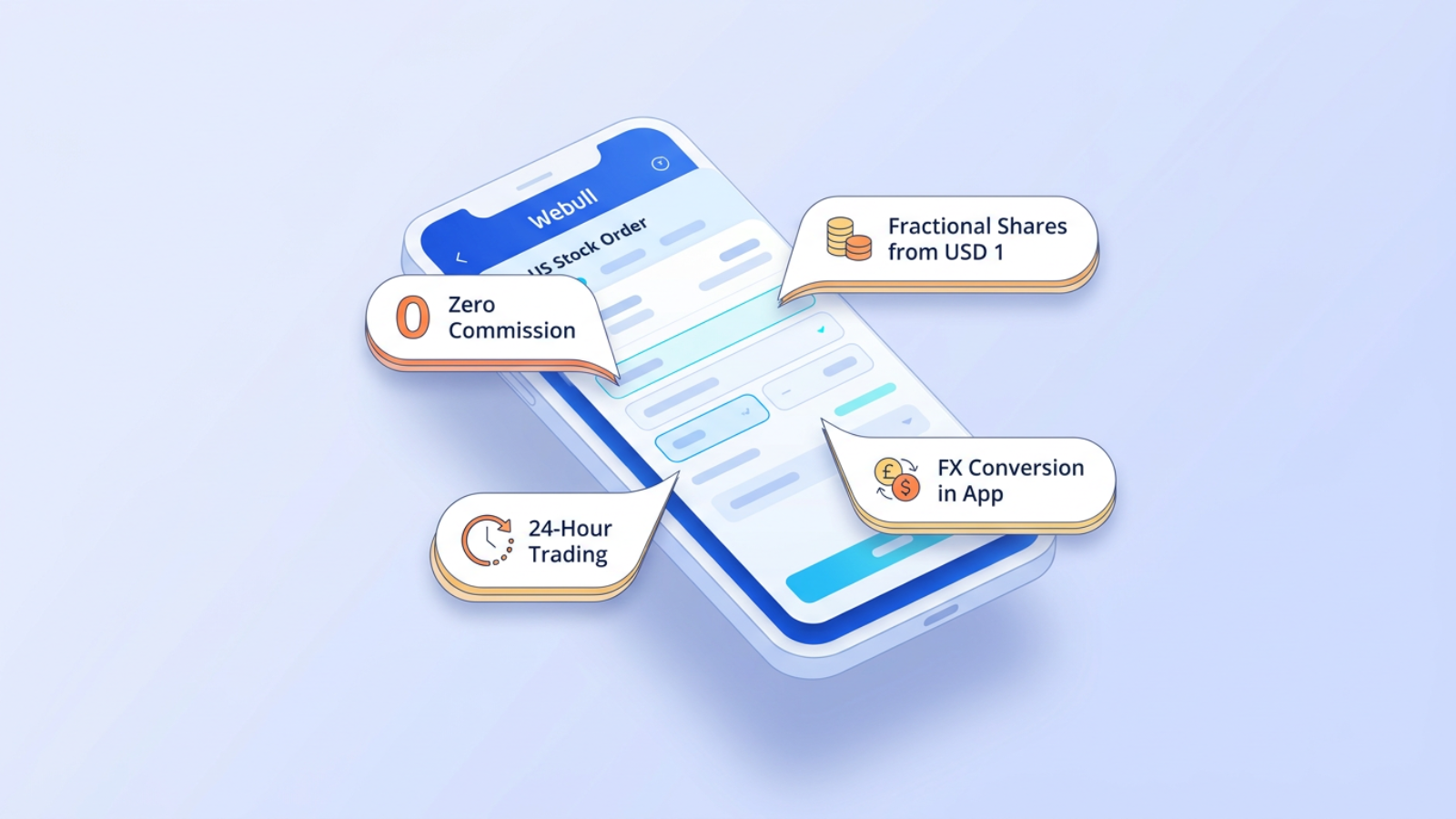
Webull Singapore offers zero-commission US stock trading, fractional shares from USD 1, and 24-hour US market access
Part 1: Understanding US Stock Trading Fees for Singapore Investors
1.1 What Counts as a US Stock Trading Fee?
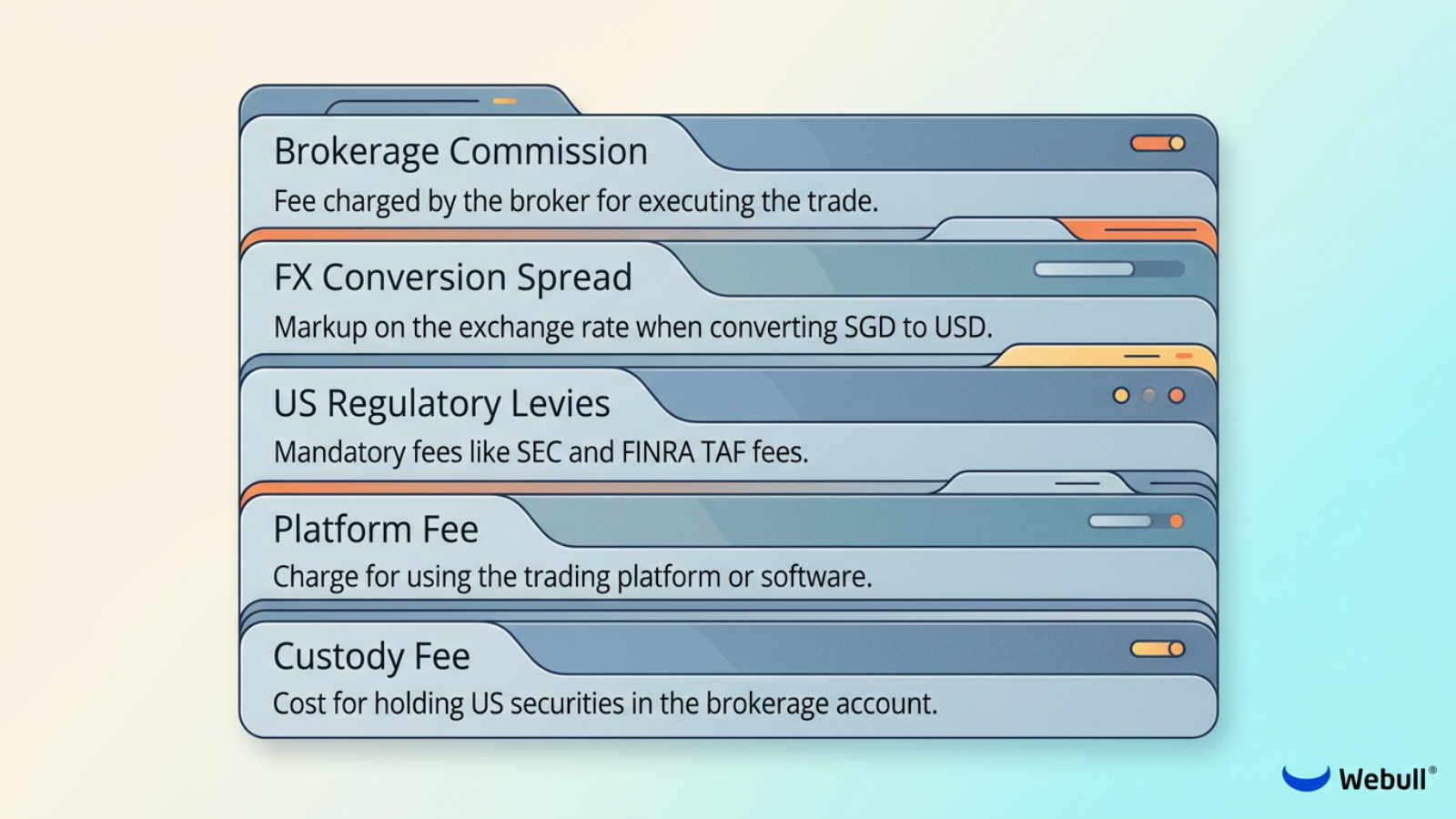
Most investors focus on the commission rate displayed on a brokerage's pricing page. In practice, your total cost of trading US stocks from Singapore includes several distinct layers:
Brokerage commission – charged per trade, either as a flat fee or a percentage of transaction value
Platform fee – a separate per-order charge levied by some brokers in addition to commission
FX conversion spread – the margin built into the SGD-to-USD exchange rate when you fund your account or settle trades
US regulatory levies – SEC Section 31 fee, FINRA Trading Activity Fee (TAF), and Consolidated Audit Trail (CAT) fee
Custody or holding fees – periodic charges for holding foreign securities, applied by some platforms
Understanding each category prevents surprises on your trade confirmations and allows meaningful comparisons across platforms.
Part 2: Breaking Down Each Fee Category in Detail
2.1 Brokerage Commissions and Platform Fees
Commission structures across licensed brokers in Singapore have converged toward zero or near-zero for US stocks. However, the distinction between "zero commission" and "zero total fee" matters.
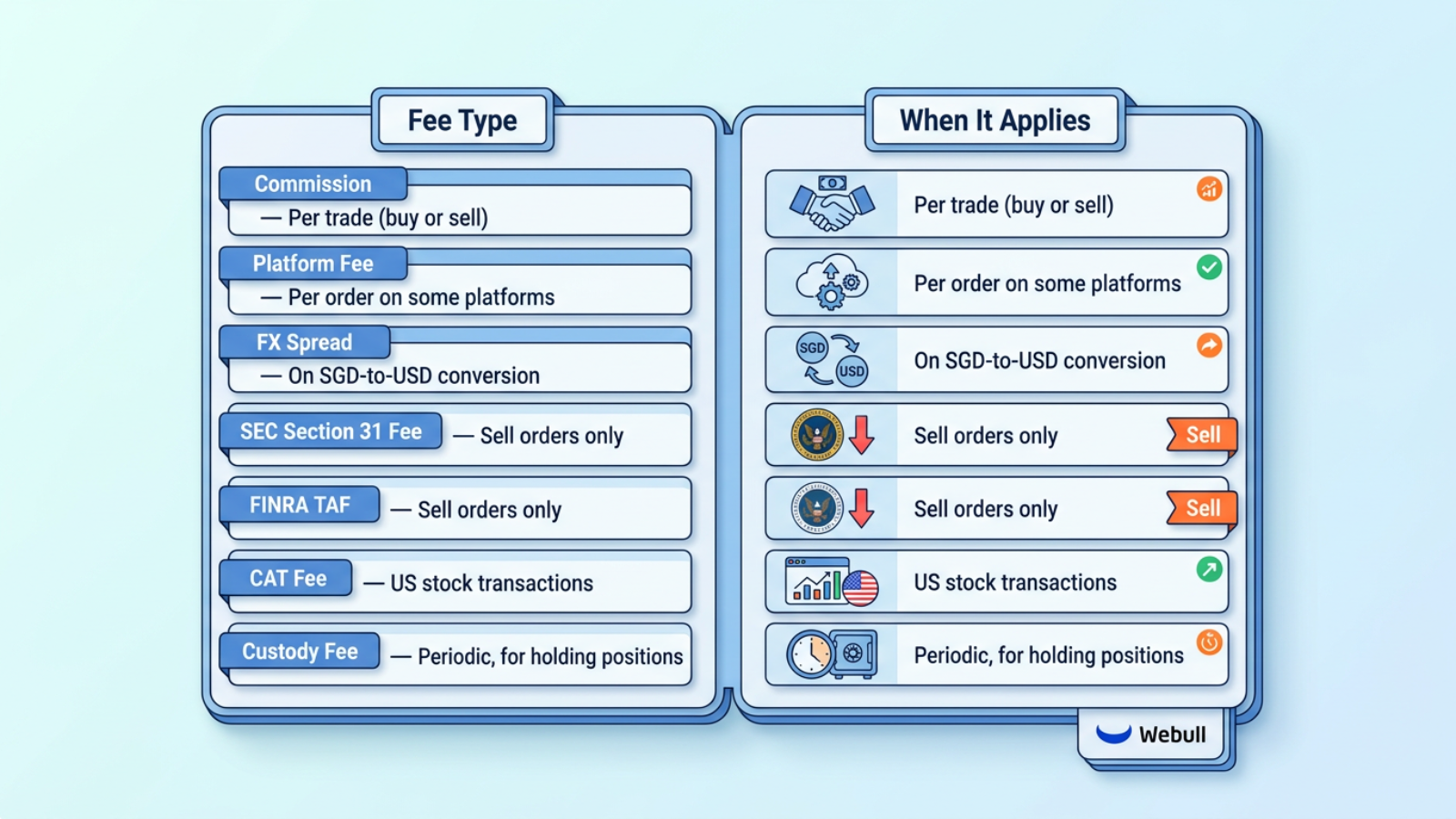
Commission refers specifically to the broker's charge for executing your order. Platform fees are separate per-transaction charges that some brokers apply regardless of commission. Always review the full fee schedule, not just the commission headline.
2.2 Foreign Exchange Conversion Costs
US stocks are priced and settled in USD, so Singapore investors trading with SGD need to convert their funds to USD. The conversion may involve an FX spread, which is the difference between the mid-market exchange rate and the rate applied by the broker.
The spread is typically embedded in the conversion rate rather than shown as a separate line item, making it less visible than a commission charge. Its size varies by platform and prevailing market conditions.
Illustrative example (hypothetical only): Converting SGD 10,000 at a 0.5% spread would incur approximately USD 50 in implicit conversion costs, separate from any commission. Actual costs depend on the prevailing rate and the platform's specific spread at the time of conversion.
Practical approaches to managing FX costs:
Maintain a USD cash balance in your brokerage account where the platform permits, reducing the frequency of SGD-to-USD conversions
Convert larger amounts less frequently rather than converting small amounts per trade
Compare each platform's stated FX conversion terms before selecting a broker
2.3 US Regulatory Levies
Three regulatory fees are passed through from US markets to investors on equity sell orders. These are small in absolute terms but appear on trade confirmations:
SEC Section 31 Fee: Charged by the US Securities and Exchange Commission on equity sell transactions. The applicable rate is published periodically by the SEC and passed through by brokers. It applies only to sell orders.
FINRA Trading Activity Fee (TAF): A regulatory fee assessed by the Financial Industry Regulatory Authority (FINRA) on certain securities transactions, generally on sell orders. The fee is temporarily set at $0 for transactions from October 1 through December 31, 2026, and is scheduled to resume on January 1, 2027, at the applicable rates.
CAT Fee (Consolidated Audit Trail): A per-share charge on US stock transactions that funds FINRA's audit trail infrastructure.
All three are regulatory pass-through costs, not broker revenue. Current rates are published by the SEC and FINRA respectively.
2.4 Custody and Holding Fees
Some brokers charge periodic custody or holding fees for maintaining foreign securities positions. These fees compound silently for long-term investors who are not actively monitoring their statements. Always check whether a custody fee applies before opening an account, particularly if you plan to hold US positions over an extended period.
Part 3: Webull Singapore: Platform Features and Fees for US Stock Trading
Webull Singapore provides access to multiple markets, including the US, Singapore, Hong Kong, and China A-shares, through a single account.
3.1 Commission Structure for US Stocks
Webull Singapore offers zero-commission trading on US stocks and ETFs. There is no separate platform fee on US market trades. Regulatory pass-through fees (SEC, FINRA TAF, CAT) still apply, as these are US market levies rather than broker charges.
3.2 FX Conversion on Webull Singapore
US and Hong Kong securities must be settled in their respective domestic currencies (USD and HKD). Webull Singapore allows you to convert SGD to USD or HKD directly within the app to facilitate these trades. Reviewing the conversion rate offered at the time of transaction is advisable, as FX spreads vary with market conditions.
3.3 Fractional Shares Trading
Webull Singapore supports fractional share trading from as low as USD 1. This allows investors to gain exposure to higher-priced US stocks without committing to the full share price, making it accessible for investors building positions gradually.
3.4 24-Hour US Market Access
Webull Singapore provides 24-hour US trading, extending beyond standard New York Stock Exchange and Nasdaq hours (9:30 PM to 4:00 AM Singapore time during US standard time; 10:30 PM to 5:00 AM during US daylight saving time). This allows Singapore-based investors to react to earnings announcements and market developments outside regular US trading hours.
3.5 Regular Savings Plan (RSP)
Webull Singapore offers both Fixed and Dynamic Regular Savings Plans for recurring investment in US stocks and ETFs, with Fixed RSP also available for mutual funds. A Fixed RSP invests the same amount at each interval. A Dynamic RSP automatically adjusts your contribution based on market conditions. It invests less when the previous closing price is above the benchmark's moving average, and more when it is below, so you buy more when prices are relatively low.
RSPs can help reduce the impact of market timing on entry prices over time. However, they do not guarantee returns or eliminate investment risk. With a Dynamic RSP, contribution amounts may vary, so ensure you have sufficient funds for higher contributions when markets fall.
3.6 Moneybull: Idle Cash Yield
Webull Singapore’s Moneybull feature allows uninvested cash to potentially earn a yield. Yields are variable and subject to change. Please refer to the official Webull Singapore website for the latest rates. Principal is not guaranteed and you may incur a loss. Returns are not guaranteed and not an indication of future performance.
3.7 Derivatives trading on Webull Singapore
US options are available on Webull Singapore at USD 0.55 per contract. To access futures trading, investors must hold a margin account and meet eligibility criteria: minimum age of 21, a valid Customer Account Review (CAR) certification, and an approved margin account. Options and futures carry significant risk and may not be suitable for all investors.
3.8 Account Opening Process
Singapore Citizens, Permanent Residents, and foreigners with Singpass can open a Webull Singapore account using Singpass for a streamlined process. Those without Singpass access can complete the in-app application manually. Account opening requires standard identity verification documents.
3.9 Platform Tools and Market Data
Webull Singapore provides:
A 14-dimension stock screener
AI-assisted trading tools for analysis and screening (note: these tools provide information and analysis, not personalised investment advice or recommendations)
Real-time market signals and company financials
Access to structured warrants and daily leverage certificates (DLCs) on the Singapore market
Part 4: Account Structure and Regulatory Protections for Singapore Investors
4.1 How Your Assets Are Held
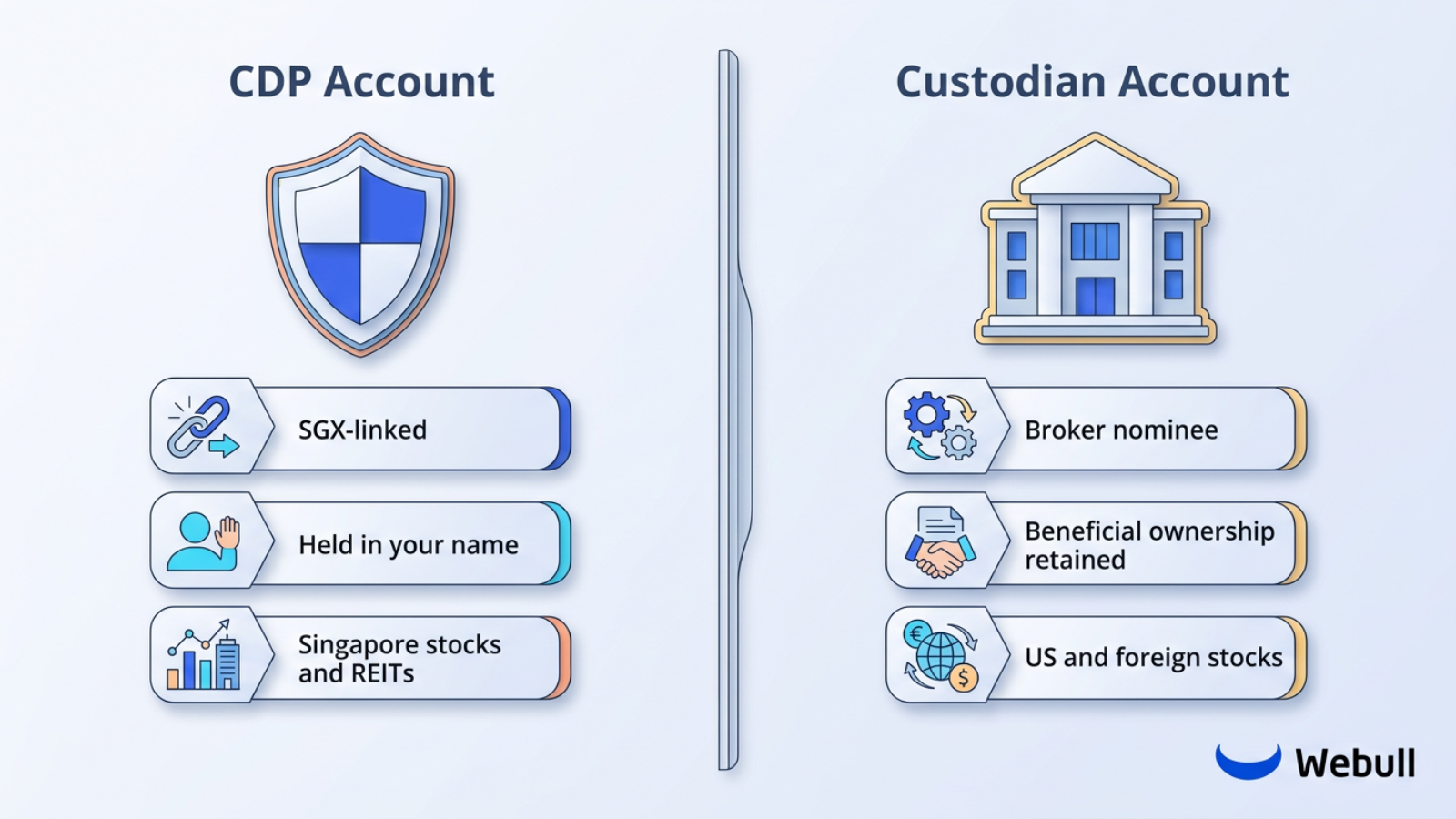
Understanding how your assets are held is important for any investor trading US stocks. Webull Singapore holds your securities in a custodian account, where shares are registered under the name of Webull's nominee or appointed custodian on your behalf. You remain the beneficial owner of your holdings. This is standard practice for cross-border securities, and you can view your holdings anytime in the Webull app and in your account statements.
4.2 MAS Regulation and CMS Licence
Webull Singapore holds a Capital Markets Services (CMS) Licence issued by the Monetary Authority of Singapore. MAS licensing requires compliance with the Securities and Futures Act (SFA), including conduct of business rules, financial requirements, and client asset handling obligations.
MAS licensing status is a regulatory requirement, not an endorsement of any product, platform, or investment outcome.
4.3 Client Asset Protection Under the SFA
Singapore does not operate a government-backed investor compensation scheme equivalent to the US Securities Investor Protection Corporation (SIPC). Client asset protection in Singapore is achieved through:
Mandatory segregation of client moneys and assets under MAS-mandated requirements pursuant to the Securities and Futures Act
Safekeeping arrangements for securities, which may involve the Central Depository (CDP) or custodian account structures, depending on the broker's arrangements and type of security.
MAS licensing and supervision of Capital Markets Services Licence holders
Client moneys must be held in segregated trust accounts, separate from the broker's own funds. This structure is designed to protect client assets in the event of a broker's insolvency, though it does not eliminate all risks associated with custodian arrangements.
4.4 Overseas-Listed Products: Regulatory Considerations
US stocks are subject to a different regulatory regime and legal system than SGX-listed products. Investors should be aware that the protections, disclosure standards, and investor remedies available under US securities law differ from those under Singapore regulatory regime.
Part 5: Practical Cost Comparison and How to Evaluate US Stock Brokers in Singapore
5.1 Key Fee Dimensions to Compare
When evaluating MAS-licensed brokers for US stock trading, assess the following dimensions rather than commission alone:
Commission per trade (USD or SGD; flat fee vs percentage)
Platform fee (separate per-order charge, if any)
FX conversion spread (SGD to USD; stated or embedded)
Custody or holding fees (periodic charges for maintaining positions)
Inactivity fees (charges for accounts below minimum trading volumes)
Data fees (real-time Level 1 or Level 2 market data; free or paid)
5.2 Step-by-Step: How to Start Trading US Stocks on Webull Singapore
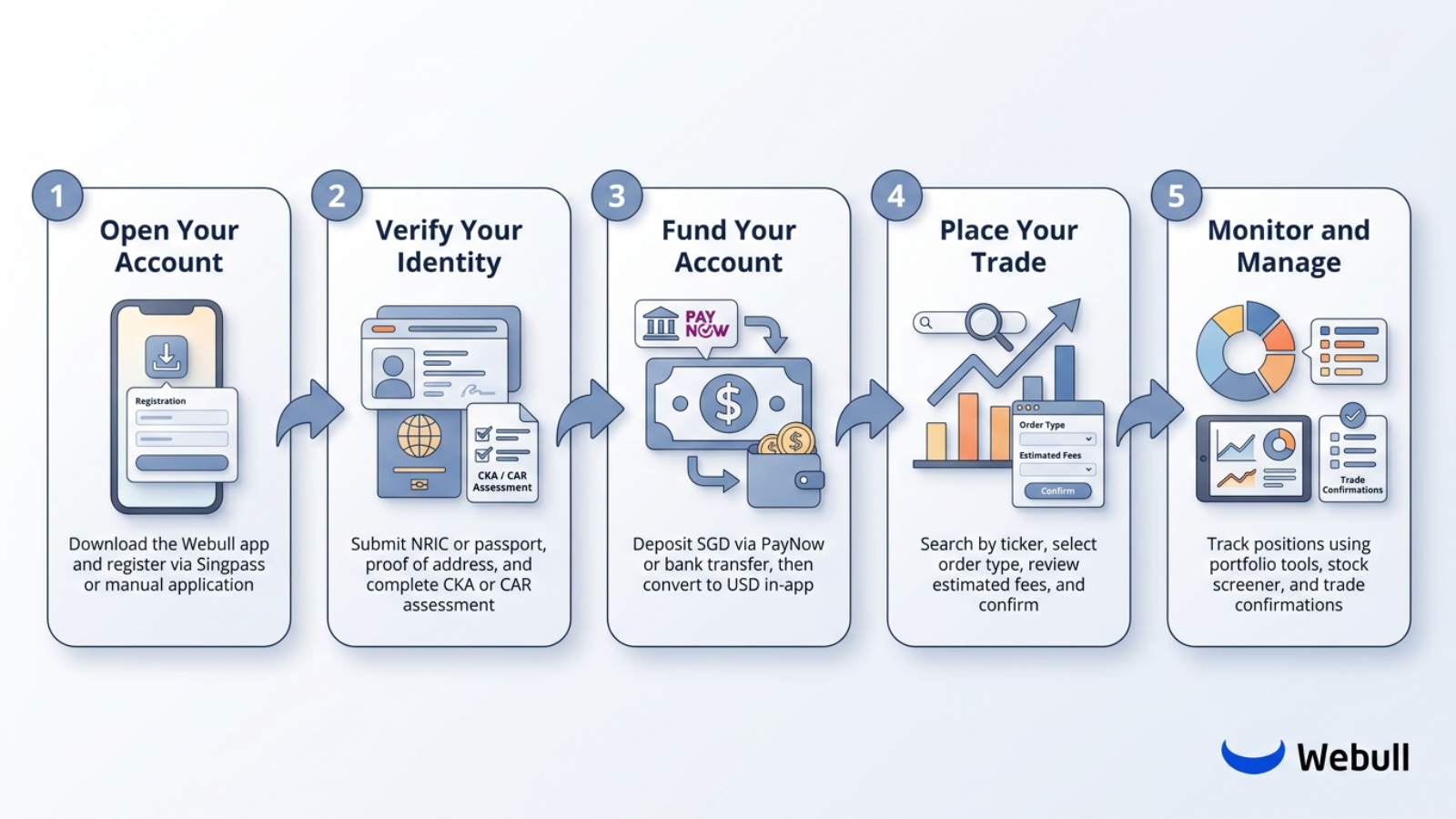
Step 1 — Open your account
Download the Webull app. Singapore Citizens, PRs, and foreigners with Singpass can use Singpass for faster verification. Manual in-app application is available for those without Singpass access.
Step 2 — Complete account verification
Provide your NRIC or passport, proof of residential address, and bank account details. Complete the Customer Knowledge Assessment (CKA) or Customer Account Review (CAR) as required for the products you intend to trade.
Step 3 — Fund your account
Deposit SGD via PayNow or bank transfer. Convert SGD to USD within the Webull app to fund US stock trades. Webull supports USD funding as well.
Step 4 — Place your first trade
Search for a US stock by ticker symbol. Select your order type (market, limit, stop-limit, or others available on the platform). Review the order details, including estimated fees, before confirming.
Step 5 — Monitor and manage
Use Webull's portfolio tools, stock screener, and market data to monitor positions. Review trade confirmations to understand the breakdown of costs applied per transaction.
The Bottom Line
US stock trading fees in Singapore involve more than the headline commission. FX conversion spreads, regulatory levies, and custody charges all contribute to your true cost per trade. Webull Singapore stands out for its zero-commission US stock trading, fractional shares from USD 1, 24-hour market access, and a single account covering four global markets. Evaluate total costs across all fee dimensions before selecting a platform.
Most regulated brokers in Singapore share a similar fee structure, which may include commissions, platform fees, FX spreads and other charges. The difference lies in how each is priced. A broker advertising "zero commission" may still charge FX spreads or other fees, while a broker with a small stated commission but a tight FX spread may cost less overall for investors who regularly convert larger SGD amounts into USD.
Practical tip: When comparing platforms, calculate your estimated total cost per trade at your typical order size, factoring in the FX spread and any platform fee alongside the stated commission.
Disclosure
All investments involve risks and are not suitable for every investor. The information provided is generated with the assistance of artificial intelligence based on publicly available sources and is for informational purposes only. Margin trading increases the risk of loss and clients’ losses may exceed the deposits placed.
Options trading involves significant risk and is not suitable for all investors as investors may be exposed to potentially rapid and substantial losses.
The content provided above is for educational purposes only and does not constitute financial, investment, or professional advice. No content should be construed as investment advice or recommendation, or an offer or solicitation, to deal in any investment product. Investors may wish to seek advice from a financial adviser before investing. In the event that investors choose not to seek advice from a financial adviser, they should consider whether the investment is suitable for them. For more information, please refer to our website at https://www.webull.com.sg.
This advertisement has not been reviewed by the Monetary Authority of Singapore.
