' fill='white'%3e %3cg id='%e7%bc%96%e7%bb%84-7' transform='translate(0.000000%2c 86.000000)'%3e %3cg id='%e7%bc%96%e7%bb%84-2' transform='translate(80.533981%2c 22.000000)'%3e %3cpath d='M41.7832962%2c0 C41.9459106%2c0 42.0882746%2c0.0866854658 42.1666825%2c0.216359069 C43.8289923%2c2.66540836 44.7676281%2c5.46271319 44.7676281%2c8.43208061 C44.7676281%2c18.1345746 34.7460532%2c26 22.383814%2c26 C10.0215749%2c26 0%2c18.1345746 0%2c8.43208061 C0%2c5.46716016 0.935826425%2c2.67378733 2.58829888%2c0.223985685 C2.67109477%2c0.0916264068 2.81687473%2c0 2.9840593%2c0 C3.23130408%2c0 3.43173558%2c0.200393004 3.43173558%2c0.447590303 C3.43173558%2c0.475056669 3.42926112%2c0.501945205 3.42452292%2c0.528045226 L3.41810883%2c0.550292077 C3.37800671%2c0.861741908 3.3575721%2c1.17661276 3.3575721%2c1.49443092 C3.3575721%2c7.98336 11.2132389%2c12.5742305 22.383814%2c12.5742305 C33.5543891%2c12.5742305 41.410056%2c7.98336 41.410056%2c1.49443092 C41.410056%2c1.17865223 41.3898828%2c0.865783153 41.3502888%2c0.556288325 C41.3402868%2c0.521941442 41.3356199%2c0.48531078 41.3356199%2c0.447590303 C41.3356199%2c0.200393004 41.5360514%2c0 41.7832962%2c0 Z' id='logo%e5%a4%87%e4%bb%bd-6'%3e%3c/path%3e %3cpath d='M75.1559425%2c3.74404927 C75.7071421%2c3.74404927 76.2394493%2c3.66184338 76.7416414%2c3.50883715 L74.281987%2c20.8666902 C74.0430787%2c22.5662954 73.2732628%2c23.0518969 71.8929033%2c23.0518969 L70.459453%2c23.0518969 C69.2649111%2c23.0518969 68.6278221%2c22.458384 68.2561868%2c20.893668 L66.1591022%2c11.9909739 C66.1060114%2c11.7481731 66.1060114%2c11.6942174 65.9998299%2c11.6942174 C65.8936484%2c11.6942174 65.867103%2c11.7481731 65.8140123%2c11.9909739 L63.7169276%2c20.893668 C63.3452924%2c22.458384 62.7082033%2c23.0518969 61.5136614%2c23.0518969 L60.0802112%2c23.0518969 C58.6998516%2c23.0518969 57.9300358%2c22.5662954 57.6911274%2c20.8666902 L55.2123917%2c3.37406084 C55.8253692%2c3.61307396 56.491017%2c3.74404927 57.1867652%2c3.74404927 C57.7974457%2c3.74404927 58.3849364%2c3.64314414 58.9339751%2c3.4568446 L60.8234817%2c19.3829078 C60.8500271%2c19.6257086 60.8500271%2c19.7875757 60.9562086%2c19.7875757 C61.0623901%2c19.7875757 61.0623901%2c19.6257086 61.1154808%2c19.3829078 L63.3983831%2c9.91367858 C63.5576554%2c9.26620991 63.9292906%2c8.69967483 65.0707418%2c8.69967483 L66.9023727%2c8.69967483 C68.0438238%2c8.69967483 68.4154591%2c9.26620991 68.5747313%2c9.91367858 L70.8576336%2c19.3829078 C70.9107244%2c19.6257086 70.9107244%2c19.7875757 71.0169059%2c19.7875757 C71.1230874%2c19.7875757 71.1230874%2c19.6257086 71.1496327%2c19.3829078 L73.0551401%2c3.32292288 C73.7026096%2c3.59432921 74.4120718%2c3.74404927 75.1559425%2c3.74404927 Z' id='Combined-Shape'%3e%3c/path%3e %3cpath d='M85.0594095%2c7.43171536 C89.1473973%2c7.43171536 91.3772089%2c10.2643908 91.3772089%2c14.2840921 L91.3772089%2c15.7948523 C91.3772089%2c16.2264981 91.2179366%2c16.4692988 90.8463013%2c16.4692988 L82.1925089%2c16.4692988 L82.1925089%2c16.5502324 C82.1925089%2c18.1149484 82.829598%2c19.9764208 85.377954%2c19.9764208 C87.3157664%2c19.9764208 89.1473973%2c19.8145536 90.2623031%2c19.7066422 L90.3419392%2c19.7066422 C90.607393%2c19.7066422 90.819756%2c19.8415315 90.819756%2c20.1113101 L90.819756%2c21.8918489 C90.819756%2c22.3234947 90.7401198%2c22.5123397 90.2623031%2c22.5932733 C88.5368537%2c22.9170076 87.501584%2c23.0518969 85.1125002%2c23.0518969 C82.4579627%2c23.0518969 78.6885194%2c21.5950924 78.6885194%2c16.2804538 L78.6885194%2c14.2840921 C78.6885194%2c10.0755457 80.997967%2c7.43171536 85.0594095%2c7.43171536 Z M85.0594095%2c10.5071915 C83.4135962%2c10.5071915 82.2190543%2c11.6942174 82.2190543%2c13.8254684 L82.2190543%2c13.9333799 L87.8466739%2c13.9333799 L87.8466739%2c13.8254684 C87.8466739%2c11.7211953 86.7052228%2c10.5071915 85.0594095%2c10.5071915 Z' id='Combined-Shape'%3e%3c/path%3e %3cpath d='M97.88151%2c2.98826245 L97.8808258%2c7.62056039 C98.8630047%2c7.48567108 99.7920929%2c7.43171536 100.429182%2c7.43171536 C104.702987%2c7.43171536 106.773527%2c9.99461216 106.773527%2c14.2031585 L106.773527%2c16.2804538 C106.773527%2c20.4890001 104.702987%2c23.0518969 100.429182%2c23.0518969 C98.7302779%2c23.0518969 96.7393747%2c22.7821183 95.0935614%2c22.3504725 C94.4830178%2c22.1886054 94.3768363%2c22.0267382 94.3768363%2c21.6220703 L94.3758373%2c3.08694115 C94.884566%2c3.24434375 95.4244809%2c3.32900525 95.9838525%2c3.32900525 C96.6506785%2c3.32900525 97.2898545%2c3.20869291 97.88151%2c2.98826245 Z M100.429182%2c10.3453244 C99.7920929%2c10.3453244 98.6240964%2c10.4262579 97.8808258%2c10.5341694 L97.8808258%2c19.9494429 C98.385188%2c20.0573544 99.4735484%2c20.1382879 100.429182%2c20.1382879 C102.712084%2c20.1382879 103.269537%2c18.4926384 103.269537%2c16.2804538 L103.269537%2c14.2031585 C103.269537%2c11.9909739 102.712084%2c10.3453244 100.429182%2c10.3453244 Z' id='Combined-Shape'%3e%3c/path%3e %3cpath d='M111.502687%2c8.72457747 C112.045508%2c8.72457747 112.570006%2c8.64485191 113.065463%2c8.49629404 L113.064781%2c16.5232546 C113.064781%2c19.3289521 114.073505%2c19.9764208 115.613137%2c19.9764208 L115.772409%2c19.9764208 C117.312041%2c19.9764208 118.320765%2c19.3289521 118.320765%2c16.5232546 L118.320226%2c8.4334735 C118.872544%2c8.62226395 119.463958%2c8.72457747 120.078886%2c8.72457747 C120.689352%2c8.72457747 121.276644%2c8.62374317 121.825517%2c8.43756894 L121.824755%2c16.5232546 C121.824755%2c22.4044283 117.338586%2c23.0518969 115.772409%2c23.0518969 L115.526483%2c23.0512514 C113.88817%2c23.0271041 109.560791%2c22.2994073 109.560791%2c16.5232546 L109.560465%2c8.36700801 C110.164542%2c8.59813531 110.819085%2c8.72457747 111.502687%2c8.72457747 Z' id='Combined-Shape'%3e%3c/path%3e %3cpath d='M128.780182%2c3.03790128 L128.779643%2c22.269539 C128.779643%2c22.5662954 128.56728%2c22.836074 128.275281%2c22.836074 L125.806561%2c22.836074 C125.514562%2c22.836074 125.275653%2c22.5662954 125.275653%2c22.269539 L125.275475%2c3.04219481 C125.82418%2c3.22824247 126.411273%2c3.32900525 127.021522%2c3.32900525 C127.63645%2c3.32900525 128.227864%2c3.22669173 128.780182%2c3.03790128 Z' id='Combined-Shape'%3e%3c/path%3e %3cpath d='M134.372549%2c3.32900525 C134.939348%2c3.32900525 135.48617%2c3.24208064 136.000812%2c3.08063296 L135.999985%2c22.269539 C135.999985%2c22.5662954 135.787622%2c22.836074 135.495623%2c22.836074 L133.026903%2c22.836074 C132.734904%2c22.836074 132.495995%2c22.5662954 132.495995%2c22.269539 L132.495929%2c2.99605058 C133.081688%2c3.21152525 133.713619%2c3.32900525 134.372549%2c3.32900525 Z' id='Combined-Shape'%3e%3c/path%3e %3c/g%3e %3c/g%3e %3c/g%3e %3c/g%3e%3c/svg%3e)



US-listed ETFs give Singapore investors access to a wide range of markets and investment themes, including S&P 500 index funds, sector funds, and thematic ETFs. They can be used to build a long-term portfolio or make regular investments through dollar-cost averaging. Before placing your first order, it is important to understand how US ETF investing works in Singapore, including account types, platform options, and order mechanics. This guide also explains how Webull Singapore supports US ETF investing.
Key Takeaways
US ETFs must be settled in USD; SGD must be converted before trading.
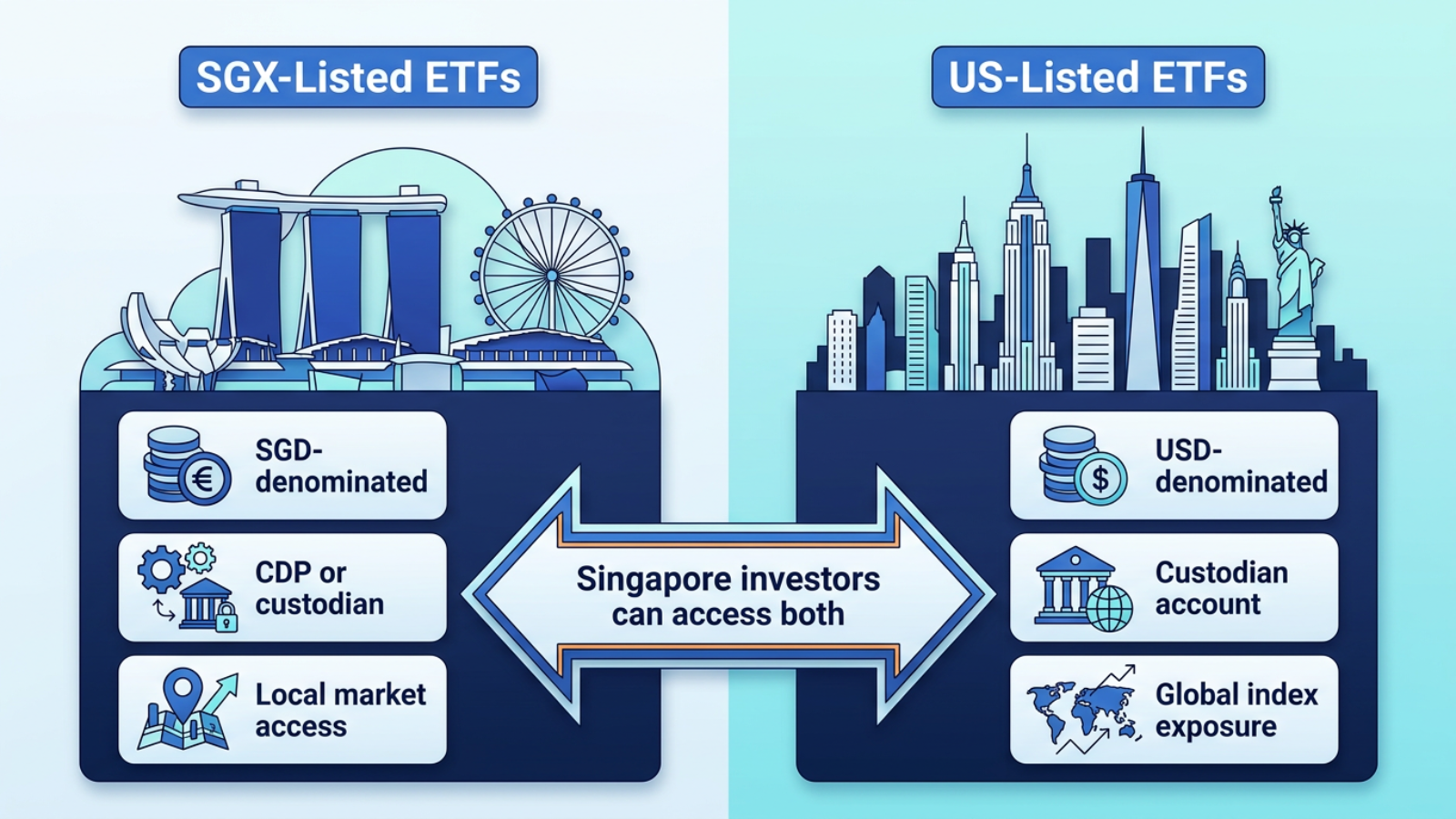
Singapore investors hold US ETFs through custodian accounts, not CDP accounts.
Webull Singapore offers zero commission and zero platform fees on US stocks and ETFs.
Client assets are protected through MAS-mandated segregation under the Securities and Futures Act (SFA), not a government-backed compensation scheme.
Consistency and cost discipline matter more than ETF selection alone.
Part 1: Understanding US ETF Investing for Singapore Investors
1.1 What Is a US-Listed ETF?
An ETF, or exchange-traded fund, is an investment fund that trades on a stock exchange like a stock. US-listed ETFs trade on exchanges such as the NYSE Arca and Nasdaq and are priced in USD. Many ETFs track indexes such as the S&P 500 or MSCI World, allowing investors to gain exposure to a diversified portfolio of securities through a single trade.
ETF vs stock vs unit trust — key distinctions:
Feature | ETF | Individual Stock | Unit Trust |
|---|---|---|---|
Diversification | Basket of securities | Single company | Basket of securities |
Intraday trading | Yes | Yes | No (end-of-day pricing) |
Expense ratio | Generally low | N/A | Generally higher |
Order types | Market, limit, stop | Market, limit, stop | Not applicable |
1.2 Why Singapore Investors Consider US ETFs
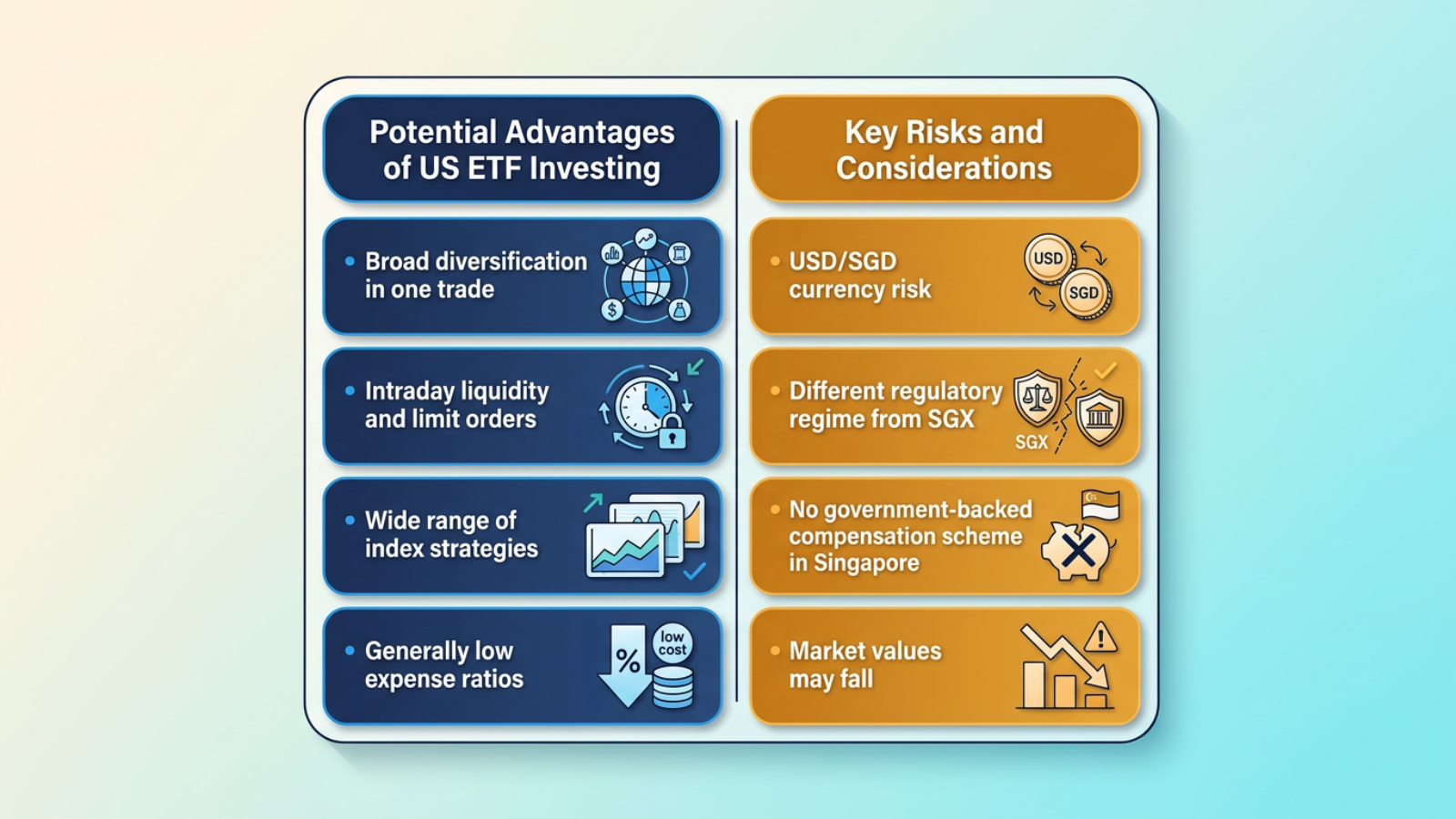
US exchanges list thousands of ETFs covering global equities, bonds, sectors, and thematic strategies. For Singapore investors, the primary appeal includes:
Breadth of choice: Access to major global index strategies not available on SGX.
Liquidity: Large US ETFs typically carry tight bid–ask spreads.
Cost efficiency: Many US-listed ETFs carry low total expense ratios (TERs).
Intraday flexibility: Limit orders allow price control during volatile sessions.
US-listed products are subject to a different regulatory regime and legal system than SGX-listed products. Investors should assess these differences before trading.
1.3 Currency Considerations: SGD to USD
US ETFs are traded and settled in USD, so Singapore investors need to convert SGD before trading. Webull supports SGD to USD conversion directly in the app. FX conversion costs may apply, so remember to factor them into your overall investment costs.
Rates vary by service provider; please refer to the latest pricing on the official website.
Part 2: Account Types for US ETF Investing in Singapore
2.1 CDP Account vs Custodian Account
Understanding the difference between these two account structures is fundamental before investing.
CDP Account (Central Depositary): A direct securities account held in your name with CDP, Singapore's central securities depository. Shares held here are registered directly to you. CDP accounts are used for SGX-listed securities only.
Custodian Account: Your broker holds the securities on your behalf. You remain the beneficial owner, but shares are not registered in your name at CDP. This structure is standard for US-listed ETFs and most overseas securities.
US ETFs are held in custodian accounts. There is no CDP equivalent for US-listed securities.
2.2 Client Asset Protection in Singapore
Singapore does not operate a government-backed investor compensation scheme equivalent to the US SIPC. Client asset protection in Singapore is achieved through:
MAS-mandated segregation of client moneys and assets under the Securities and Futures Act (SFA).
Custodial safekeeping arrangements maintained by licensed brokers.
Capital Markets Services (CMS) Licence requirements, which impose ongoing obligations on brokers to maintain adequate financial resources and comply with MAS conduct standards.
MAS licensing status may be verified factually but does not constitute an endorsement of any firm's products or investment outcomes.
2.3 What to Check Before Opening a Brokerage Account
Before opening an account to trade US ETFs from Singapore, verify:
MAS regulated: Confirm the broker holds a valid CMS Licence issued by the Monetary Authority of Singapore.
Market access: Confirm the platform provides access to US exchanges (NYSE, Nasdaq).
Account type: Understand whether your US holdings will be held in a custodian structure.
Fee structure: Review commissions, platform fees, FX conversion costs, and any minimum fees.
Currency conversion: Confirm how SGD-to-USD conversion works on the platform.
Order types available: Ensure limit orders and market orders are supported.
Part 3: A Step-by-Step Guide to Buying US ETFs from Singapore
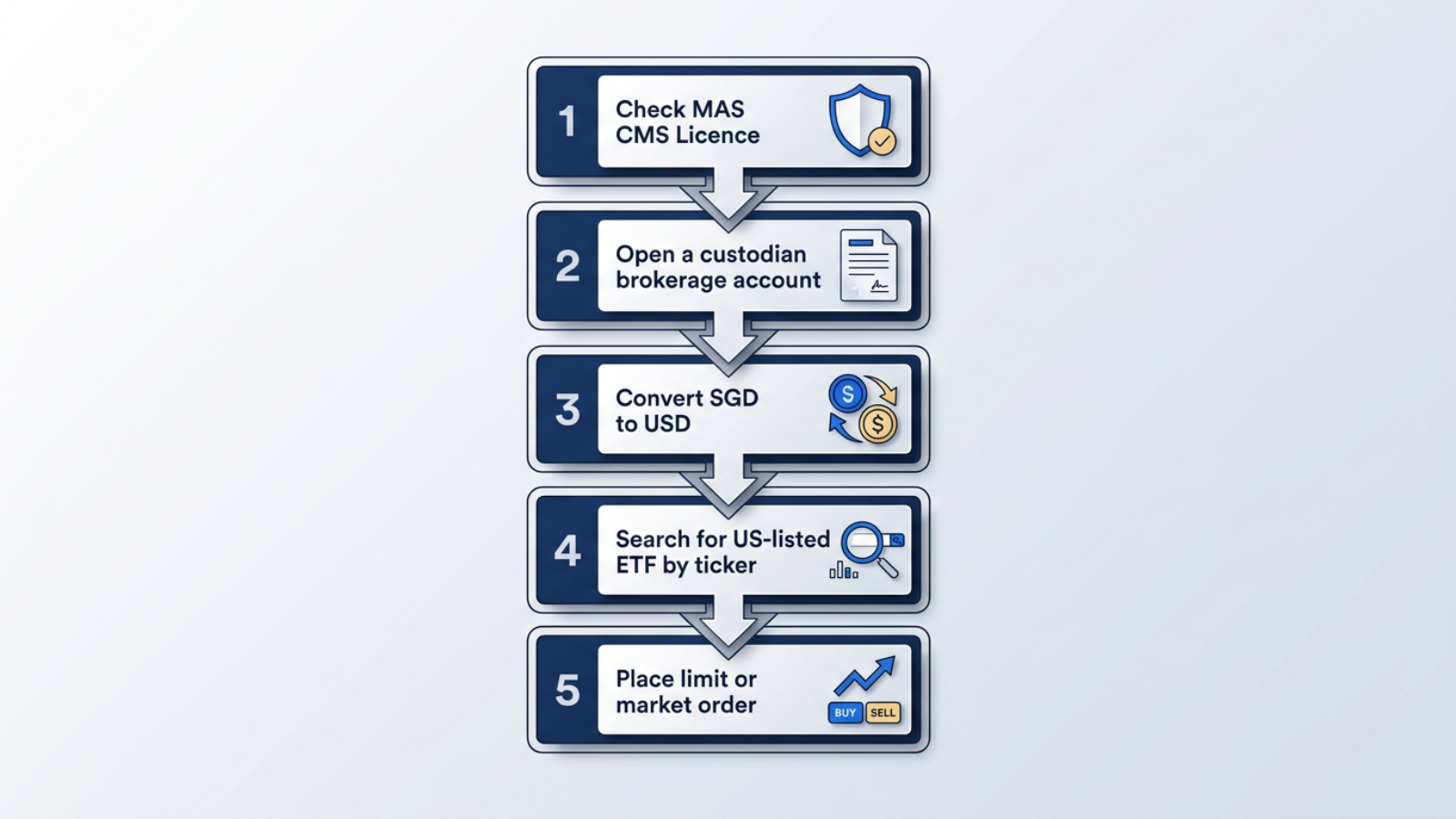
3.1 Step-by-Step: Placing Your First US ETF Trade
Step 1: Open and fund your account
Complete your brokerage account application online. For US ETF trading, you will need a custodian account with a MAS-regulated broker. Deposit SGD into your account.
Step 2: Convert SGD to USD
US ETFs settle in USD. Convert your SGD to USD within the brokerage platform before placing a trade. Note the FX conversion rate and any applicable spread.
Step 3: Search for the ETF by ticker
Use the platform's search function to locate the ETF by its ticker symbol (e.g. SPY, IVV, QQQ). Verify the exchange listing (NYSE Arca or Nasdaq) to ensure you are viewing the correct instrument.
Step 4: Choose your order type
Market order: Executes immediately at the best available price. Suitable for highly liquid ETFs during normal market hours. Price is not guaranteed.
Limit order: You set the maximum price you are willing to pay. The order executes only at your specified price or better. Preferred for price control, especially during volatile sessions or for less liquid ETFs.
Stop order: Triggers a market or limit order once a specified price is reached. Useful for managing downside risk.
Step 5: Review and confirm
Before confirming, check the order details: quantity, order type, price (for limit orders), estimated cost in USD, and any applicable fees. Confirm the trade.
Step 6: Monitor and manage
After execution, your ETF units appear in your custodian account. Review your portfolio periodically and rebalance according to your investment plan.
3.2 Dollar-Cost Averaging (DCA) with US ETFs
DCA involves investing a fixed amount at regular intervals regardless of market price. For Singapore investors using US ETFs, this approach:
Reduces the impact of short-term price volatility on entry cost.
Builds a repeatable investing habit.
Avoids the need to time the market.
To implement DCA effectively:
Keep per-trade costs low relative to your contribution amount.
Set a fixed schedule (e.g. monthly on a set date).
Use a Regular Savings Plan (RSP) feature if available on your platform.
Fixed RSP vs Dynamic RSP
A Fixed RSP invests the same amount at each interval, following the traditional DCA approach. A Dynamic RSP adjusts your contribution based on market conditions. It invests less when the previous close is above the benchmark's moving average, and more when it is below.
Dynamic RSP does not guarantee better returns, and contributions may vary. Ensure you have sufficient funds for higher contributions when markets fall.
Past performance is not indicative of future results. DCA does not eliminate market risk.
Part 4: Webull Singapore Features for US ETF Investing
4.1 Regulatory Status and Account Structure
Webull Singapore operates under a Capital Markets Services (CMS) Licence issued by the Monetary Authority of Singapore (MAS). US ETFs traded through Webull Singapore are held in a custodian account. Client money and assets are segregated in accordance with MAS requirements under the SFA.
Singapore does not operate a government-backed investor compensation scheme. Client asset protection is provided through MAS-mandated segregation, not through any scheme equivalent to the US SIPC.
4.2 Fees for US ETF Trading on Webull Singapore
Webull Singapore currently offers:
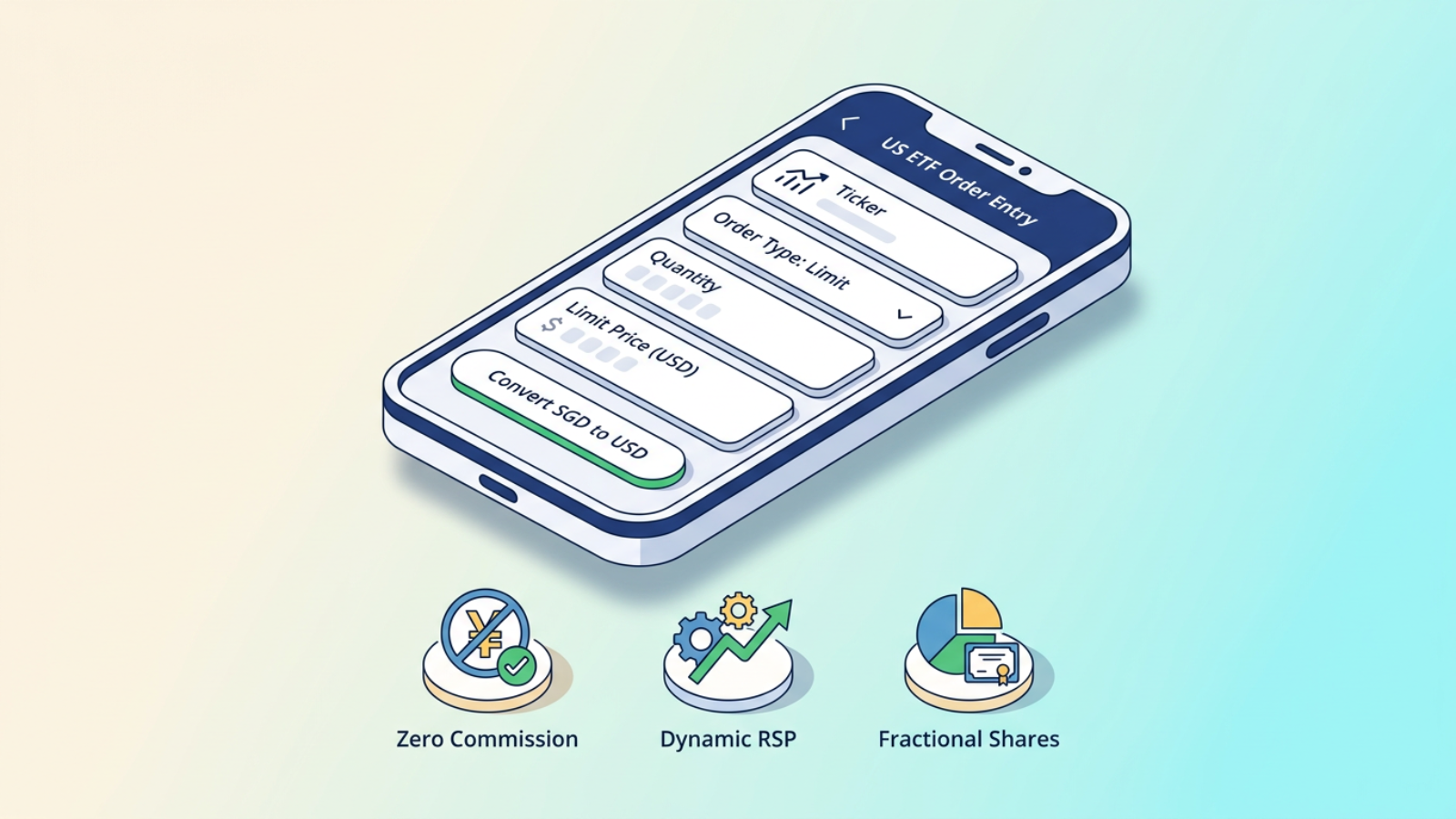
Zero commission on US stocks and ETFs.
Zero platform fees on US stocks and ETFs.
Other costs that may apply include FX conversion charges when converting SGD to USD, and regulatory or exchange-imposed fees. These should be reviewed on the official Webull Singapore website before trading.
4.3 Currency Conversion
US ETFs must be settled in USD. Webull allows you to convert SGD to USD directly within the Webull app to facilitate US market trades. FX conversion costs apply; review the applicable rate and spread on the platform before converting.
4.4 Dynamic Regular Savings Plan (RSP)
Webull Singapore offers a Dynamic Regular Savings Plan (RSP) that supports US-listed stocks, US-listed ETFs, and SGD/USD mutual funds. Key features include:
Market-responsive contributions: Invests less when the previous closing price is above the benchmark's moving average, and more when it is below.
Automated recurring investments on a schedule you define, with no manual order placement each period.
Zero platform fee on the US RSP
This feature is designed for investors who want a systematic approach to building US exposure over time, with contributions that respond to market movements. Dynamic RSP does not guarantee better returns, and contribution amounts may vary. Ensure you have sufficient funds for higher contributions when markets fall.
4.5 Fractional Shares
Webull Singapore supports fractional trading for eligible US-listed ETFs. This allows investors to purchase a portion of a single ETF unit, making it possible to invest a fixed dollar amount even when a full unit price is high. Note that fractional shares are not supported for shares transfer-in from another brokerage.
4.6 Order Types and Platform Tools
Webull's trading platform supports a range of order types relevant to US ETF investing:
Market orders for immediate execution.
Limit orders for price-controlled entry and exit.
Stop orders for risk management.
The platform also provides real-time market data, charting tools, and portfolio tracking across web and mobile interfaces. These tools support investors in monitoring their US ETF positions and making informed decisions.
4.7 Shares Transfer In
US and SGX-listed stocks and ETFs are supported for shares transfer-in to Webull from another brokerage. The minimum threshold for US shares transfer-in is USD 5,000. The following are not supported for transfer-in from another broker for US securities: OTC symbols, options positions, fractional shares, and penny stocks (defined as US exchange-listed stocks and ETFs with a prior-day closing price below USD 5, or a market capitalisation below USD 300 million).
4.8 Webull Singapore: Key Features
Feature | Detail |
|---|---|
MAS CMS Licence | Yes |
US ETF commission | USD 0 |
US ETF platform fee | USD 0 |
Minimum deposit (cash account) | None |
Currency conversion | SGD to USD in-app |
Regular Savings Plan | Yes (US stocks, ETFs, mutual funds) |
Fractional shares (US ETFs) | Yes (eligible instruments) |
Order types | Market, limit, stop |
Client asset protection | MAS-mandated segregation under SFA |
Dynamic Regular Savings Plan | Yes (US stocks and ETFs; contributions adjust based on market conditions) |
Information accurate as of September 2026.
Part 5: How to Choose US ETFs as a Singapore Investor
5.1 Define Your Investment Objective First
Before selecting an ETF, clarify its role in your portfolio:
Growth allocation: Broad equity index ETFs (e.g. global equities, US large-cap).
Stability allocation: Investment-grade bond ETFs to reduce portfolio volatility.
Income tilt: Dividend equity ETFs, noting that income-focused assets can still be volatile.
Your long-term outcome is driven primarily by your equity–bond allocation, not by minor differences between similar ETFs.
5.2 Key Screening Criteria
Use this checklist when evaluating US-listed ETFs:
Index exposure: What does the ETF track? (e.g. S&P 500, MSCI World, FTSE All-World). Index choice typically matters more than provider.
Total expense ratio (TER): The annual fund fee deducted from performance. Lower is generally preferable, all else equal.
Tracking difference: The real-world gap between ETF performance and its index after fees and implementation costs.
Fund size and liquidity: Larger funds typically carry tighter bid–ask spreads and lower trading friction.
Distribution type: Accumulating ETFs reinvest dividends automatically; distributing ETFs pay out income. Choose based on your cash flow needs.
Trading costs: These include commissions, FX conversion spreads, and bid-ask spreads. They can be particularly relevant if you invest regularly through DCA.
5.3 Understanding ETF Costs for Regular Investors
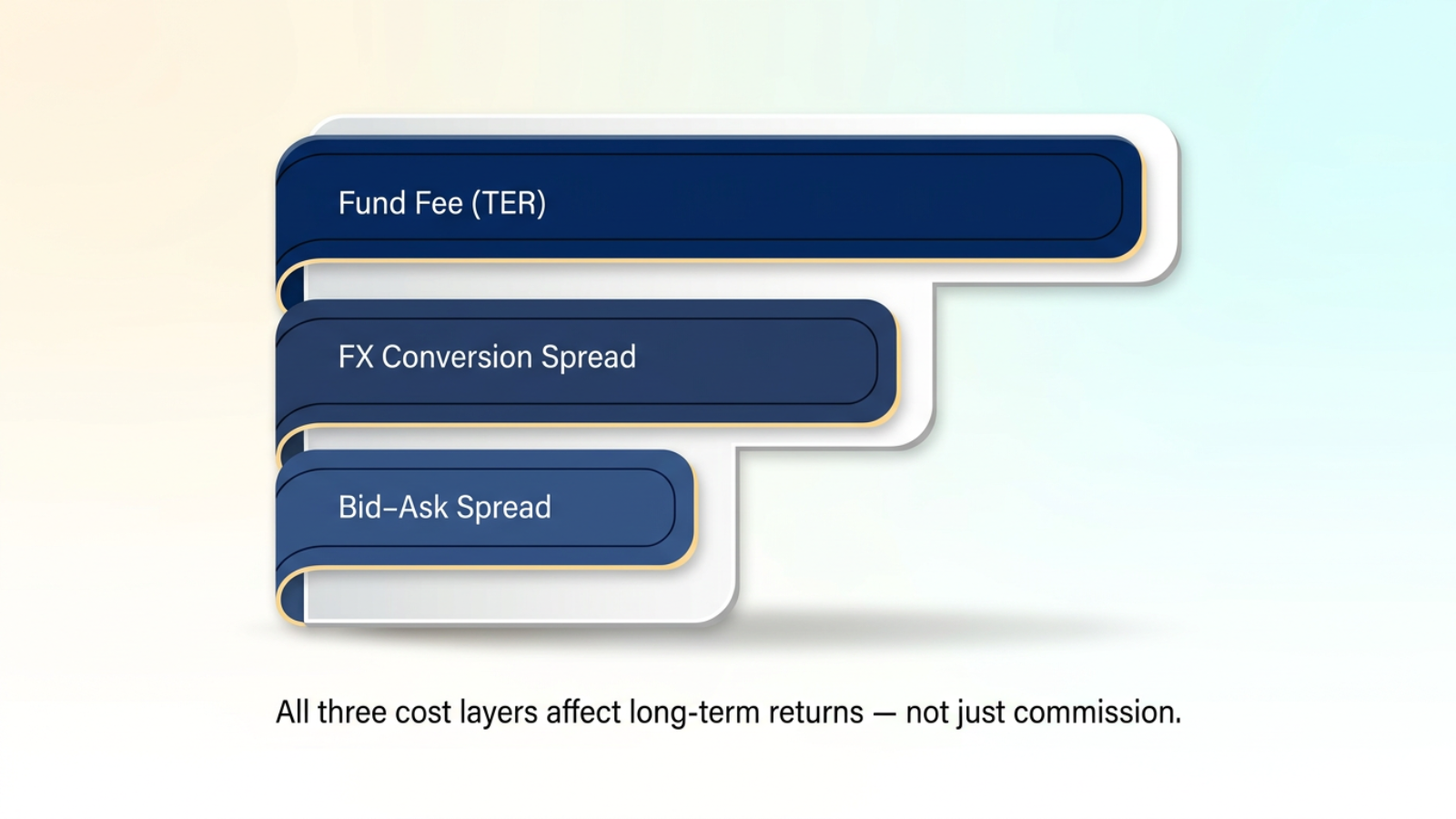
For investors who DCA monthly, small per-trade costs compound over time. The three cost layers to monitor are:
Fund fee (TER): Deducted from the fund's NAV continuously.
Trading friction: Bid–ask spread plus any brokerage commission.
FX conversion cost: The spread applied when converting SGD to USD.
Managing all three types of costs, including commissions, can help support better long-term investment outcomes.
5.4 Rebalancing Your US ETF Portfolio
Over time, strong equity performance can shift your portfolio beyond your intended risk level. A simple rebalancing approach:
Review your allocation annually.
Rebalance if any asset class drifts meaningfully from your target.
Use new contributions to top up underweight positions where possible, reducing transaction costs.
This creates a disciplined mechanism for maintaining your risk profile without relying on market forecasts.
Investment values may rise or fall.
The Bottom Line
Investing in US ETFs from Singapore is straightforward through regulated brokers. Platforms such as Webull Singapore offer zero commission and zero platform fees on US stocks and ETFs. What matters most is keeping investment costs under control, investing consistently, and following a clear plan. Before investing, check all applicable fees, including foreign exchange costs, and make sure your chosen platform holds a valid MAS CMS Licence.
Disclosure
All investments involve risks and are not suitable for every investor. The information provided is generated with the assistance of artificial intelligence based on publicly available sources and is for informational purposes only.
The content provided above is for educational purposes only and does not constitute financial, investment, or professional advice. No content should be construed as investment advice or recommendation, or an offer or solicitation, to deal in any investment product. Investors may wish to seek advice from a financial adviser before investing. In the event that investors choose not to seek advice from a financial adviser, they should consider whether the investment is suitable for them. For more information, please refer to our website at https://www.webull.com.sg.
This advertisement has not been reviewed by the Monetary Authority of Singapore.
