' fill='white'%3e %3cg id='%e7%bc%96%e7%bb%84-7' transform='translate(0.000000%2c 86.000000)'%3e %3cg id='%e7%bc%96%e7%bb%84-2' transform='translate(80.533981%2c 22.000000)'%3e %3cpath d='M41.7832962%2c0 C41.9459106%2c0 42.0882746%2c0.0866854658 42.1666825%2c0.216359069 C43.8289923%2c2.66540836 44.7676281%2c5.46271319 44.7676281%2c8.43208061 C44.7676281%2c18.1345746 34.7460532%2c26 22.383814%2c26 C10.0215749%2c26 0%2c18.1345746 0%2c8.43208061 C0%2c5.46716016 0.935826425%2c2.67378733 2.58829888%2c0.223985685 C2.67109477%2c0.0916264068 2.81687473%2c0 2.9840593%2c0 C3.23130408%2c0 3.43173558%2c0.200393004 3.43173558%2c0.447590303 C3.43173558%2c0.475056669 3.42926112%2c0.501945205 3.42452292%2c0.528045226 L3.41810883%2c0.550292077 C3.37800671%2c0.861741908 3.3575721%2c1.17661276 3.3575721%2c1.49443092 C3.3575721%2c7.98336 11.2132389%2c12.5742305 22.383814%2c12.5742305 C33.5543891%2c12.5742305 41.410056%2c7.98336 41.410056%2c1.49443092 C41.410056%2c1.17865223 41.3898828%2c0.865783153 41.3502888%2c0.556288325 C41.3402868%2c0.521941442 41.3356199%2c0.48531078 41.3356199%2c0.447590303 C41.3356199%2c0.200393004 41.5360514%2c0 41.7832962%2c0 Z' id='logo%e5%a4%87%e4%bb%bd-6'%3e%3c/path%3e %3cpath d='M75.1559425%2c3.74404927 C75.7071421%2c3.74404927 76.2394493%2c3.66184338 76.7416414%2c3.50883715 L74.281987%2c20.8666902 C74.0430787%2c22.5662954 73.2732628%2c23.0518969 71.8929033%2c23.0518969 L70.459453%2c23.0518969 C69.2649111%2c23.0518969 68.6278221%2c22.458384 68.2561868%2c20.893668 L66.1591022%2c11.9909739 C66.1060114%2c11.7481731 66.1060114%2c11.6942174 65.9998299%2c11.6942174 C65.8936484%2c11.6942174 65.867103%2c11.7481731 65.8140123%2c11.9909739 L63.7169276%2c20.893668 C63.3452924%2c22.458384 62.7082033%2c23.0518969 61.5136614%2c23.0518969 L60.0802112%2c23.0518969 C58.6998516%2c23.0518969 57.9300358%2c22.5662954 57.6911274%2c20.8666902 L55.2123917%2c3.37406084 C55.8253692%2c3.61307396 56.491017%2c3.74404927 57.1867652%2c3.74404927 C57.7974457%2c3.74404927 58.3849364%2c3.64314414 58.9339751%2c3.4568446 L60.8234817%2c19.3829078 C60.8500271%2c19.6257086 60.8500271%2c19.7875757 60.9562086%2c19.7875757 C61.0623901%2c19.7875757 61.0623901%2c19.6257086 61.1154808%2c19.3829078 L63.3983831%2c9.91367858 C63.5576554%2c9.26620991 63.9292906%2c8.69967483 65.0707418%2c8.69967483 L66.9023727%2c8.69967483 C68.0438238%2c8.69967483 68.4154591%2c9.26620991 68.5747313%2c9.91367858 L70.8576336%2c19.3829078 C70.9107244%2c19.6257086 70.9107244%2c19.7875757 71.0169059%2c19.7875757 C71.1230874%2c19.7875757 71.1230874%2c19.6257086 71.1496327%2c19.3829078 L73.0551401%2c3.32292288 C73.7026096%2c3.59432921 74.4120718%2c3.74404927 75.1559425%2c3.74404927 Z' id='Combined-Shape'%3e%3c/path%3e %3cpath d='M85.0594095%2c7.43171536 C89.1473973%2c7.43171536 91.3772089%2c10.2643908 91.3772089%2c14.2840921 L91.3772089%2c15.7948523 C91.3772089%2c16.2264981 91.2179366%2c16.4692988 90.8463013%2c16.4692988 L82.1925089%2c16.4692988 L82.1925089%2c16.5502324 C82.1925089%2c18.1149484 82.829598%2c19.9764208 85.377954%2c19.9764208 C87.3157664%2c19.9764208 89.1473973%2c19.8145536 90.2623031%2c19.7066422 L90.3419392%2c19.7066422 C90.607393%2c19.7066422 90.819756%2c19.8415315 90.819756%2c20.1113101 L90.819756%2c21.8918489 C90.819756%2c22.3234947 90.7401198%2c22.5123397 90.2623031%2c22.5932733 C88.5368537%2c22.9170076 87.501584%2c23.0518969 85.1125002%2c23.0518969 C82.4579627%2c23.0518969 78.6885194%2c21.5950924 78.6885194%2c16.2804538 L78.6885194%2c14.2840921 C78.6885194%2c10.0755457 80.997967%2c7.43171536 85.0594095%2c7.43171536 Z M85.0594095%2c10.5071915 C83.4135962%2c10.5071915 82.2190543%2c11.6942174 82.2190543%2c13.8254684 L82.2190543%2c13.9333799 L87.8466739%2c13.9333799 L87.8466739%2c13.8254684 C87.8466739%2c11.7211953 86.7052228%2c10.5071915 85.0594095%2c10.5071915 Z' id='Combined-Shape'%3e%3c/path%3e %3cpath d='M97.88151%2c2.98826245 L97.8808258%2c7.62056039 C98.8630047%2c7.48567108 99.7920929%2c7.43171536 100.429182%2c7.43171536 C104.702987%2c7.43171536 106.773527%2c9.99461216 106.773527%2c14.2031585 L106.773527%2c16.2804538 C106.773527%2c20.4890001 104.702987%2c23.0518969 100.429182%2c23.0518969 C98.7302779%2c23.0518969 96.7393747%2c22.7821183 95.0935614%2c22.3504725 C94.4830178%2c22.1886054 94.3768363%2c22.0267382 94.3768363%2c21.6220703 L94.3758373%2c3.08694115 C94.884566%2c3.24434375 95.4244809%2c3.32900525 95.9838525%2c3.32900525 C96.6506785%2c3.32900525 97.2898545%2c3.20869291 97.88151%2c2.98826245 Z M100.429182%2c10.3453244 C99.7920929%2c10.3453244 98.6240964%2c10.4262579 97.8808258%2c10.5341694 L97.8808258%2c19.9494429 C98.385188%2c20.0573544 99.4735484%2c20.1382879 100.429182%2c20.1382879 C102.712084%2c20.1382879 103.269537%2c18.4926384 103.269537%2c16.2804538 L103.269537%2c14.2031585 C103.269537%2c11.9909739 102.712084%2c10.3453244 100.429182%2c10.3453244 Z' id='Combined-Shape'%3e%3c/path%3e %3cpath d='M111.502687%2c8.72457747 C112.045508%2c8.72457747 112.570006%2c8.64485191 113.065463%2c8.49629404 L113.064781%2c16.5232546 C113.064781%2c19.3289521 114.073505%2c19.9764208 115.613137%2c19.9764208 L115.772409%2c19.9764208 C117.312041%2c19.9764208 118.320765%2c19.3289521 118.320765%2c16.5232546 L118.320226%2c8.4334735 C118.872544%2c8.62226395 119.463958%2c8.72457747 120.078886%2c8.72457747 C120.689352%2c8.72457747 121.276644%2c8.62374317 121.825517%2c8.43756894 L121.824755%2c16.5232546 C121.824755%2c22.4044283 117.338586%2c23.0518969 115.772409%2c23.0518969 L115.526483%2c23.0512514 C113.88817%2c23.0271041 109.560791%2c22.2994073 109.560791%2c16.5232546 L109.560465%2c8.36700801 C110.164542%2c8.59813531 110.819085%2c8.72457747 111.502687%2c8.72457747 Z' id='Combined-Shape'%3e%3c/path%3e %3cpath d='M128.780182%2c3.03790128 L128.779643%2c22.269539 C128.779643%2c22.5662954 128.56728%2c22.836074 128.275281%2c22.836074 L125.806561%2c22.836074 C125.514562%2c22.836074 125.275653%2c22.5662954 125.275653%2c22.269539 L125.275475%2c3.04219481 C125.82418%2c3.22824247 126.411273%2c3.32900525 127.021522%2c3.32900525 C127.63645%2c3.32900525 128.227864%2c3.22669173 128.780182%2c3.03790128 Z' id='Combined-Shape'%3e%3c/path%3e %3cpath d='M134.372549%2c3.32900525 C134.939348%2c3.32900525 135.48617%2c3.24208064 136.000812%2c3.08063296 L135.999985%2c22.269539 C135.999985%2c22.5662954 135.787622%2c22.836074 135.495623%2c22.836074 L133.026903%2c22.836074 C132.734904%2c22.836074 132.495995%2c22.5662954 132.495995%2c22.269539 L132.495929%2c2.99605058 C133.081688%2c3.21152525 133.713619%2c3.32900525 134.372549%2c3.32900525 Z' id='Combined-Shape'%3e%3c/path%3e %3c/g%3e %3c/g%3e %3c/g%3e %3c/g%3e%3c/svg%3e)



Algorithmic trading in Singapore has moved well beyond institutional desks. Retail investors and independent developers now access the same execution infrastructure once reserved for hedge funds. This guide covers how algorithmic trading works in Singapore, what tools are available, and how platforms like Webull Securities (Singapore) support automated and data-driven strategies for Singapore-based investors.
Key Takeaways
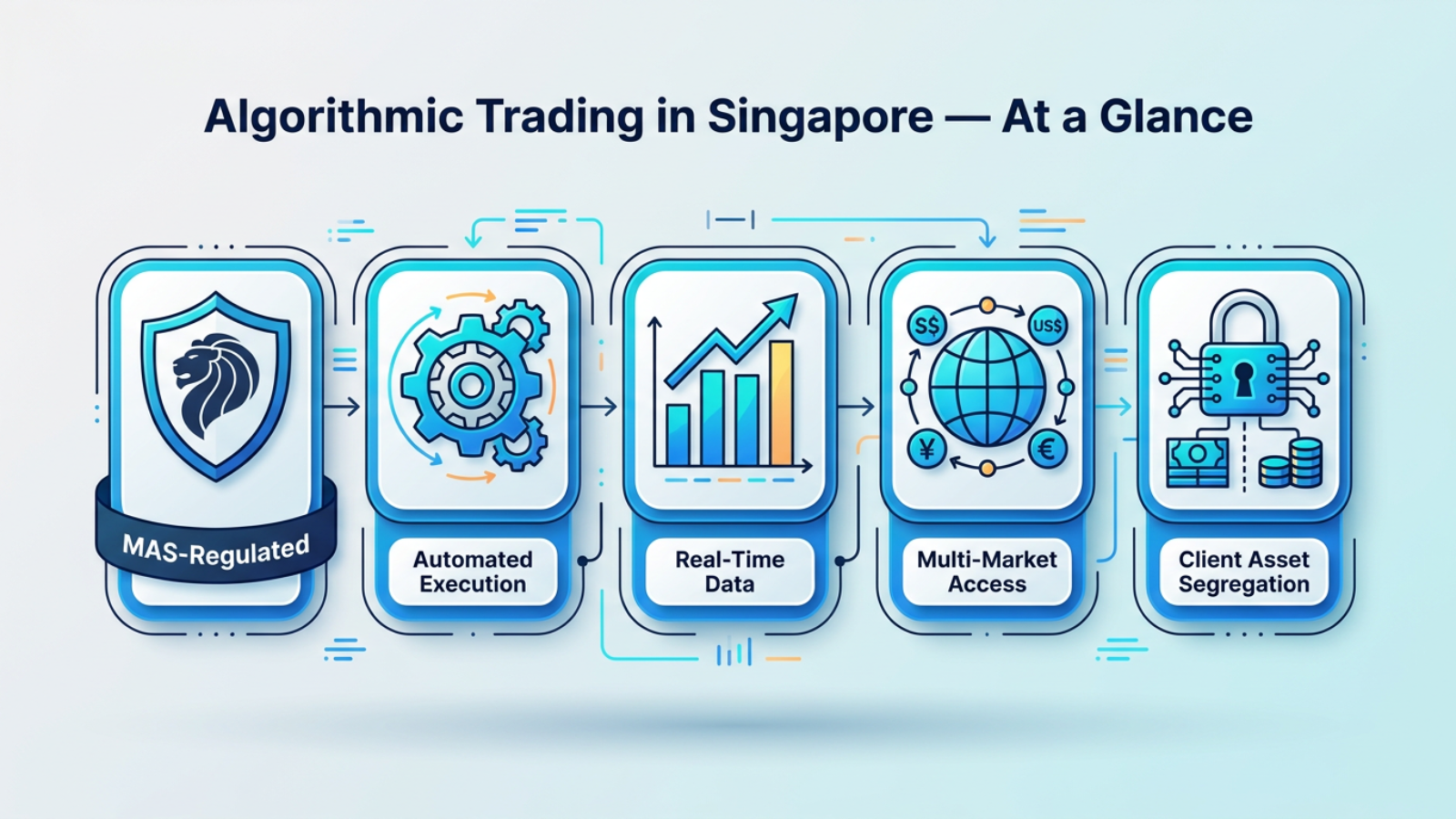
Trading in capital market products in Singapore is regulated under the Securities and Futures Act (SFA).
Webull Securities (Singapore) offers an OpenAPI supporting automated order execution, real-time market data, and AI-assisted market monitoring.
SGX and US market access differ in regulatory protections; overseas-listed products carry different legal-system risks than SGX-listed securities.
Client assets are segregated as required by the SFA. Singapore does not have a government-backed investor compensation scheme equivalent to the US SIPC.
Part 1: What Is Algorithmic Trading and How Does It Work in Singapore?
1.1 Defining Algorithmic Trading for Singapore Investors
Algorithmic trading, or algo trading, uses computer programs to execute orders automatically based on predefined rules such as price, volume, technical signals, or timing.
In Singapore, this spans a wide spectrum: from simple rule-based scripts placing limit orders on SGX-listed stocks, to quantitative strategies running across US equities, Hong Kong-listed securities, and China A-shares simultaneously.
Key terms to know:
Algorithmic trading: Automated order placement driven by coded logic.
Quantitative trading: Strategy development using statistical models and historical data.
High-frequency trading (HFT): A subset using extremely low-latency infrastructure; typically institutional.
API trading: Using a broker's Application Programming Interface to send orders programmatically.
1.2 The Singapore Regulatory Context
All trading activities in Singapore involving capital markets products falls under the Securities and Futures Act 2001 (SFA). Key regulatory points:
Brokers facilitating algo trading must hold a CMS Licence from the Monetary Authority of Singapore (MAS).
Traders using algorithms remain personally responsible for ensuring their strategies do not result in any market misconduct.
Overseas-listed products (e.g. US stocks traded from Singapore) are subject to a different regulatory regime and legal system than SGX-listed securities.
MAS does not endorse any specific broker or trading strategy by virtue of licensing. Licensing status reflects regulatory compliance, not investment quality.
Part 2: Singapore's Regulatory and Market Infrastructure for Algo Traders
2.1 MAS Licensing and the CMS Licence Framework
Brokers carrying out regulated activities in Singapore in relation to capital markets products are required to hold the relevant licence or exemption under the Securities and Futures Act (SFA).
Licensed brokers are subject to applicable regulatory requirements, including those relating to capital adequacy and business conduct. These requirements form part of Singapore's regulatory framework for capital markets activities.
2.2 SGX Infrastructure and Market Access
The Singapore Exchange (SGX) operates the primary equities and derivatives market in Singapore. Key infrastructure facts relevant to algo traders:
SGX trading hours: Continuous trading runs 09:00–12:00 and 13:00–17:00 (SGT, UTC+8), with a pre-open session from 08:30.
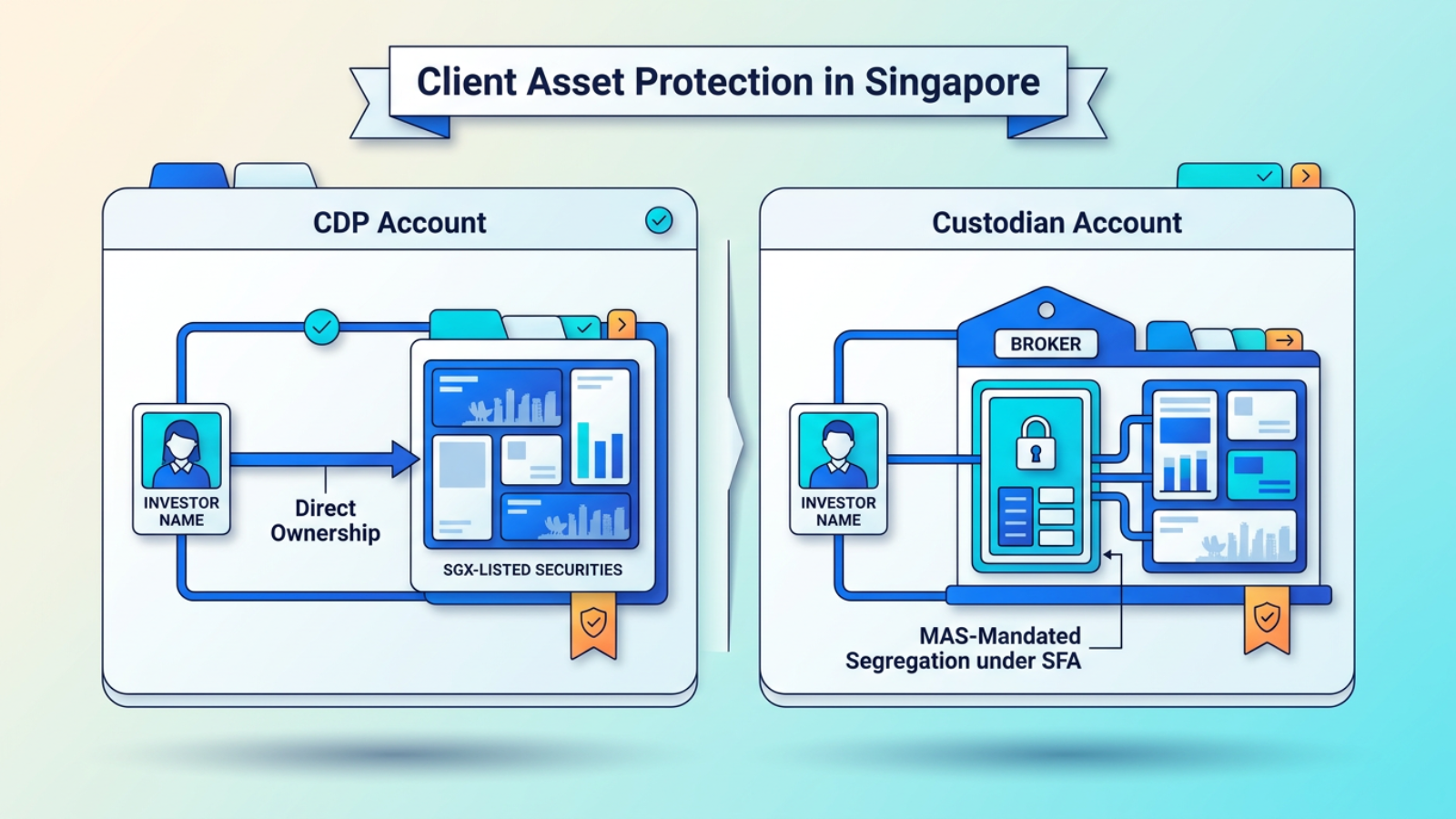
CDP account: The Central Depository (Pte) Limited (CDP) account holds SGX-listed securities directly in an investor's name. This is distinct from a custodian account, where securities are held by the broker on the investor's behalf.
Custodian account: Used by most retail brokers for overseas markets (US, HK, China A-shares). Securities are held in the broker's name as custodian.
CDP vs Custodian Account — Quick Definition:
Feature | CDP Account | Custodian Account |
|---|---|---|
Securities held in | Investor's own name | Broker's name (as custodian) |
Typical use | SGX-listed stocks | Overseas markets (US, HK, CN) |
Direct ownership | Yes | Beneficial ownership only |
2.3 Client Asset Protection Under the SFA
Singapore does not operate a government-backed investor compensation scheme equivalent to the US SIPC. Client asset protection is achieved through:
MAS-mandated segregation of client moneys and assets under the SFA and related MAS Notices.
Custodial and CDP safekeeping arrangements that keep client assets separate from the broker's own assets.
Ongoing MAS supervision of licensed dealers' compliance with these requirements.
Part 3: Webull Securities Singapore: Algorithmic and Automated Trading Features
3.1 Webull Open API: Automated Trading for Singapore Developers
Webull's Open API is the platform's primary infrastructure for algorithmic and automated trading. It is designed for developers, quantitative traders, and technically proficient retail investors who want programmatic market access.
Core API capabilities:
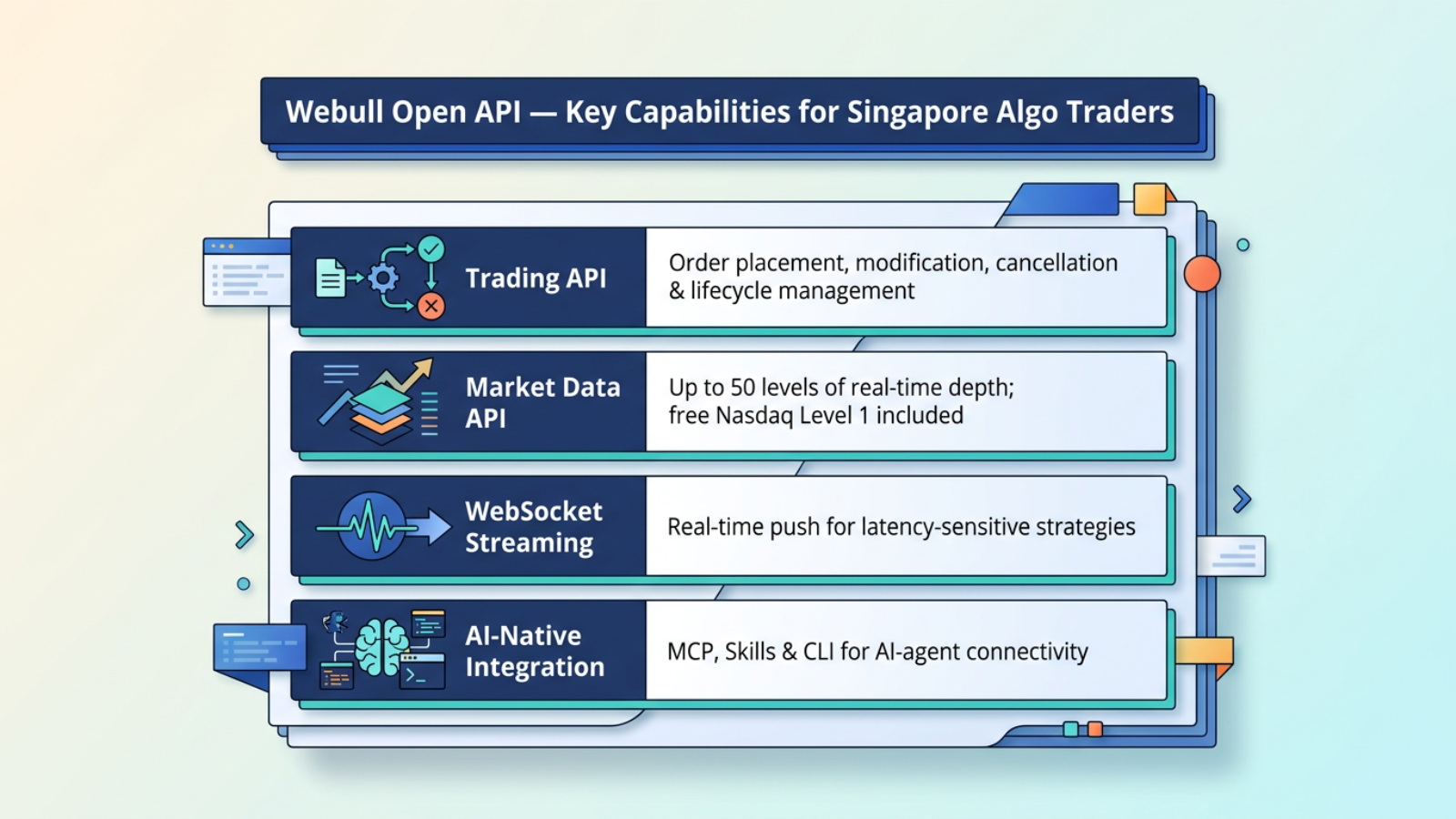
Trading API: Place, modify, cancel, and query orders for US stocks, ETFs, and options programmatically. Supports full order lifecycle management with real-time position and account tracking.
Market Data API: Access real-time quotes, market depth (up to 50 levels), time and sales, historical data, and live streaming. Free Nasdaq Level 1 data is included; deeper data tiers are available by subscription.
WebSocket streaming: Real-time push delivery for latency-sensitive strategies.
AI-native integration: Supports MCP, Skills, and CLI interfaces, enabling connection to AI agents for natural-language trade management and analysis.
Security infrastructure:
Dynamic Token + Two-Factor Authentication (2FA)
Self-managed IP whitelisting
Enterprise-grade security architecture
Getting started with Webull Open API:
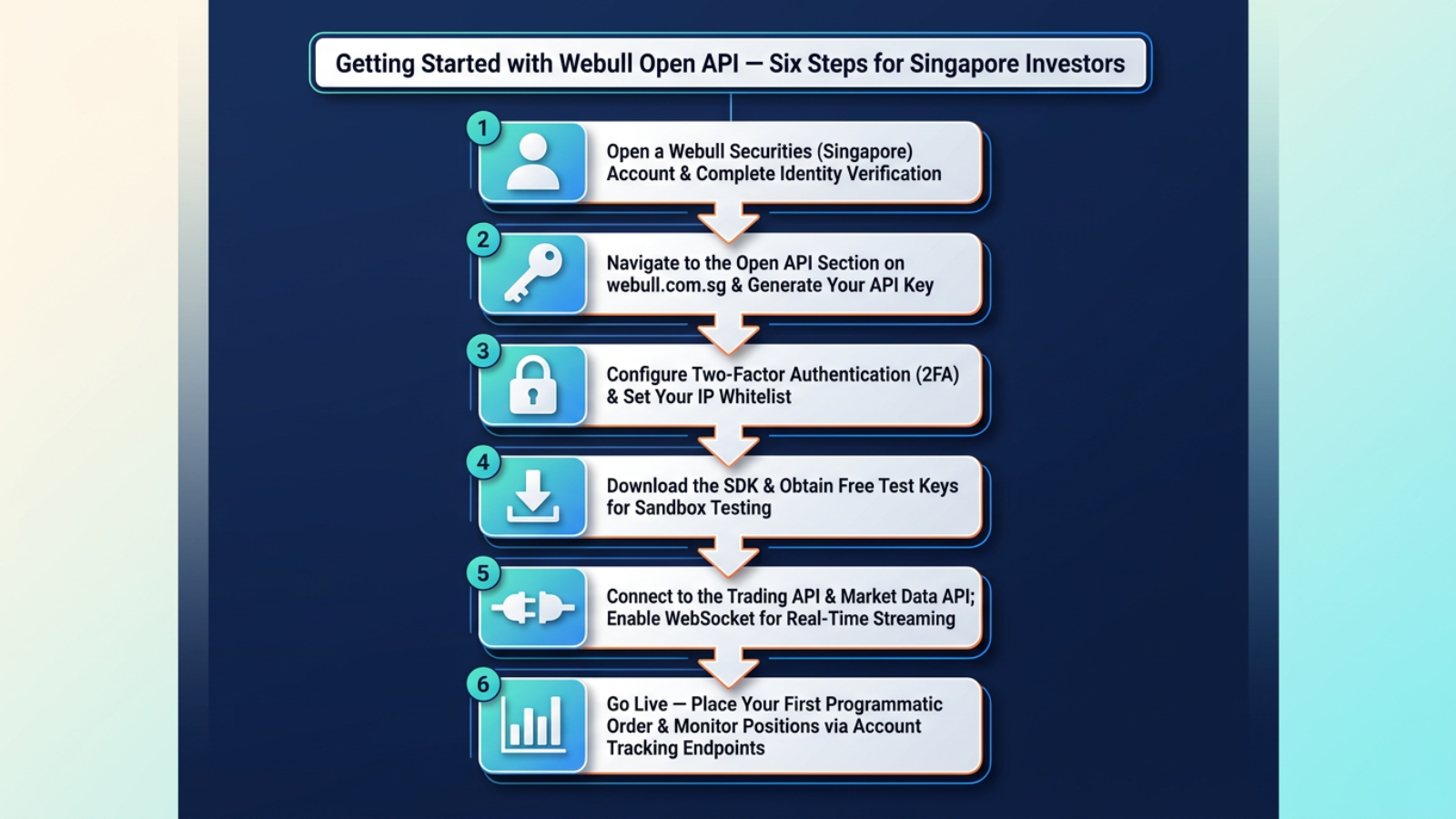
Step 1: Open a Webull Securities (Singapore) brokerage account and complete identity verification.
Step 2: Navigate to the Open API section on webull.com.sg and generate your API key.
Step 3: Configure Two-Factor Authentication and set your IP whitelist for secure access.
Step 4: Download the SDK and obtain free test keys to build and test your strategy in a sandbox environment.
Step 5: Connect to the Trading API and Market Data API endpoints; use WebSocket for real-time streaming if your strategy requires low-latency data.
Step 6: Place your first programmatic order and monitor positions through the account tracking endpoints.
3.2 Market Data Depth and Backtesting Support
Webull's API provides up to 50 levels of real-time US stock market depth, which is substantially more granular than standard Level 1 quotes. This supports:
Order book analysis for execution optimisation
Liquidity assessment before large orders
Spread monitoring for cost-aware algorithmic strategies
Historical API data supports backtesting, allowing traders to test strategies against past price data before deployment. Past backtested performance is not indicative of future results.
3.3 Extended Hours and Overnight Trading on Webull
For Singapore-based investors trading US markets, Webull supports trading outside regular NYSE/NASDAQ hours:
Extended hours trading (US stocks):
Pre-market: 04:00–09:30 Eastern Time
After-hours: 16:00–20:00 Eastern Time
After-hours (half-day market): 13:00–17:00 Eastern Time
To access extended hours on the Webull App: place a limit order and select "Include Extended Hours" under Trading Hours.
Overnight (24-hour) trading:
Webull offers overnight trading on eligible US securities. To identify eligible stocks:
Tap "Markets" in the bottom menu → scroll to "24H US Securities Trading."
Search for a US stock marked "24H" to find eligible stocks.
On a stock's quotes page, look for the "Overnight Trading" icon. Please note that margin trading is not supported during overnight sessions on Webull Singapore.
This feature is particularly relevant for Singapore investors, given the time-zone gap between SGT (UTC+8) and US market hours.
3.4 AI-Assisted Market Monitoring Tools
Webull's platform includes AI-powered tools to support market monitoring and research. These tools do not provide personalised investment advice or portfolio recommendations.
AI features on Webull (research and monitoring support):
AI market assistant: Tracks price action and volatility across watchlists.
AI-driven alerts: Flags earnings releases, unusual volume activity, and significant market moves.
AI summaries: Condenses stock and market event information to speed up initial research.
Trend and signal detection: Highlights momentum shifts across sectors and individual securities.
These tools are designed to help investors stay informed and conduct faster initial research. They do not constitute financial advisory services under the Financial Advisers Act (FAA), and outputs should not be treated as buy or sell signals. Investors retain full decision-making responsibility.
3.5 Fees and Commission Structure
Webull Securities (Singapore) offers zero commission and zero platform fees on US stocks and ETFs. Third-party fees, including regulatory, exchange, and clearing fees, apply separately and are not covered by the zero-fee structure.
Please refer to the latest pricing on the official website at webull.com.sg.
For SGX-listed securities, separate commission rates apply in SGD. For US-listed products, fees are quoted in USD. Always review the full fee schedule, including any FX conversion charges, custody fees, and financing costs where applicable.
Information accurate as of October 2026.
Part 4: Building an Algorithmic Trading Strategy in Singapore: Practical Mechanics
4.1 Strategy Types Accessible to Singapore Retail Investors
Singapore retail investors using API-enabled brokers can implement a range of algorithmic strategy types:
Rule-based execution strategies:
TWAP (Time-Weighted Average Price): Splits a large order into smaller tranches executed at regular intervals to reduce market impact.
VWAP (Volume-Weighted Average Price): Executes in proportion to market volume throughout the trading session.
Limit order laddering: Places multiple limit orders at different price levels to build or reduce a position gradually.
Signal-based strategies:
Moving average crossovers: Triggers buy or sell orders when short-term and long-term moving averages intersect.
Momentum strategies: Enters positions in the direction of recent price trends based on rate-of-change indicators.
Mean reversion: Identifies securities trading away from historical norms and positions for a return to average.
Risk management automation:
Stop-loss automation: Programmatically cancels or reverses positions when losses reach a defined threshold.
Position sizing rules: Automatically calculates order size based on account equity and risk parameters.
4.2 Order Types Available for Algorithmic Execution
Understanding available order types is essential for strategy design. On Webull platform:
Order Type | Description | Typical Algo Use Case |
|---|---|---|
Limit order | Executes only at specified price or better | Precise entry/exit; extended hours trading |
Market order | Executes immediately at best available price | Fast fills; less price control |
Stop order | Triggers a market order when price hits a level | Automated stop-loss |
Stop-limit order | Triggers a limit order when price hits a level | Stop-loss with price floor |
GTC (Good Till Cancelled) | Remains active until filled or cancelled, for up to 90 calendar days. | Multi-session strategies |
For US extended hours trading, limit orders are required. Market orders are not accepted outside regular trading hours.
4.3 Backtesting and Strategy Validation
Before deploying any algorithm with real capital, backtesting against historical data is standard practice. Key steps:
Step 1: Define the strategy rules
Specify entry and exit conditions, position sizing, and risk limits before testing.
Step 2: Source historical data
Use the broker's API or a third-party data provider to obtain OHLCV (Open, High, Low, Close, Volume) data for the relevant market and timeframe.
Step 3: Run the backtest
Apply the strategy rules to historical data and record simulated trades, returns, and drawdowns.
Step 4: Evaluate results critically
Assess metrics such as Sharpe ratio, maximum drawdown, win rate, and average trade duration. Watch for overfitting, where a strategy performs well on historical data but fails on new data.
Step 5: Paper trade before going live
Test the strategy in a simulated environment using real-time data without risking real capital.
Important: Backtested results reflect historical conditions that may not recur. Past performance is not indicative of future results. Market microstructure, liquidity, and regulatory conditions change over time.
4.4 Multi-Market Access for Singapore Algo Traders
Singapore investors using API-enabled platforms can access multiple markets through a single integration:
SGX (Singapore Exchange): Local equities, REITs, ETFs, and derivatives.
US markets (NYSE, NASDAQ): The largest and most liquid equity markets globally; accessible via custodian account.
Hong Kong (HKEX): Access to Hong Kong-listed equities and China H-shares.
China A-shares (SSE, SZSE): Mainland Chinese equities via Stock Connect or direct access, depending on the broker.
Part 5: Choosing an Algo-Friendly Broker in Singapore: What to Evaluate
5.1 Regulatory and Licensing Checklist
Before using any platform for algorithmic trading in Singapore, verify:
CMS Licence status: Confirm the broker holds a valid CMS Licence from MAS. Webull Securities (Singapore) holds CMS Licence No. CMS101150.
Scope of licence: Ensure the licence covers the products you intend to trade (securities, derivatives, ETFs).
API terms of use: Review the broker's API terms for any restrictions on strategy types, order frequency, or data usage.
5.2 Technical Evaluation Criteria for API Trading
Criterion | What to Look For |
|---|---|
API documentation quality | Clear, complete, with code examples |
Order types supported | Limit, market, stop, stop-limit, GTC |
Market data depth | Level 1 minimum; Level 2 / depth-of-book preferred |
Latency | WebSocket streaming for real-time strategies |
Authentication security | 2FA, IP whitelisting, dynamic tokens |
Sandbox / test environment | Essential for strategy testing before live deployment |
Historical data access | Sufficient depth for backtesting |
Rate limits | Understand request caps to avoid throttling |
5.3 Pros and Cons of Algorithmic Trading for Singapore Investors
Potential advantages:
Removes emotional decision-making from trade execution
Enables consistent application of defined rules across multiple instruments
Can monitor markets continuously, including during Singapore's off-hours relative to US markets
Supports systematic risk management through automated stop-loss and position sizing
Risks and limitations:
Algorithms can amplify losses if strategy logic is flawed or market conditions change
Technical failures (connectivity issues, API outages, code bugs) can cause unintended trades
Overfitted strategies may perform well in backtests but poorly in live markets
Regulatory compliance responsibility remains with the trader, not the platform
Overseas market access introduces additional risks including currency risk, different legal systems, and varying regulatory protections
All investments carry risk. The value of investments and any income from them can fall as well as rise. Past performance is not indicative of future results.
The Bottom Line
Algorithmic trading in Singapore is increasingly accessible to retail investors with technical skills. Webull Securities (Singapore), offers an Open API with automated order execution, up to 50 levels of market depth, extended hours trading, and AI-assisted monitoring tools.
Before committing capital, evaluate a platform's MAS licensing status, API capabilities, and fee structure.
Disclosure
All investments involve risks and are not suitable for every investor. The information provided is generated with the assistance of artificial intelligence based on publicly available sources and is for informational purposes only.
Options trading involves significant risk and is not suitable for all investors as investors may be exposed to potentially rapid and substantial losses.
The content provided above is for educational purposes only and does not constitute financial, investment, or professional advice. No content should be construed as investment advice or recommendation, or an offer or solicitation, to deal in any investment product. Investors may wish to seek advice from a financial adviser before investing. In the event that investors choose not to seek advice from a financial adviser, they should consider whether the investment is suitable for them. For more information, please refer to our website at https://www.webull.com.sg.
This advertisement has not been reviewed by the Monetary Authority of Singapore.
