' fill='white'%3e %3cg id='%e7%bc%96%e7%bb%84-7' transform='translate(0.000000%2c 86.000000)'%3e %3cg id='%e7%bc%96%e7%bb%84-2' transform='translate(80.533981%2c 22.000000)'%3e %3cpath d='M41.7832962%2c0 C41.9459106%2c0 42.0882746%2c0.0866854658 42.1666825%2c0.216359069 C43.8289923%2c2.66540836 44.7676281%2c5.46271319 44.7676281%2c8.43208061 C44.7676281%2c18.1345746 34.7460532%2c26 22.383814%2c26 C10.0215749%2c26 0%2c18.1345746 0%2c8.43208061 C0%2c5.46716016 0.935826425%2c2.67378733 2.58829888%2c0.223985685 C2.67109477%2c0.0916264068 2.81687473%2c0 2.9840593%2c0 C3.23130408%2c0 3.43173558%2c0.200393004 3.43173558%2c0.447590303 C3.43173558%2c0.475056669 3.42926112%2c0.501945205 3.42452292%2c0.528045226 L3.41810883%2c0.550292077 C3.37800671%2c0.861741908 3.3575721%2c1.17661276 3.3575721%2c1.49443092 C3.3575721%2c7.98336 11.2132389%2c12.5742305 22.383814%2c12.5742305 C33.5543891%2c12.5742305 41.410056%2c7.98336 41.410056%2c1.49443092 C41.410056%2c1.17865223 41.3898828%2c0.865783153 41.3502888%2c0.556288325 C41.3402868%2c0.521941442 41.3356199%2c0.48531078 41.3356199%2c0.447590303 C41.3356199%2c0.200393004 41.5360514%2c0 41.7832962%2c0 Z' id='logo%e5%a4%87%e4%bb%bd-6'%3e%3c/path%3e %3cpath d='M75.1559425%2c3.74404927 C75.7071421%2c3.74404927 76.2394493%2c3.66184338 76.7416414%2c3.50883715 L74.281987%2c20.8666902 C74.0430787%2c22.5662954 73.2732628%2c23.0518969 71.8929033%2c23.0518969 L70.459453%2c23.0518969 C69.2649111%2c23.0518969 68.6278221%2c22.458384 68.2561868%2c20.893668 L66.1591022%2c11.9909739 C66.1060114%2c11.7481731 66.1060114%2c11.6942174 65.9998299%2c11.6942174 C65.8936484%2c11.6942174 65.867103%2c11.7481731 65.8140123%2c11.9909739 L63.7169276%2c20.893668 C63.3452924%2c22.458384 62.7082033%2c23.0518969 61.5136614%2c23.0518969 L60.0802112%2c23.0518969 C58.6998516%2c23.0518969 57.9300358%2c22.5662954 57.6911274%2c20.8666902 L55.2123917%2c3.37406084 C55.8253692%2c3.61307396 56.491017%2c3.74404927 57.1867652%2c3.74404927 C57.7974457%2c3.74404927 58.3849364%2c3.64314414 58.9339751%2c3.4568446 L60.8234817%2c19.3829078 C60.8500271%2c19.6257086 60.8500271%2c19.7875757 60.9562086%2c19.7875757 C61.0623901%2c19.7875757 61.0623901%2c19.6257086 61.1154808%2c19.3829078 L63.3983831%2c9.91367858 C63.5576554%2c9.26620991 63.9292906%2c8.69967483 65.0707418%2c8.69967483 L66.9023727%2c8.69967483 C68.0438238%2c8.69967483 68.4154591%2c9.26620991 68.5747313%2c9.91367858 L70.8576336%2c19.3829078 C70.9107244%2c19.6257086 70.9107244%2c19.7875757 71.0169059%2c19.7875757 C71.1230874%2c19.7875757 71.1230874%2c19.6257086 71.1496327%2c19.3829078 L73.0551401%2c3.32292288 C73.7026096%2c3.59432921 74.4120718%2c3.74404927 75.1559425%2c3.74404927 Z' id='Combined-Shape'%3e%3c/path%3e %3cpath d='M85.0594095%2c7.43171536 C89.1473973%2c7.43171536 91.3772089%2c10.2643908 91.3772089%2c14.2840921 L91.3772089%2c15.7948523 C91.3772089%2c16.2264981 91.2179366%2c16.4692988 90.8463013%2c16.4692988 L82.1925089%2c16.4692988 L82.1925089%2c16.5502324 C82.1925089%2c18.1149484 82.829598%2c19.9764208 85.377954%2c19.9764208 C87.3157664%2c19.9764208 89.1473973%2c19.8145536 90.2623031%2c19.7066422 L90.3419392%2c19.7066422 C90.607393%2c19.7066422 90.819756%2c19.8415315 90.819756%2c20.1113101 L90.819756%2c21.8918489 C90.819756%2c22.3234947 90.7401198%2c22.5123397 90.2623031%2c22.5932733 C88.5368537%2c22.9170076 87.501584%2c23.0518969 85.1125002%2c23.0518969 C82.4579627%2c23.0518969 78.6885194%2c21.5950924 78.6885194%2c16.2804538 L78.6885194%2c14.2840921 C78.6885194%2c10.0755457 80.997967%2c7.43171536 85.0594095%2c7.43171536 Z M85.0594095%2c10.5071915 C83.4135962%2c10.5071915 82.2190543%2c11.6942174 82.2190543%2c13.8254684 L82.2190543%2c13.9333799 L87.8466739%2c13.9333799 L87.8466739%2c13.8254684 C87.8466739%2c11.7211953 86.7052228%2c10.5071915 85.0594095%2c10.5071915 Z' id='Combined-Shape'%3e%3c/path%3e %3cpath d='M97.88151%2c2.98826245 L97.8808258%2c7.62056039 C98.8630047%2c7.48567108 99.7920929%2c7.43171536 100.429182%2c7.43171536 C104.702987%2c7.43171536 106.773527%2c9.99461216 106.773527%2c14.2031585 L106.773527%2c16.2804538 C106.773527%2c20.4890001 104.702987%2c23.0518969 100.429182%2c23.0518969 C98.7302779%2c23.0518969 96.7393747%2c22.7821183 95.0935614%2c22.3504725 C94.4830178%2c22.1886054 94.3768363%2c22.0267382 94.3768363%2c21.6220703 L94.3758373%2c3.08694115 C94.884566%2c3.24434375 95.4244809%2c3.32900525 95.9838525%2c3.32900525 C96.6506785%2c3.32900525 97.2898545%2c3.20869291 97.88151%2c2.98826245 Z M100.429182%2c10.3453244 C99.7920929%2c10.3453244 98.6240964%2c10.4262579 97.8808258%2c10.5341694 L97.8808258%2c19.9494429 C98.385188%2c20.0573544 99.4735484%2c20.1382879 100.429182%2c20.1382879 C102.712084%2c20.1382879 103.269537%2c18.4926384 103.269537%2c16.2804538 L103.269537%2c14.2031585 C103.269537%2c11.9909739 102.712084%2c10.3453244 100.429182%2c10.3453244 Z' id='Combined-Shape'%3e%3c/path%3e %3cpath d='M111.502687%2c8.72457747 C112.045508%2c8.72457747 112.570006%2c8.64485191 113.065463%2c8.49629404 L113.064781%2c16.5232546 C113.064781%2c19.3289521 114.073505%2c19.9764208 115.613137%2c19.9764208 L115.772409%2c19.9764208 C117.312041%2c19.9764208 118.320765%2c19.3289521 118.320765%2c16.5232546 L118.320226%2c8.4334735 C118.872544%2c8.62226395 119.463958%2c8.72457747 120.078886%2c8.72457747 C120.689352%2c8.72457747 121.276644%2c8.62374317 121.825517%2c8.43756894 L121.824755%2c16.5232546 C121.824755%2c22.4044283 117.338586%2c23.0518969 115.772409%2c23.0518969 L115.526483%2c23.0512514 C113.88817%2c23.0271041 109.560791%2c22.2994073 109.560791%2c16.5232546 L109.560465%2c8.36700801 C110.164542%2c8.59813531 110.819085%2c8.72457747 111.502687%2c8.72457747 Z' id='Combined-Shape'%3e%3c/path%3e %3cpath d='M128.780182%2c3.03790128 L128.779643%2c22.269539 C128.779643%2c22.5662954 128.56728%2c22.836074 128.275281%2c22.836074 L125.806561%2c22.836074 C125.514562%2c22.836074 125.275653%2c22.5662954 125.275653%2c22.269539 L125.275475%2c3.04219481 C125.82418%2c3.22824247 126.411273%2c3.32900525 127.021522%2c3.32900525 C127.63645%2c3.32900525 128.227864%2c3.22669173 128.780182%2c3.03790128 Z' id='Combined-Shape'%3e%3c/path%3e %3cpath d='M134.372549%2c3.32900525 C134.939348%2c3.32900525 135.48617%2c3.24208064 136.000812%2c3.08063296 L135.999985%2c22.269539 C135.999985%2c22.5662954 135.787622%2c22.836074 135.495623%2c22.836074 L133.026903%2c22.836074 C132.734904%2c22.836074 132.495995%2c22.5662954 132.495995%2c22.269539 L132.495929%2c2.99605058 C133.081688%2c3.21152525 133.713619%2c3.32900525 134.372549%2c3.32900525 Z' id='Combined-Shape'%3e%3c/path%3e %3c/g%3e %3c/g%3e %3c/g%3e %3c/g%3e%3c/svg%3e)



Agentic trading uses AI agents to research markets, analyse data, look through portfolios, and prepare trade instructions on behalf of investors. Platforms now connect large language models (LLMs) with brokerage accounts through standardised protocols, allowing investors to interact with trading tools through natural language. This article explains how agentic trading works, what Singapore investors should know about the available tools, and how Webull’s MCP-based integration works.
Key Takeaways
Agentic trading uses AI agents connected to brokerage accounts to research, analyse, and draft trade instructions in natural language.
Webull Singapore supports MCP (Model Context Protocol) integration, allowing ChatGPT, Claude, and compatible agents to connect to your account.
You retain full control: every order is previewed before execution, and read-only mode is available.
Client assets at MAS-regulated brokers are protected through SFA-mandated segregation, not a government-backed compensation scheme.
Part 1: What Is Agentic Trading and How Does It Work for Singapore Investors?
1.1 Defining Agentic Trading
Agentic trading refers to the use of AI agents, software powered by large language models, to research markets, analyse market data, and generate trade instructions within a brokerage environment. Unlike traditional rule-based algorithms, agentic systems can process natural language and unstructured information and use contextual information when carrying out these tasks.
Definition:
AI Agent: A software system powered by an LLM, such as ChatGPT or Claude, that can perform multiple steps in response to a plain-language instruction, including retrieving market data, analysing a portfolio, and drafting an order.
MCP (Model Context Protocol): An open standard, originally developed by Anthropic, that allows AI applications to securely connect to external platforms and tools through a single, unified interface.
Agentic trading: The application of AI agents to investment workflows, from research and screening to order drafting and portfolio monitoring.
1.2 How MCP Connects AI to Your Brokerage Account
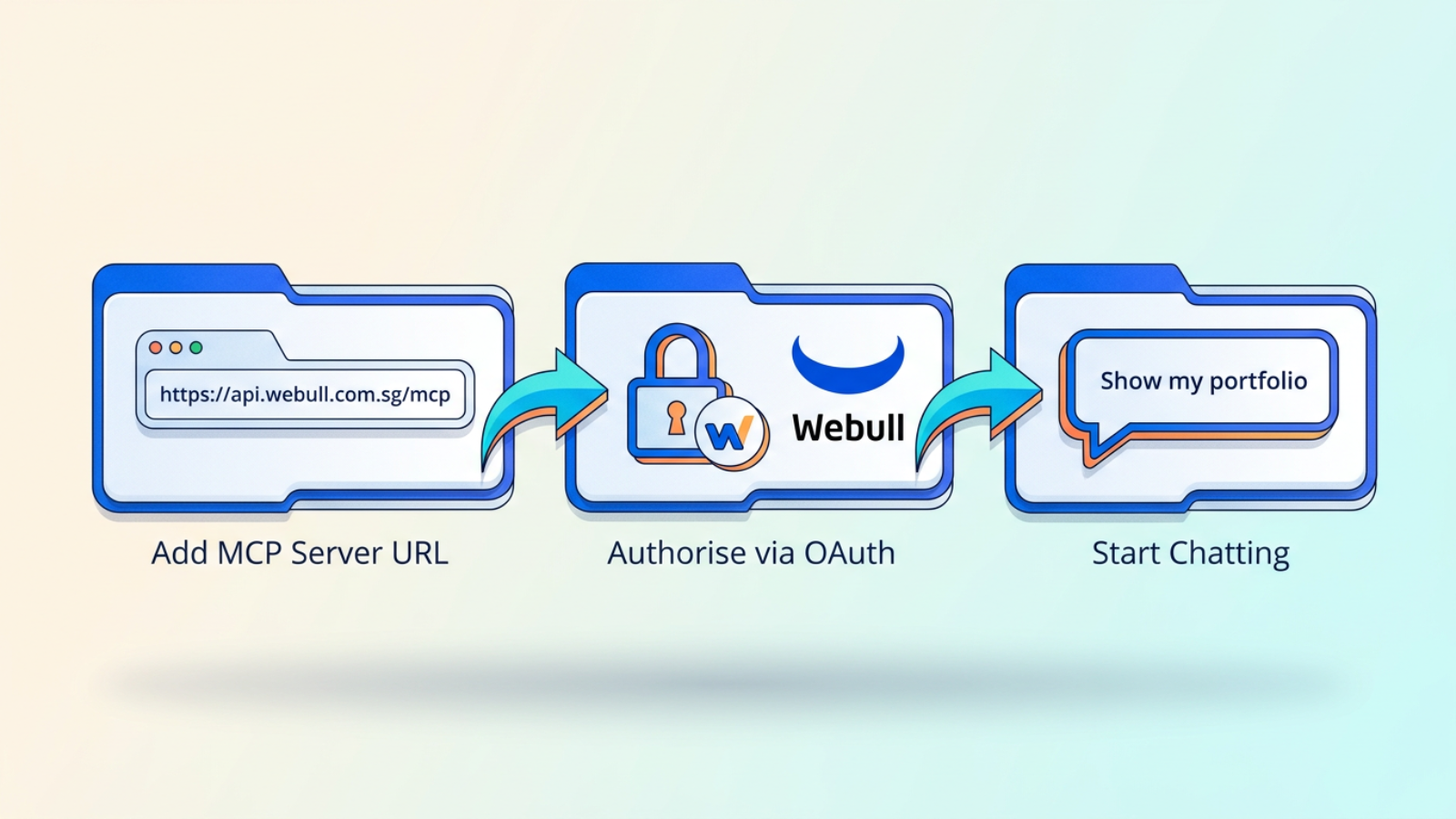
MCP provides a standardised connection between an AI assistant and a brokerage platform. The broker operates as an MCP server and makes specific tools available to the connected AI agent, such as retrieving live prices, checking account balances, and drafting orders. Authentication is handled through OAuth, so brokerage login credentials are not shared directly with the AI platform.
The workflow typically follows three steps:
Add the broker's MCP server URL to your AI agent's connector settings.
Authorise access by logging in through the broker's own secure login screen.
Use natural language to get market updates, portfolio summaries, or order drafts.
Part 2: Webull's Agentic Trading Platform: Features and Capabilities for Singapore Investors
Webull Securities (Singapore) Pte. Ltd. holds a Capital Markets Services (CMS) Licence under the Securities and Futures Act (SFA) and is regulated by the Monetary Authority of Singapore (MAS). Its agentic trading offering is built on the Model Context Protocol, supporting live price retrieval, order drafting, portfolio monitoring, and read-only mode, with OAuth-secured authentication.
2.1 Connecting Your AI Agent to Webull
Webull's MCP server is accessible. Compatible agents include ChatGPT, Claude, and any MCP-supported assistant.
Webull also supports local deployment options for technically inclined users:
Local MCP: Runs locally on your machine via
uvx, with API keys stored on your device. It can be used with environments such as Claude Code, Cursor, and Codex.Agent Skills: Ready-made skills your assistant runs directly, without protocol configuration.
CLI: Headless automation, scheduled jobs, and CI pipelines using the same account and controls.
Open API: Raw market data and trading APIs for custom code development.
2.2 What Your AI Agent Can Do on Webull
Once connected, a compatible AI agent can perform the following actions within your Webull account:
Market tracking:
Retrieve live prices, charts, and market depth on demand.
Request snapshots covering the last five trading days or current movers.
Research and analysis:
Pull company profiles, analyst ratings, and price targets.
Provide the agent with real context to reason through investment ideas.
Order drafting and management:
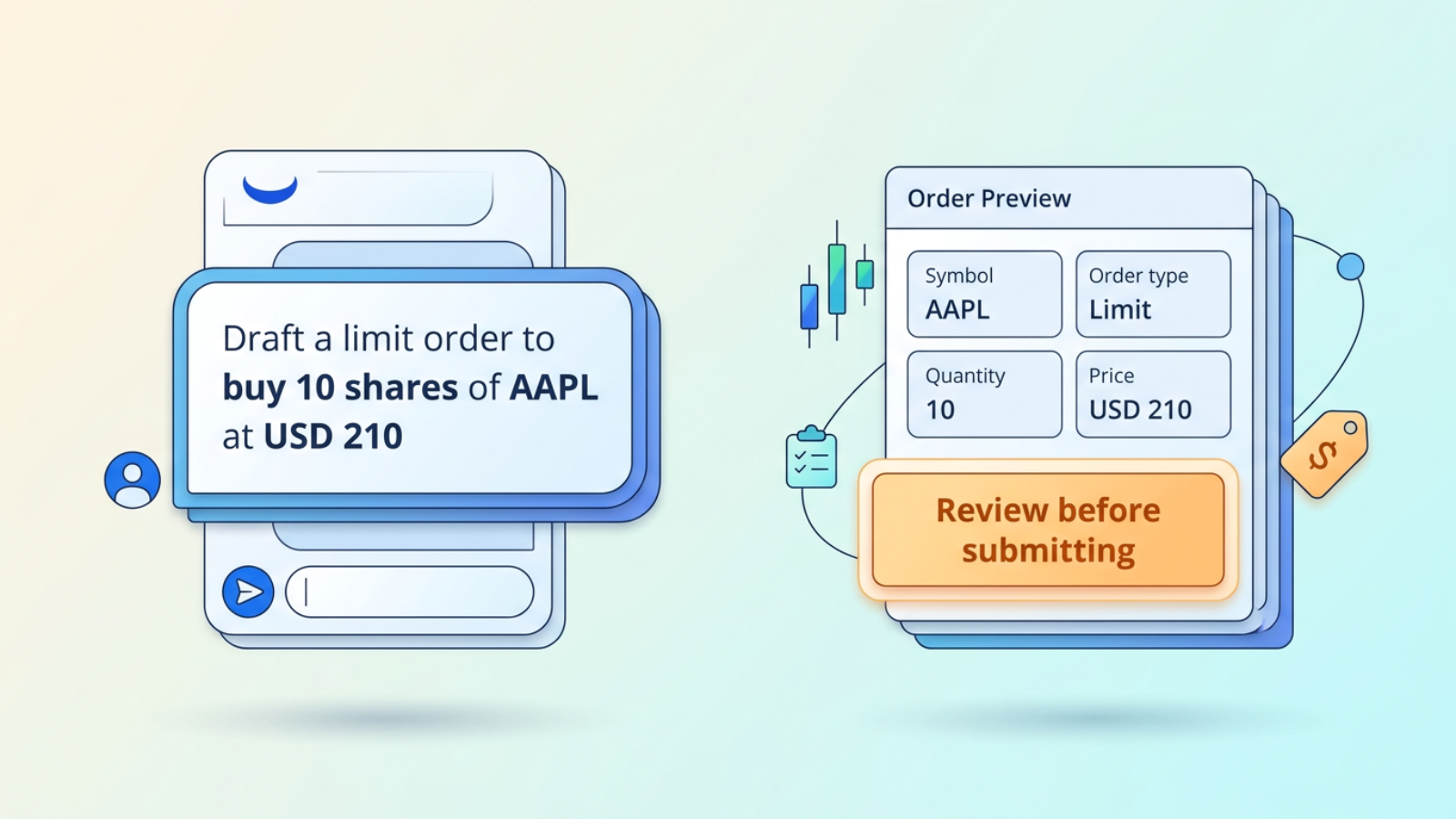
Draft buy, sell, modify, or cancel instructions in plain language.
Preview every order before anything goes live — no automatic execution.
Supports US equities and options.
Portfolio monitoring:
Check account balances, buying power, and current positions instantly.
Eliminates the need to switch between tabs or maintain manual spreadsheets.
What Your AI Agent Does Not Do
Your AI agent cannot place, modify or cancel orders on its own. It only drafts instructions, and you must review and confirm every order before it goes live. It cannot move funds, change your account or security settings, or bypass eligibility requirements such as assessments for options and other Specified Investment Products. Any analysis or ideas it produces come from a third-party AI tool, not Webull. They are not a recommendation or financial advice.
These limits keep every investment decision with you and your account secure. Webull does not control third-party AI models, and their output may be inaccurate or outdated, so please verify key information in the Webull app and consider whether an investment suits your circumstances before acting. These boundaries also support our regulatory obligations in Singapore.
2.3 Control and Safety Features
Webull's AI trading framework is designed around a "human-in-the-loop" model, which means a person must review and approve every action before it takes effect. Key safeguards include:
Control Feature | Description |
|---|---|
Order preview | Agent shows full order details before any trade is submitted |
Read-only mode | Agent can research and monitor without placing any trades |
Hard limits | Cap order size, total value, or restrict trading to a defined list of symbols |
Instant disconnect | Unlink the agent with one click; credentials are never stored by the AI |
OAuth authentication | Secure authorisation; Webull credentials stay with Webull |
2.4 Extended Hours and Order Types on Webull
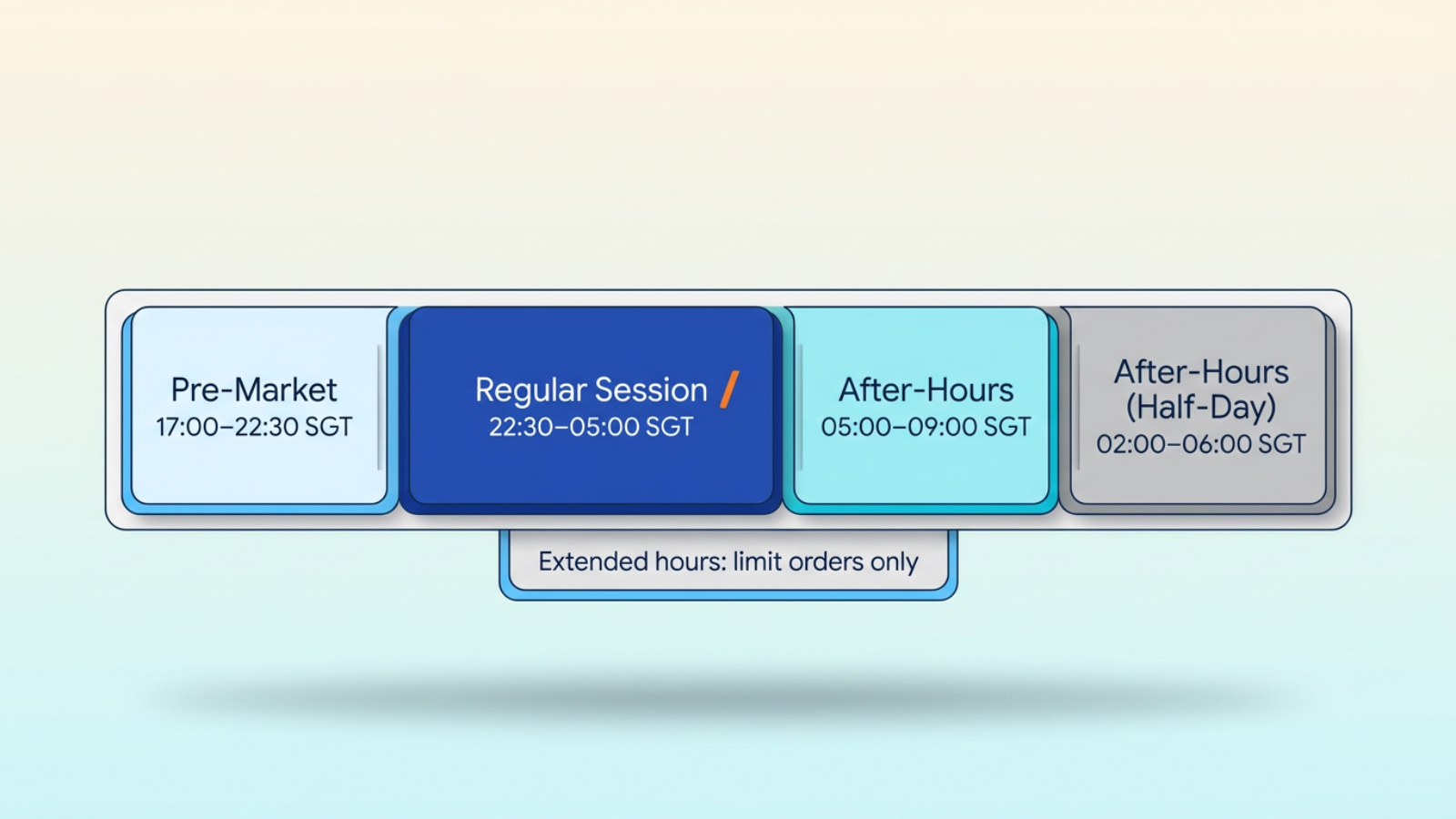
For Singapore investors trading US equities through an AI agent, understanding Webull's extended hours capability is practically important. Webull supports pre-market and after-hours trading via limit orders with the "Include Extended Hours" option selected.
US market extended hours (Singapore Time, SGT = ET + 13 hours):
Pre-market: 04:00–09:30 ET (17:00–22:30 SGT)
Regular session: 09:30–16:00 ET (22:30–05:00 SGT next day)
After-hours: 16:00–20:00 ET (05:00–09:00 SGT)
After-hours (half-day market): 13:00–17:00 ET (02:00–06:00 SGT)
Extended hours support limit orders only. Market orders are unavailable outside regular trading hours.
2.5 Shares Transfer and OTC Trading on Webull
For investors managing positions across brokers, Webull supports shares transfer out for both US and SGX-listed securities:
US Share Transfer Out: USD 150 per symbol. Supports DTC transfers only; ACAT transfers are not currently supported.
SGX Share Transfer Out: SGD 100 per symbol plus CDP fees (SGD 5 for DA transfers; SGD 10 for CDP transfers).
Transfers are restricted to exchange-listed stocks and ETFs. Transfer out is not permitted when the account has a margin call.
Webull Singapore does not charge additional fees or commissions for trading OTC securities.
Part 3: The Broader Landscape: Types of AI Trading Tools Available in Singapore
3.1 Five Categories of AI Trading Tools
Not all AI trading tools work the same way. Singapore investors should understand the distinctions before connecting any tool to a live account:
Fully automated execution: connects directly to broker APIs and places orders without human intervention. Highest risk; requires robust safeguards.
Signal-based: surfaces buy or sell signals; the investor decides whether to act.
Conversational AI-assisted (agentic): uses LLMs to analyse data, interpret reports, and draft strategies; the user retains control and no trades execute automatically.
Strategy backtesting: simulates a strategy against historical data before going live.
Broker-embedded: AI features built directly into a trading platform, requiring no separate account or API connection.
For most Singapore retail investors, broker-embedded and conversational agentic tools offer a practical entry point: they keep execution within a regulated brokerage and require no external API configuration.
3.2 SGX vs US Market Considerations for Agentic Tools
SGX-listed securities present specific challenges for AI-assisted trading. Many SGX small-cap stocks have lower average daily volumes than US-listed stocks, so even modest order sizes can affect execution quality. SGX board lots are 100, 10 or 1 share depending on the security's price, with most stocks still trading in lots of 100. Odd lots are traded separately on the Unit Share Market, where liquidity is typically thinner. An AI agent that calculates order quantities by value or percentage may produce sizes that don't fit these rules. For these reasons, agentic tools are generally better suited to US equities, where liquidity is deeper and fractional or single-share orders are common, than to thinly traded SGX counters.
Risk note: Overseas-listed investment products (e.g. US stocks traded from Singapore) are subject to a different regulatory regime and legal system than SGX-listed products.
Part 4: Practical Considerations Before Using Agentic Trading Tools in Singapore
4.1 Risks Specific to Agentic and AI-Assisted Trading
AI agents introduce risks that differ from conventional manual trading:
Instruction misinterpretation: LLMs may misread ambiguous prompts and draft unintended orders. Always review the order preview carefully.
Delayed data risk: Agents acting on slightly stale price data may draft orders that no longer reflect current market conditions.
Overfitting in backtested strategies: Strategies that perform well in historical simulations may not hold up in live markets. Past performance is not indicative of future results.
Strategy decay: Market regimes change. A strategy that worked in a low-volatility environment may underperform in a high-volatility one.
Black swan events: AI models trained on historical patterns may respond unreliably to sudden, severe market dislocations.
4.2 Practical Steps Before Connecting an AI Agent
Before connecting any AI agent to a live brokerage account:
Verify the broker is MAS-regulated and holds a valid CMS Licence.
Start with read-only mode to observe how the agent interprets your portfolio and market data before granting trade permissions.
Set hard limits on order size and value, and restrict the agent to a defined list of symbols if you are new to agentic tools.
Review every order preview before confirming a trade. Avoid enabling automatic execution without a human review step.
Understand the fee structure for each market you intend to trade. US stock commissions are typically quoted in USD; SGX stock commissions in SGD.
Read the platform's data and privacy policy to understand what information is shared with the connected AI service.
Do not input sensitive personal financial data into third-party AI platforms beyond what is required for the authorised connection.
4.3 Pros and Cons of Agentic Trading for Singapore Investors
Potential advantages:
Processes large volumes of market data and company information faster than manual research.
Enables natural-language interaction with your portfolio without having to navigate through multiple screens.
Read-only mode provides research benefits without execution risk.
Extended hours coverage helps Singapore-based investors monitor US markets during local daytime hours.
Potential limitations:
AI agents can misinterpret instructions or act on delayed data.
Not suited to thinly traded SGX securities where order impact is a concern.
Requires active monitoring, as agentic tools do not replace the need for investor oversight.
Regulatory framework for AI in financial services is still evolving; compliance obligations may change.
No AI tool eliminates investment risk. All trading involves a substantial risk of loss.
Part 5: Regulatory Framework and Client Asset Protection in Singapore
5.1 MAS Regulation and CMS Licensing
MAS regulates dealing activities involving capital market products under the Securities and Futures Act (SFA). Brokers offering trading services to Singapore retail investors must hold a Capital Markets Services (CMS) Licence. MAS licensing status may be verified on the MAS Financial Institutions Directory.
Important: MAS licensing is a regulatory requirement, not an endorsement of a firm's products, investment outcomes, or the performance of any AI tool it offers.
5.2 Client Asset Protection Under the SFA
Singapore does not operate a government-backed investor compensation scheme equivalent to the US SIPC. Client asset protection in Singapore is achieved through:
MAS-mandated segregation of client moneys and assets under the Securities and Futures Act (SFA) and related MAS Notices.
Safekeeping arrangements for SGX-listed securities, which may involve the Central Depository (CDP) or custodian account structures, depending on the broker's arrangements.
Custodian account structures for overseas-listed securities, where assets are held in the client's beneficial interest but not registered directly in the client's name.
Definition:
CDP account: A direct securities account with the Central Depository (Pte) Ltd, where SGX-listed shares are held in the investor's own name.
Custodian account: An account where securities are held by the broker or a sub-custodian on the investor's behalf. Common for US and other overseas-listed stocks.
5.3 MAS's Evolving AI Risk Framework
In November 2025, MAS issued a consultation paper proposing guidelines on AI risk management for financial institutions, indicating that Singapore’s regulatory framework for AI in finance is continuing to develop. MAS does not generally prohibit retail investors from using AI-assisted or agentic trading tools. However, trading activities must comply with applicable laws and conduct requirements, including prohibitions on market manipulation such as spoofing and wash trading, whether trades are executed manually or through automated systems.
Singapore users are also covered by the Personal Data Protection Act (PDPA). Before connecting any AI tool to a brokerage account, investors should review what data the platform collects, retains, and shares.
The Bottom Line
Agentic trading represents a meaningful shift in how Singapore investors can interact with their portfolios, combining the research capabilities of LLMs with the execution infrastructure of a MAS-regulated broker. Webull's MCP integration offers a structured, human-in-the-loop framework with practical safeguards. As with any trading tool, understanding the mechanics, costs, and risks before going live is essential. Past performance is not indicative of future results.
Disclosure
All investments involve risks and are not suitable for every investor. The information provided is generated with the assistance of artificial intelligence based on publicly available sources and is for informational purposes only.
Options trading involves significant risk and is not suitable for all investors as investors may be exposed to potentially rapid and substantial losses. This
The content provided above is for educational purposes only and does not constitute financial, investment, or professional advice. No content should be construed as investment advice or recommendation, or an offer or solicitation, to deal in any investment product. Investors may wish to seek advice from a financial adviser before investing. In the event that investors choose not to seek advice from a financial adviser, they should consider whether the investment is suitable for them. For more information, please refer to our website at https://www.webull.com.sg.
This advertisement has not been reviewed by the Monetary Authority of Singapore.
