' fill='white'%3e %3cg id='%e7%bc%96%e7%bb%84-7' transform='translate(0.000000%2c 86.000000)'%3e %3cg id='%e7%bc%96%e7%bb%84-2' transform='translate(80.533981%2c 22.000000)'%3e %3cpath d='M41.7832962%2c0 C41.9459106%2c0 42.0882746%2c0.0866854658 42.1666825%2c0.216359069 C43.8289923%2c2.66540836 44.7676281%2c5.46271319 44.7676281%2c8.43208061 C44.7676281%2c18.1345746 34.7460532%2c26 22.383814%2c26 C10.0215749%2c26 0%2c18.1345746 0%2c8.43208061 C0%2c5.46716016 0.935826425%2c2.67378733 2.58829888%2c0.223985685 C2.67109477%2c0.0916264068 2.81687473%2c0 2.9840593%2c0 C3.23130408%2c0 3.43173558%2c0.200393004 3.43173558%2c0.447590303 C3.43173558%2c0.475056669 3.42926112%2c0.501945205 3.42452292%2c0.528045226 L3.41810883%2c0.550292077 C3.37800671%2c0.861741908 3.3575721%2c1.17661276 3.3575721%2c1.49443092 C3.3575721%2c7.98336 11.2132389%2c12.5742305 22.383814%2c12.5742305 C33.5543891%2c12.5742305 41.410056%2c7.98336 41.410056%2c1.49443092 C41.410056%2c1.17865223 41.3898828%2c0.865783153 41.3502888%2c0.556288325 C41.3402868%2c0.521941442 41.3356199%2c0.48531078 41.3356199%2c0.447590303 C41.3356199%2c0.200393004 41.5360514%2c0 41.7832962%2c0 Z' id='logo%e5%a4%87%e4%bb%bd-6'%3e%3c/path%3e %3cpath d='M75.1559425%2c3.74404927 C75.7071421%2c3.74404927 76.2394493%2c3.66184338 76.7416414%2c3.50883715 L74.281987%2c20.8666902 C74.0430787%2c22.5662954 73.2732628%2c23.0518969 71.8929033%2c23.0518969 L70.459453%2c23.0518969 C69.2649111%2c23.0518969 68.6278221%2c22.458384 68.2561868%2c20.893668 L66.1591022%2c11.9909739 C66.1060114%2c11.7481731 66.1060114%2c11.6942174 65.9998299%2c11.6942174 C65.8936484%2c11.6942174 65.867103%2c11.7481731 65.8140123%2c11.9909739 L63.7169276%2c20.893668 C63.3452924%2c22.458384 62.7082033%2c23.0518969 61.5136614%2c23.0518969 L60.0802112%2c23.0518969 C58.6998516%2c23.0518969 57.9300358%2c22.5662954 57.6911274%2c20.8666902 L55.2123917%2c3.37406084 C55.8253692%2c3.61307396 56.491017%2c3.74404927 57.1867652%2c3.74404927 C57.7974457%2c3.74404927 58.3849364%2c3.64314414 58.9339751%2c3.4568446 L60.8234817%2c19.3829078 C60.8500271%2c19.6257086 60.8500271%2c19.7875757 60.9562086%2c19.7875757 C61.0623901%2c19.7875757 61.0623901%2c19.6257086 61.1154808%2c19.3829078 L63.3983831%2c9.91367858 C63.5576554%2c9.26620991 63.9292906%2c8.69967483 65.0707418%2c8.69967483 L66.9023727%2c8.69967483 C68.0438238%2c8.69967483 68.4154591%2c9.26620991 68.5747313%2c9.91367858 L70.8576336%2c19.3829078 C70.9107244%2c19.6257086 70.9107244%2c19.7875757 71.0169059%2c19.7875757 C71.1230874%2c19.7875757 71.1230874%2c19.6257086 71.1496327%2c19.3829078 L73.0551401%2c3.32292288 C73.7026096%2c3.59432921 74.4120718%2c3.74404927 75.1559425%2c3.74404927 Z' id='Combined-Shape'%3e%3c/path%3e %3cpath d='M85.0594095%2c7.43171536 C89.1473973%2c7.43171536 91.3772089%2c10.2643908 91.3772089%2c14.2840921 L91.3772089%2c15.7948523 C91.3772089%2c16.2264981 91.2179366%2c16.4692988 90.8463013%2c16.4692988 L82.1925089%2c16.4692988 L82.1925089%2c16.5502324 C82.1925089%2c18.1149484 82.829598%2c19.9764208 85.377954%2c19.9764208 C87.3157664%2c19.9764208 89.1473973%2c19.8145536 90.2623031%2c19.7066422 L90.3419392%2c19.7066422 C90.607393%2c19.7066422 90.819756%2c19.8415315 90.819756%2c20.1113101 L90.819756%2c21.8918489 C90.819756%2c22.3234947 90.7401198%2c22.5123397 90.2623031%2c22.5932733 C88.5368537%2c22.9170076 87.501584%2c23.0518969 85.1125002%2c23.0518969 C82.4579627%2c23.0518969 78.6885194%2c21.5950924 78.6885194%2c16.2804538 L78.6885194%2c14.2840921 C78.6885194%2c10.0755457 80.997967%2c7.43171536 85.0594095%2c7.43171536 Z M85.0594095%2c10.5071915 C83.4135962%2c10.5071915 82.2190543%2c11.6942174 82.2190543%2c13.8254684 L82.2190543%2c13.9333799 L87.8466739%2c13.9333799 L87.8466739%2c13.8254684 C87.8466739%2c11.7211953 86.7052228%2c10.5071915 85.0594095%2c10.5071915 Z' id='Combined-Shape'%3e%3c/path%3e %3cpath d='M97.88151%2c2.98826245 L97.8808258%2c7.62056039 C98.8630047%2c7.48567108 99.7920929%2c7.43171536 100.429182%2c7.43171536 C104.702987%2c7.43171536 106.773527%2c9.99461216 106.773527%2c14.2031585 L106.773527%2c16.2804538 C106.773527%2c20.4890001 104.702987%2c23.0518969 100.429182%2c23.0518969 C98.7302779%2c23.0518969 96.7393747%2c22.7821183 95.0935614%2c22.3504725 C94.4830178%2c22.1886054 94.3768363%2c22.0267382 94.3768363%2c21.6220703 L94.3758373%2c3.08694115 C94.884566%2c3.24434375 95.4244809%2c3.32900525 95.9838525%2c3.32900525 C96.6506785%2c3.32900525 97.2898545%2c3.20869291 97.88151%2c2.98826245 Z M100.429182%2c10.3453244 C99.7920929%2c10.3453244 98.6240964%2c10.4262579 97.8808258%2c10.5341694 L97.8808258%2c19.9494429 C98.385188%2c20.0573544 99.4735484%2c20.1382879 100.429182%2c20.1382879 C102.712084%2c20.1382879 103.269537%2c18.4926384 103.269537%2c16.2804538 L103.269537%2c14.2031585 C103.269537%2c11.9909739 102.712084%2c10.3453244 100.429182%2c10.3453244 Z' id='Combined-Shape'%3e%3c/path%3e %3cpath d='M111.502687%2c8.72457747 C112.045508%2c8.72457747 112.570006%2c8.64485191 113.065463%2c8.49629404 L113.064781%2c16.5232546 C113.064781%2c19.3289521 114.073505%2c19.9764208 115.613137%2c19.9764208 L115.772409%2c19.9764208 C117.312041%2c19.9764208 118.320765%2c19.3289521 118.320765%2c16.5232546 L118.320226%2c8.4334735 C118.872544%2c8.62226395 119.463958%2c8.72457747 120.078886%2c8.72457747 C120.689352%2c8.72457747 121.276644%2c8.62374317 121.825517%2c8.43756894 L121.824755%2c16.5232546 C121.824755%2c22.4044283 117.338586%2c23.0518969 115.772409%2c23.0518969 L115.526483%2c23.0512514 C113.88817%2c23.0271041 109.560791%2c22.2994073 109.560791%2c16.5232546 L109.560465%2c8.36700801 C110.164542%2c8.59813531 110.819085%2c8.72457747 111.502687%2c8.72457747 Z' id='Combined-Shape'%3e%3c/path%3e %3cpath d='M128.780182%2c3.03790128 L128.779643%2c22.269539 C128.779643%2c22.5662954 128.56728%2c22.836074 128.275281%2c22.836074 L125.806561%2c22.836074 C125.514562%2c22.836074 125.275653%2c22.5662954 125.275653%2c22.269539 L125.275475%2c3.04219481 C125.82418%2c3.22824247 126.411273%2c3.32900525 127.021522%2c3.32900525 C127.63645%2c3.32900525 128.227864%2c3.22669173 128.780182%2c3.03790128 Z' id='Combined-Shape'%3e%3c/path%3e %3cpath d='M134.372549%2c3.32900525 C134.939348%2c3.32900525 135.48617%2c3.24208064 136.000812%2c3.08063296 L135.999985%2c22.269539 C135.999985%2c22.5662954 135.787622%2c22.836074 135.495623%2c22.836074 L133.026903%2c22.836074 C132.734904%2c22.836074 132.495995%2c22.5662954 132.495995%2c22.269539 L132.495929%2c2.99605058 C133.081688%2c3.21152525 133.713619%2c3.32900525 134.372549%2c3.32900525 Z' id='Combined-Shape'%3e%3c/path%3e %3c/g%3e %3c/g%3e %3c/g%3e %3c/g%3e%3c/svg%3e)



Singapore investors have more access than ever to the world's largest equity market. Whether you are looking to diversify beyond the SGX or gain exposure to global technology leaders, learning how to buy US stocks in Singapore is a practical first step. This guide covers everything from choosing a MAS-regulated broker to understanding custodian arrangements, fees, and tax considerations for Singapore residents.
Key Takeaways
You need a brokerage account with US market access to buy US stocks from Singapore.
Choose a broker holding a Capital Markets Services (CMS) Licence issued by the Monetary Authority of Singapore (MAS).
US stocks are held in a custodian account, not the CDP (Central Depository).
Currency conversion from SGD to USD is required before trading.
Margin trading is available now.
Past performance is not indicative of future results.
Part 1: Why Singapore Investors Buy US Stocks
1.1 Access to Global Market Leaders
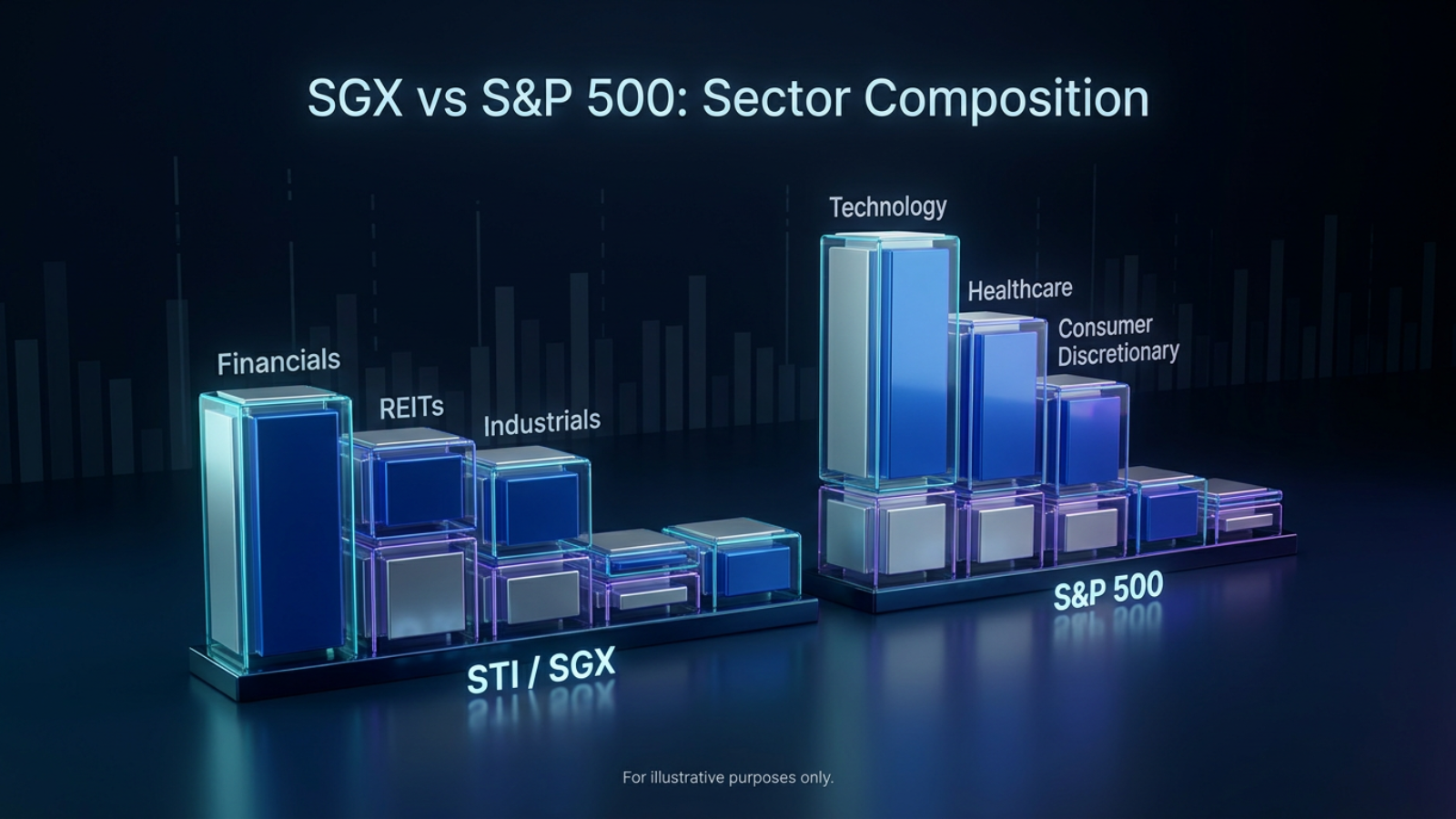
The US stock market is anchored by two of its largest exchanges, the New York Stock Exchange (NYSE) and Nasdaq, while also encompassing other exchanges and trading venues. For Singapore investors, whose local SGX market is relatively concentrated in financials, real estate investment trusts (REITs), and industrials, US equities can provide exposure to sectors that are less represented locally, including technology, semiconductors, biotechnology, software-as-a-service (SaaS), and consumer discretionary.
Companies such as Apple (AAPL), Microsoft (MSFT), NVIDIA (NVDA), and Alphabet (GOOGL) are not listed on the SGX. Gaining direct ownership in these businesses requires access to a US-linked brokerage account. This is a key reason why cross-border investing, which are Singapore residents investing in US, HK, and China A-share markets, has grown substantially in recent years.
1.2 Portfolio Diversification for Singapore Residents
Geographical diversification is a foundational principle of portfolio construction. Concentrating investments solely in Singapore means your portfolio is exposed to the economic cycle of a single, relatively small open economy. Adding US equities introduces exposure to different economic drivers, interest rate environments, and corporate earnings cycles.
Investors should note that diversification does not eliminate investment risk, and the value of investments may rise or fall. When holding USD-denominated assets, investors should also consider currency risk arising from fluctuations in the SGD/USD exchange rate.
1.3 SGX vs US Market: Key Differences for Singapore Investors
Feature | SGX (Singapore) | US Markets (NYSE/Nasdaq) |
|---|---|---|
Settlement | T+2 | T+1 (as of May 2024) |
Asset custody | CDP or custodian account | Custodian account only |
Trading hours (SGT) | 9:00 AM – 5:00 PM | 9:30 PM – 4:00 AM (ET) |
Currency | SGD | USD |
Capital gains tax (SG residents) | None (personal investments) | None (SG-side); US withholding on dividends applies |
Regulatory framework | MAS / SFA | SEC / FINRA (US-side) |
Overseas-listed investment products are subject to a different regulatory regime and legal system than SGX-listed products. Singapore investors should be aware of this distinction before trading US-listed securities.
Part 2: Understanding Brokerage Accounts for US Stocks in Singapore
2.1 CDP Account vs Custodian Account
Before opening a brokerage account, it is important to understand how your assets will be held.
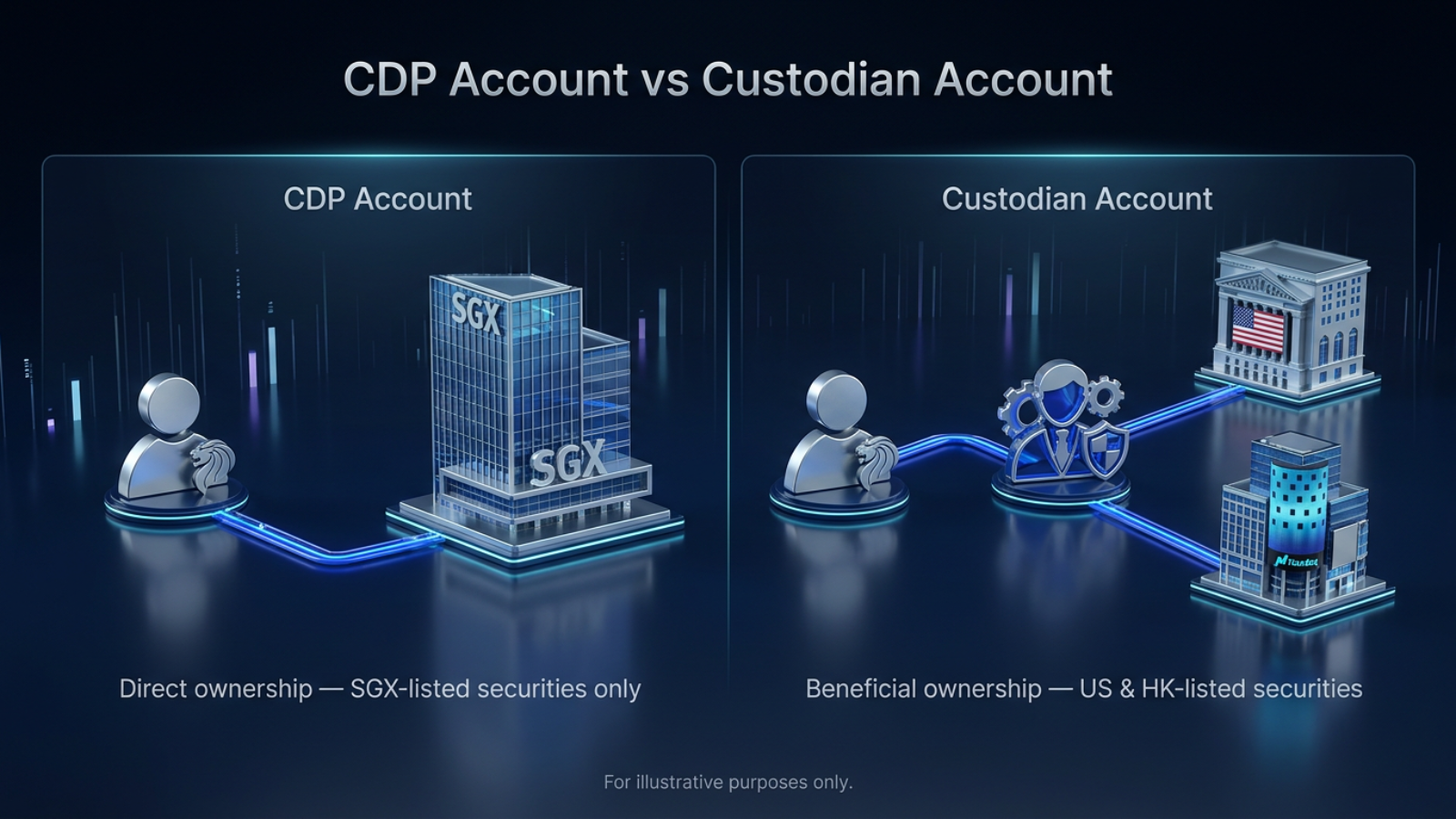
CDP Account (Central Depository Account): A direct securities account maintained by the Singapore Exchange's Central Depository (Pte) Limited. SGX-listed shares are registered directly in your name. The CDP account is used exclusively for SGX-listed securities.
Custodian Account: An account where your securities are held by the broker or a third-party custodian on your behalf. All US stocks purchased through Singapore-based online brokers are held in custodian accounts, not the CDP. Your beneficial ownership is recorded by the broker, and the securities are typically held in an omnibus account with a US clearing house.
When US shares are purchased through a Singapore-based broker, they are generally held through a custodian or nominee arrangement, as is common in international markets. Under Singapore’s Securities and Futures Act framework, MAS-regulated brokers are subject to requirements governing the segregation and safekeeping of client money and assets. These requirements are intended to keep client assets separate from the broker’s own property.
Singapore does not provide brokerage-account protection comparable in scope to the US Securities Investor Protection Corporation. Instead, client protection relies primarily on regulatory segregation requirements, custodial safeguards and certain limited statutory compensation arrangements.
2.2 What Is a CMS Licence?
A Capital Markets Services (CMS) Licence is issued by the Monetary Authority of Singapore under the Securities and Futures Act. It authorises a firm to conduct regulated activities such as dealing in capital markets products (including securities and futures). When selecting a broker to buy US stocks in Singapore, verifying that the firm holds a valid CMS Licence is a non-negotiable first step.
MAS maintains a public Financial Institutions Directory where you can verify any broker's licensing status.
MAS Financial Institutions Directory — https://eservices.mas.gov.sg/fid
Part 3: How to Buy US Stocks in Singapore — Step-by-Step Guide
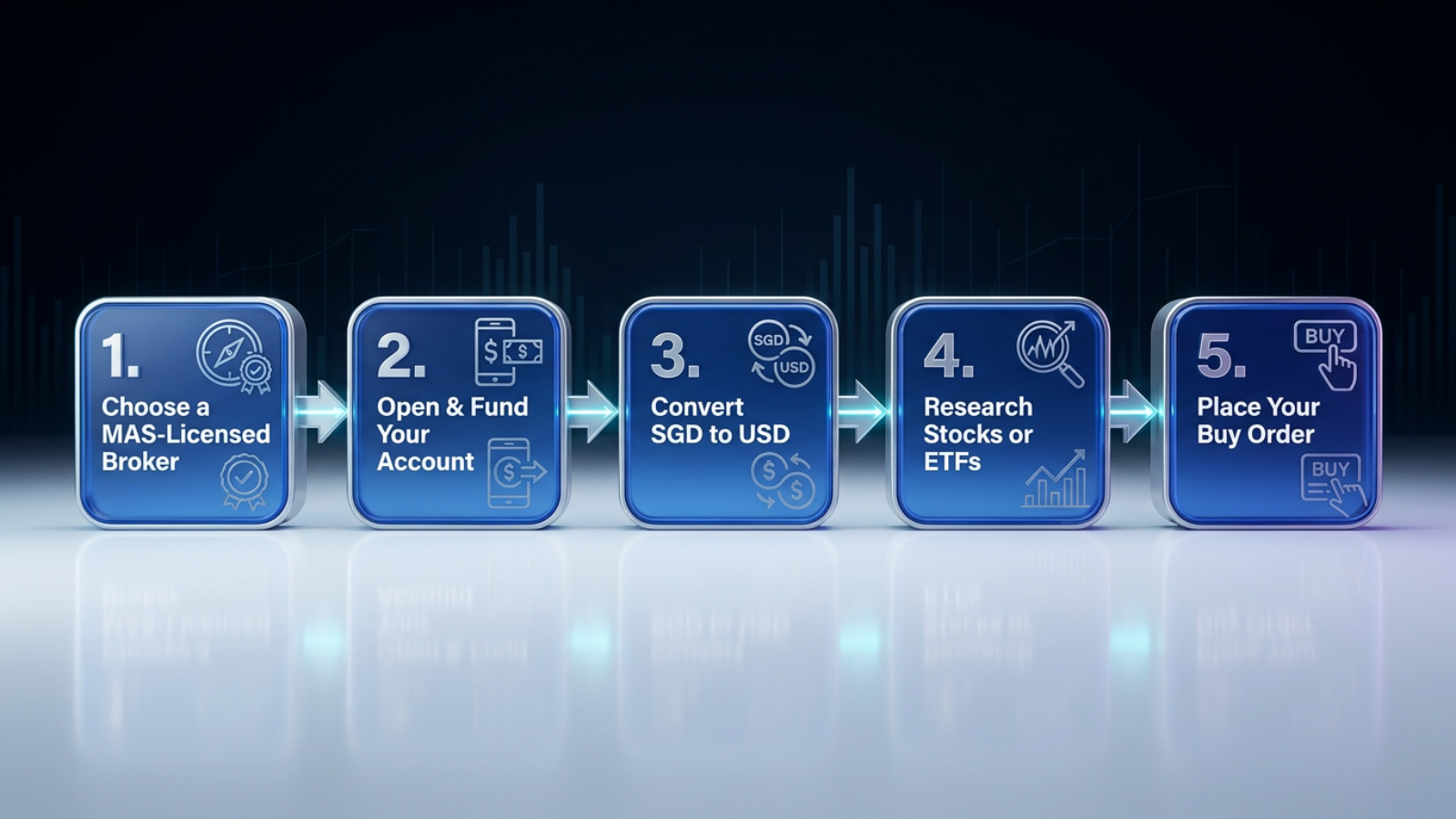
Step 1: Choose a MAS-Licensed Broker with US Market Access
Select a broker that holds a valid CMS Licence and provides direct access to US exchanges (NYSE and Nasdaq). Key factors to evaluate include commission structure, platform fees, currency conversion costs, available order types, research tools, and the quality of the mobile application.
Step 2: Open and Fund Your Account
Most Singapore-focused online brokers offer fully digital account opening. Many integrate with Myinfo via Singpass, which automates identity verification using your NRIC data. Webull Singapore currently supports user registration via Singpass. You will typically need to:
Complete a Know Your Customer (KYC) application
Submit proof of identity (NRIC or passport)
Complete a Customer Account Review (CAR) form as required under MAS regulations
Funding methods commonly available to Singapore residents include PayNow, FAST bank transfer, and direct debit arrangements (DDA). Funds are typically received in SGD. TT deposit for HKD & USD are also available
Step 3: Convert SGD to USD
US stocks are priced and settled in USD. You will need to convert your SGD to USD before placing a buy order. Be aware of the foreign exchange (FX) spread, which is the difference between the interbank rate and the rate offered by your broker. This is a real cost that affects your overall investment return. Some brokers offer multi-currency accounts that allow you to hold SGD, USD, HKD, and other currencies simultaneously.
Step 4: Research Your Target Stock or ETF
Before placing any order, conduct thorough research. Consider:
The company's financial statements, revenue growth, and valuation metrics
Sector and macroeconomic context
For ETFs: the underlying index, expense ratio, and liquidity
Your own risk tolerance and investment horizon
Step 5: Place Your Buy Order
Navigate to the stock or ETF on your broker's platform and select your order type:
Market Order: Executes immediately at the prevailing market price. Suitable for highly liquid stocks where price slippage is minimal.
Limit Order: Executes only at your specified price or better. Provides price control but does not guarantee execution.
Stop-Limit Order: Combines a stop trigger with a limit price, useful for managing downside risk on existing positions.
Part 4: Webull Singapore — Platform Overview for US Stock Investors
Webull Singapore is a MAS-regulated online brokerage that offers Singapore investors access to US and Hong Kong-listed securities. The platform is designed for both newer investors and those with more trading experience, offering a range of order types, analytical tools, and market data features.
Regulatory Status
Webull Singapore holds a Capital Markets Services (CMS) Licence from the Monetary Authority of Singapore, authorising it to deal in capital markets products. Client assets are held in segregated custodian accounts in accordance with MAS requirements under the SFA. Singapore does not have a government-backed investor compensation scheme equivalent to the US SIPC; asset protection is provided through MAS-mandated segregation requirements.
You can open a Webull Singapore account and explore available markets at www.webull.com.sg.
US Market Access and Trading Hours
Webull Singapore provides access to US-listed stocks and ETFs on the NYSE and Nasdaq. US regular trading hours run from 9:30 AM to 4:00 PM Eastern Time (ET). In Singapore Time (SGT), this corresponds approximately to 9:30 PM to 4:00 AM (during US winter/standard time) or 9:30 PM to 4:00 AM (adjusted during US summer/daylight saving time).
Webull also supports pre-market, after-hours trading and overnight trading for US stocks:
Session | US Eastern Time | Notes |
|---|---|---|
Pre-Market | 4:00 AM – 9:30 AM ET | Limit orders only; select "Include Extended Hours" |
Regular Trading | 9:30 AM – 4:00 PM ET | All order types available |
After-Hours | 4:00 PM – 8:00 PM ET | Limit orders only |
After-Hours (half-day market) | 1:00 PM – 5:00 PM ET | Applies on US half-day trading sessions |
To access extended hours trading on the Webull app, place a limit order and select "Include Extended Hours" under Trading Hours. Note that extended hours trading carries additional risks, including lower liquidity and wider bid-ask spreads.
Fractional Shares on Webull
Webull offers fractional share trading for selected US stocks and ETFs. This feature allows Singapore investors to purchase a position in a high-priced stock with as little as USD 1, making it possible to build a diversified portfolio without needing to commit to the full price of a single share.
What is a Fractional Share? A fractional share represents ownership of less than one whole share of a company. For example, if a stock is priced at USD 500 per share, a fractional share allows you to invest USD 50 and own 0.1 of a share. Your gains, losses, and any dividends are proportional to your fractional ownership.
How to trade fractional shares on Webull:
Tap on the stock and check for the green diamond logo indicator at the top right of the page, this confirms the stock supports fractional trading.
Tap "Trade."
Tap "Order Type."
For a market order: select "Order Type: MARKET" and choose to trade by share amount or USD value.
For a limit order: select "Order Type: LIMIT" and enter a fractional share quantity to up to five decimal places (minimum: 0.00001 shares or USD 1).
Review and confirm your order.
Important notes on Webull fractional shares:
Fractional shares are only available for selected US stocks and ETFs.
Fractional share trading is only available during US regular trading hours (9:30 AM – 4:00 PM ET). It is not available during pre-market or after-hours sessions.
Short selling is not supported for fractional share positions.
Fractional shares trading is only available on the Webull Mobile App.
Rates vary by service provider; please refer to the latest pricing on the official website: www.webull.com.sg.
Order Types Available
Webull Singapore supports a range of order types for US stocks, including market orders, limit orders, stop-limit orders, and extended-hours limit orders. This range of functionality is useful for investors who wish to manage entry and exit prices with greater precision.
Research and Analytical Tools
The Webull platform provides access to market data, charting tools, financial summaries, and news feeds to support investment research. These tools are designed to assist investors in conducting their own analysis; they do not constitute personalised investment advice or recommendations.
Suitability Considerations
Webull may be suitable for Singapore investors who:
Are looking for US and HK market access through a MAS-licensed platform
Wish to start with smaller investment amounts using fractional shares
Value extended trading hours access for US stocks
Prefer a mobile-first trading experience
Investors should assess whether any platform is appropriate for their individual financial circumstances, risk tolerance, and investment objectives before opening an account.
Learn more about Webull Singapore's features and account types at www.webull.com.sg.
Part 5: Fees, Tax, and Risk Considerations for Singapore Investors
5.1 Fee Structure Overview
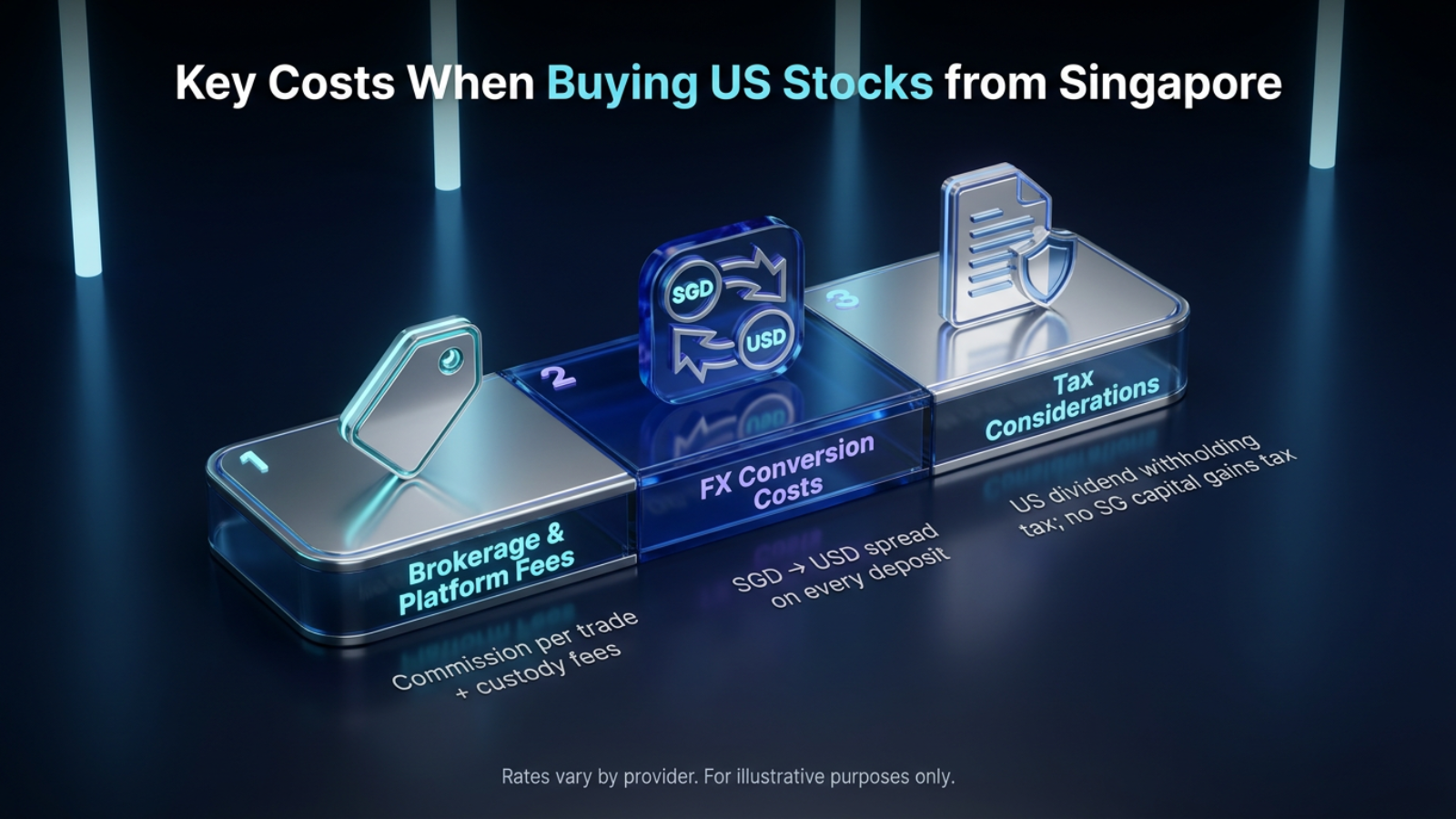
When buying US stocks from Singapore, the following cost categories apply:
Brokerage commission: The fee charged per trade. Some online brokers offer promotional or ongoing zero-commission structures for US stocks. However, investors should review the full fee schedule, as other charges may apply.
Platform and custody fees: Some brokers charge monthly or quarterly custody fees for holding US securities. Others do not. Verify the full fee schedule before opening an account.
Foreign exchange (FX) conversion costs: Converting SGD to USD incurs a spread. This is often the largest hidden cost for Singapore investors trading US stocks. A spread of even 0.5% on every deposit and withdrawal adds up meaningfully over time.
Regulatory and exchange fees: US trades may be subject to SEC transaction fees and FINRA Trading Activity Fees (TAF), which are typically small but should be factored into your cost calculation.
Rates vary by service provider; please refer to the latest pricing on the official website. For US stock commissions, fees are typically quoted in USD; for SGX stock commissions, fees are typically quoted in SGD.
The Bottom Line
Buying US stocks from Singapore is accessible through any MAS-licensed broker offering a custodian account with US market access. Webull Singapore provides a regulated platform with fractional shares, extended trading hours, and a range of order types suited to different investor needs. Compare fees carefully — including FX conversion costs — and ensure any investment aligns with your personal risk tolerance and financial goals. Past performance is not indicative of future results.
Explore Webull Singapore's account options at www.webull.com.sg
Disclosure
All investments involve risks and are not suitable for every investor. The information provided is generated with the assistance of artificial intelligence based on publicly available sources and is for informational purposes only.
The content provided above is for educational purposes only and does not constitute financial, investment, or professional advice. No content should be construed as investment advice or recommendation, or an offer or solicitation, to deal in any investment product. Investors may wish to seek advice from a financial adviser before investing. In the event that investors choose not to seek advice from a financial adviser, they should consider whether the investment is suitable for them. For more information, please refer to our website at https://www.webull.com.sg.
This advertisement has not been reviewed by the Monetary Authority of Singapore.
