' fill='white'%3e %3cg id='%e7%bc%96%e7%bb%84-7' transform='translate(0.000000%2c 86.000000)'%3e %3cg id='%e7%bc%96%e7%bb%84-2' transform='translate(80.533981%2c 22.000000)'%3e %3cpath d='M41.7832962%2c0 C41.9459106%2c0 42.0882746%2c0.0866854658 42.1666825%2c0.216359069 C43.8289923%2c2.66540836 44.7676281%2c5.46271319 44.7676281%2c8.43208061 C44.7676281%2c18.1345746 34.7460532%2c26 22.383814%2c26 C10.0215749%2c26 0%2c18.1345746 0%2c8.43208061 C0%2c5.46716016 0.935826425%2c2.67378733 2.58829888%2c0.223985685 C2.67109477%2c0.0916264068 2.81687473%2c0 2.9840593%2c0 C3.23130408%2c0 3.43173558%2c0.200393004 3.43173558%2c0.447590303 C3.43173558%2c0.475056669 3.42926112%2c0.501945205 3.42452292%2c0.528045226 L3.41810883%2c0.550292077 C3.37800671%2c0.861741908 3.3575721%2c1.17661276 3.3575721%2c1.49443092 C3.3575721%2c7.98336 11.2132389%2c12.5742305 22.383814%2c12.5742305 C33.5543891%2c12.5742305 41.410056%2c7.98336 41.410056%2c1.49443092 C41.410056%2c1.17865223 41.3898828%2c0.865783153 41.3502888%2c0.556288325 C41.3402868%2c0.521941442 41.3356199%2c0.48531078 41.3356199%2c0.447590303 C41.3356199%2c0.200393004 41.5360514%2c0 41.7832962%2c0 Z' id='logo%e5%a4%87%e4%bb%bd-6'%3e%3c/path%3e %3cpath d='M75.1559425%2c3.74404927 C75.7071421%2c3.74404927 76.2394493%2c3.66184338 76.7416414%2c3.50883715 L74.281987%2c20.8666902 C74.0430787%2c22.5662954 73.2732628%2c23.0518969 71.8929033%2c23.0518969 L70.459453%2c23.0518969 C69.2649111%2c23.0518969 68.6278221%2c22.458384 68.2561868%2c20.893668 L66.1591022%2c11.9909739 C66.1060114%2c11.7481731 66.1060114%2c11.6942174 65.9998299%2c11.6942174 C65.8936484%2c11.6942174 65.867103%2c11.7481731 65.8140123%2c11.9909739 L63.7169276%2c20.893668 C63.3452924%2c22.458384 62.7082033%2c23.0518969 61.5136614%2c23.0518969 L60.0802112%2c23.0518969 C58.6998516%2c23.0518969 57.9300358%2c22.5662954 57.6911274%2c20.8666902 L55.2123917%2c3.37406084 C55.8253692%2c3.61307396 56.491017%2c3.74404927 57.1867652%2c3.74404927 C57.7974457%2c3.74404927 58.3849364%2c3.64314414 58.9339751%2c3.4568446 L60.8234817%2c19.3829078 C60.8500271%2c19.6257086 60.8500271%2c19.7875757 60.9562086%2c19.7875757 C61.0623901%2c19.7875757 61.0623901%2c19.6257086 61.1154808%2c19.3829078 L63.3983831%2c9.91367858 C63.5576554%2c9.26620991 63.9292906%2c8.69967483 65.0707418%2c8.69967483 L66.9023727%2c8.69967483 C68.0438238%2c8.69967483 68.4154591%2c9.26620991 68.5747313%2c9.91367858 L70.8576336%2c19.3829078 C70.9107244%2c19.6257086 70.9107244%2c19.7875757 71.0169059%2c19.7875757 C71.1230874%2c19.7875757 71.1230874%2c19.6257086 71.1496327%2c19.3829078 L73.0551401%2c3.32292288 C73.7026096%2c3.59432921 74.4120718%2c3.74404927 75.1559425%2c3.74404927 Z' id='Combined-Shape'%3e%3c/path%3e %3cpath d='M85.0594095%2c7.43171536 C89.1473973%2c7.43171536 91.3772089%2c10.2643908 91.3772089%2c14.2840921 L91.3772089%2c15.7948523 C91.3772089%2c16.2264981 91.2179366%2c16.4692988 90.8463013%2c16.4692988 L82.1925089%2c16.4692988 L82.1925089%2c16.5502324 C82.1925089%2c18.1149484 82.829598%2c19.9764208 85.377954%2c19.9764208 C87.3157664%2c19.9764208 89.1473973%2c19.8145536 90.2623031%2c19.7066422 L90.3419392%2c19.7066422 C90.607393%2c19.7066422 90.819756%2c19.8415315 90.819756%2c20.1113101 L90.819756%2c21.8918489 C90.819756%2c22.3234947 90.7401198%2c22.5123397 90.2623031%2c22.5932733 C88.5368537%2c22.9170076 87.501584%2c23.0518969 85.1125002%2c23.0518969 C82.4579627%2c23.0518969 78.6885194%2c21.5950924 78.6885194%2c16.2804538 L78.6885194%2c14.2840921 C78.6885194%2c10.0755457 80.997967%2c7.43171536 85.0594095%2c7.43171536 Z M85.0594095%2c10.5071915 C83.4135962%2c10.5071915 82.2190543%2c11.6942174 82.2190543%2c13.8254684 L82.2190543%2c13.9333799 L87.8466739%2c13.9333799 L87.8466739%2c13.8254684 C87.8466739%2c11.7211953 86.7052228%2c10.5071915 85.0594095%2c10.5071915 Z' id='Combined-Shape'%3e%3c/path%3e %3cpath d='M97.88151%2c2.98826245 L97.8808258%2c7.62056039 C98.8630047%2c7.48567108 99.7920929%2c7.43171536 100.429182%2c7.43171536 C104.702987%2c7.43171536 106.773527%2c9.99461216 106.773527%2c14.2031585 L106.773527%2c16.2804538 C106.773527%2c20.4890001 104.702987%2c23.0518969 100.429182%2c23.0518969 C98.7302779%2c23.0518969 96.7393747%2c22.7821183 95.0935614%2c22.3504725 C94.4830178%2c22.1886054 94.3768363%2c22.0267382 94.3768363%2c21.6220703 L94.3758373%2c3.08694115 C94.884566%2c3.24434375 95.4244809%2c3.32900525 95.9838525%2c3.32900525 C96.6506785%2c3.32900525 97.2898545%2c3.20869291 97.88151%2c2.98826245 Z M100.429182%2c10.3453244 C99.7920929%2c10.3453244 98.6240964%2c10.4262579 97.8808258%2c10.5341694 L97.8808258%2c19.9494429 C98.385188%2c20.0573544 99.4735484%2c20.1382879 100.429182%2c20.1382879 C102.712084%2c20.1382879 103.269537%2c18.4926384 103.269537%2c16.2804538 L103.269537%2c14.2031585 C103.269537%2c11.9909739 102.712084%2c10.3453244 100.429182%2c10.3453244 Z' id='Combined-Shape'%3e%3c/path%3e %3cpath d='M111.502687%2c8.72457747 C112.045508%2c8.72457747 112.570006%2c8.64485191 113.065463%2c8.49629404 L113.064781%2c16.5232546 C113.064781%2c19.3289521 114.073505%2c19.9764208 115.613137%2c19.9764208 L115.772409%2c19.9764208 C117.312041%2c19.9764208 118.320765%2c19.3289521 118.320765%2c16.5232546 L118.320226%2c8.4334735 C118.872544%2c8.62226395 119.463958%2c8.72457747 120.078886%2c8.72457747 C120.689352%2c8.72457747 121.276644%2c8.62374317 121.825517%2c8.43756894 L121.824755%2c16.5232546 C121.824755%2c22.4044283 117.338586%2c23.0518969 115.772409%2c23.0518969 L115.526483%2c23.0512514 C113.88817%2c23.0271041 109.560791%2c22.2994073 109.560791%2c16.5232546 L109.560465%2c8.36700801 C110.164542%2c8.59813531 110.819085%2c8.72457747 111.502687%2c8.72457747 Z' id='Combined-Shape'%3e%3c/path%3e %3cpath d='M128.780182%2c3.03790128 L128.779643%2c22.269539 C128.779643%2c22.5662954 128.56728%2c22.836074 128.275281%2c22.836074 L125.806561%2c22.836074 C125.514562%2c22.836074 125.275653%2c22.5662954 125.275653%2c22.269539 L125.275475%2c3.04219481 C125.82418%2c3.22824247 126.411273%2c3.32900525 127.021522%2c3.32900525 C127.63645%2c3.32900525 128.227864%2c3.22669173 128.780182%2c3.03790128 Z' id='Combined-Shape'%3e%3c/path%3e %3cpath d='M134.372549%2c3.32900525 C134.939348%2c3.32900525 135.48617%2c3.24208064 136.000812%2c3.08063296 L135.999985%2c22.269539 C135.999985%2c22.5662954 135.787622%2c22.836074 135.495623%2c22.836074 L133.026903%2c22.836074 C132.734904%2c22.836074 132.495995%2c22.5662954 132.495995%2c22.269539 L132.495929%2c2.99605058 C133.081688%2c3.21152525 133.713619%2c3.32900525 134.372549%2c3.32900525 Z' id='Combined-Shape'%3e%3c/path%3e %3c/g%3e %3c/g%3e %3c/g%3e %3c/g%3e%3c/svg%3e)



Options trading allows investors in Singapore to explore a range of strategies beyond traditional stock ownership. Before committing capital, investors should understand the fundamentals, including how options work, account requirements and the importance of choosing a MAS-regulated platform. This guide explains the key considerations for Singapore investors, including how to access US options markets through a locally licensed brokerage account.
Key Takeaways
Options are derivatives that give the holder the right, but not the obligation, to buy or sell an underlying asset at a predetermined price before expiration.
Singapore investors can access US equity options through MAS-regulated brokers holding a Capital Markets Services (CMS) Licence.
Webull Singapore offers options trading across four strategy levels, from covered calls to advanced naked strategies, subject to account type and eligibility.
Options trading carries significant risk, including the potential for total loss of the premium paid. It is not suitable for all investors.
Client assets held with MAS-licensed brokers are protected through mandatory segregation requirements under the Securities and Futures Act (SFA) — not through a government-backed compensation scheme.
Part 1: What Is Options Trading and How Does It Work for Singapore Investors?
1.1 Defining Options: Calls, Puts, and Key Contract Terms
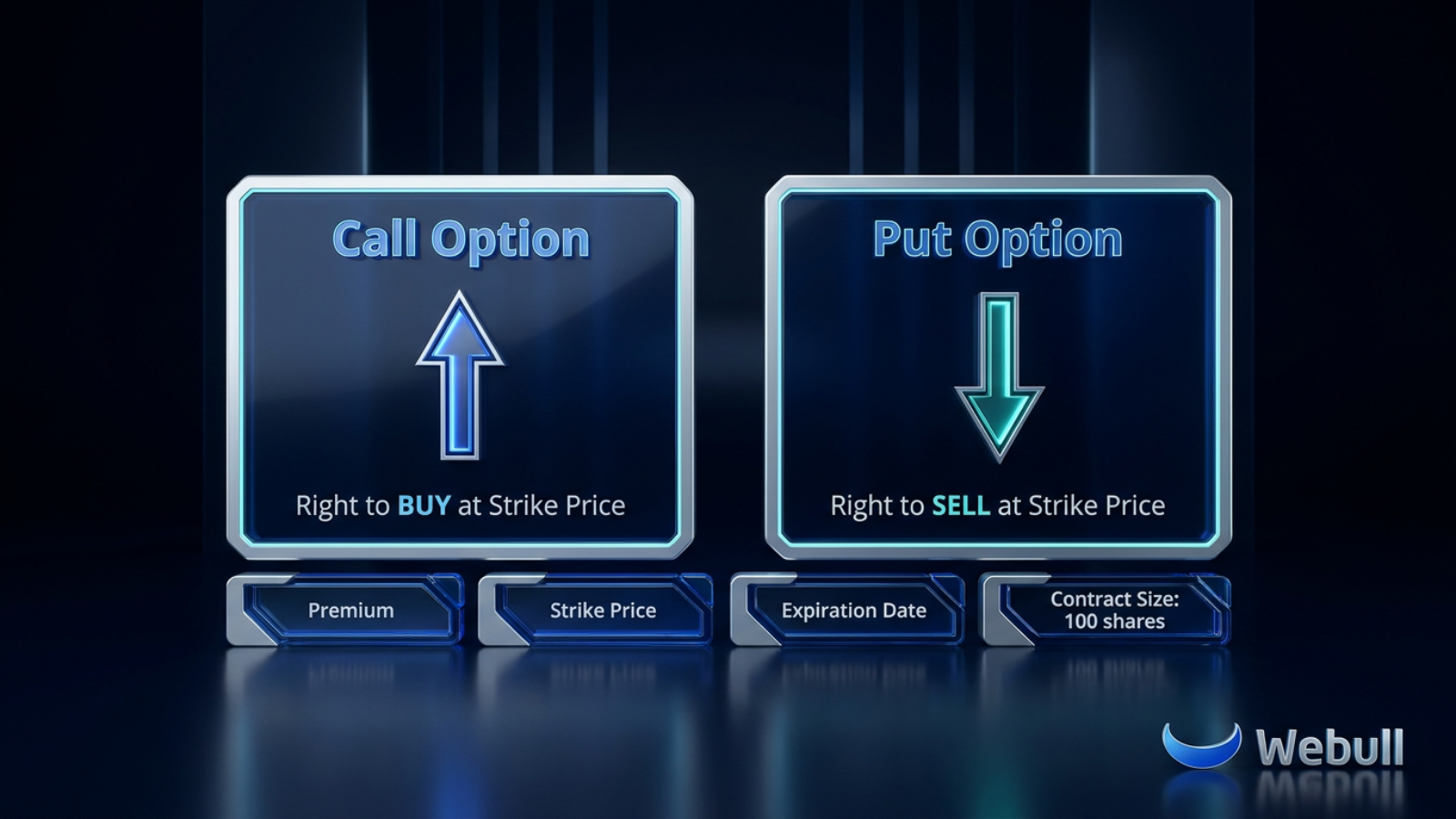
An option is a financial contract that grants the buyer the right, but not the obligation, to buy or sell an underlying asset at a predetermined price (the strike price) before or on a specified expiration date. The buyer pays an upfront cost known as the premium, which represents the maximum potential loss for the option buyer.
There are two fundamental types:
Call option: Gives the holder the right to purchase the underlying asset at the strike price. Generally used when an investor expects the asset's price to rise.
Put option: Gives the holder the right to sell the underlying asset at the strike price. Generally used when an investor expects the asset's price to fall or wishes to hedge an existing position.
In the US equity options market, a standard contract typically represents 100 shares of the underlying stock. Option premiums are quoted on a per-share basis, so a call option quoted at USD 2 would cost USD 200 per contract, excluding fees and commissions.
Key components of every options contract:
Term | Definition |
|---|---|
Strike Price | The agreed price at which the underlying asset can be bought (call) or sold (put) |
Premium | The upfront cost paid by the option buyer to the seller |
Expiration Date | The date by which the option must be exercised or it expires worthless |
Contract Size | Typically 100 shares per contract for US equity options |
Intrinsic Value | The in-the-money portion of an option's value |
Time Value | The portion of premium reflecting time remaining until expiration |
1.2 How Options Differ from Stocks and Other Instruments
Unlike buying shares outright, options can provide capital-efficient exposure to an underlying asset. Investors may participate in price movements while committing less upfront capital than would typically be required to purchase the shares directly. This leverage can enhance percentage returns when the market moves as anticipated, but it also increases risk.
For an option buyer, the maximum loss is generally limited to the premium paid. If the option expires out of the money, it becomes worthless and the premium is lost in full. Option sellers face a different risk profile and, depending on the strategy used, may incur losses exceeding the premium received.
Unlike futures contracts, an option buyer has the right, but not the obligation, to complete the transaction. This flexibility allows options to be used for a range of purposes, including gaining market exposure, generating income and managing portfolio risk through hedging.
Important risk disclosure: Options trading involves significant risk and is not suitable for all investors. Option buyers may lose the entire premium paid within a short period, while option sellers may face substantially greater losses depending on the strategy. Investors should fully understand the potential gains, maximum losses, breakeven points and expiration risks before trading.
1.3 Why Singapore Investors Use Options
Singapore investors may consider options for several purposes:
Portfolio hedging: Purchasing put options on existing equity holdings to limit downside exposure during periods of uncertainty.
Income generation: Writing covered calls against long stock positions to collect premiums in neutral or moderately bullish markets.
Directional exposure: Gaining leveraged exposure to anticipated price movements without committing the full capital required to purchase shares outright.
Volatility strategies: Using strategies such as straddles or iron condors to potentially benefit from significant price movements or range-bound conditions.
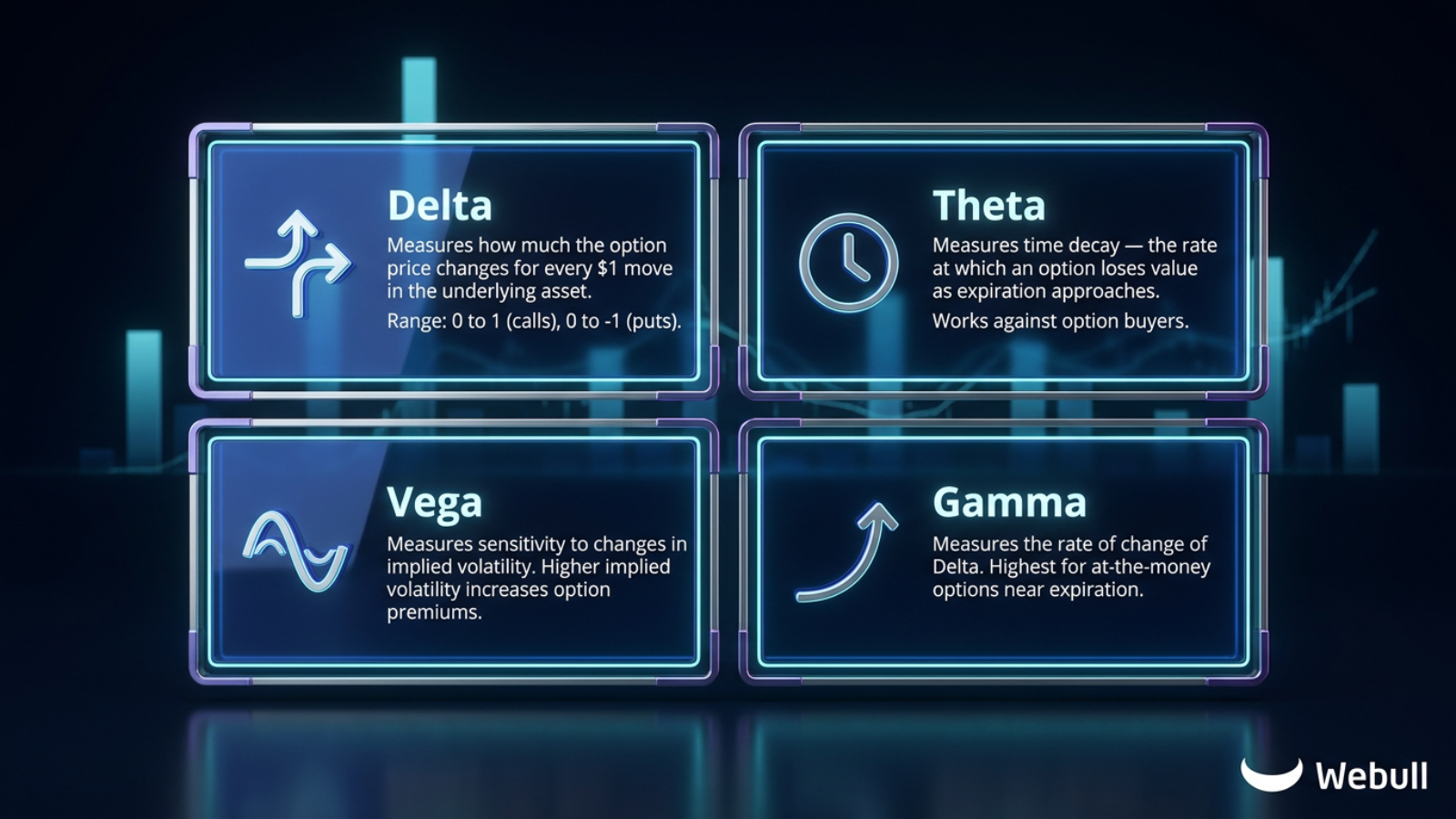
It is important to note that options trading involves complex decision-making and requires a solid understanding of pricing factors including implied volatility, time decay (theta), and the Greeks (delta, gamma, vega). Investors should ensure they fully understand a strategy's mechanics and risk profile before executing any trade. Past performance is not indicative of future results.
Part 2: Regulatory Framework for Options Trading in Singapore
2.1 MAS Licensing and the CMS Licence
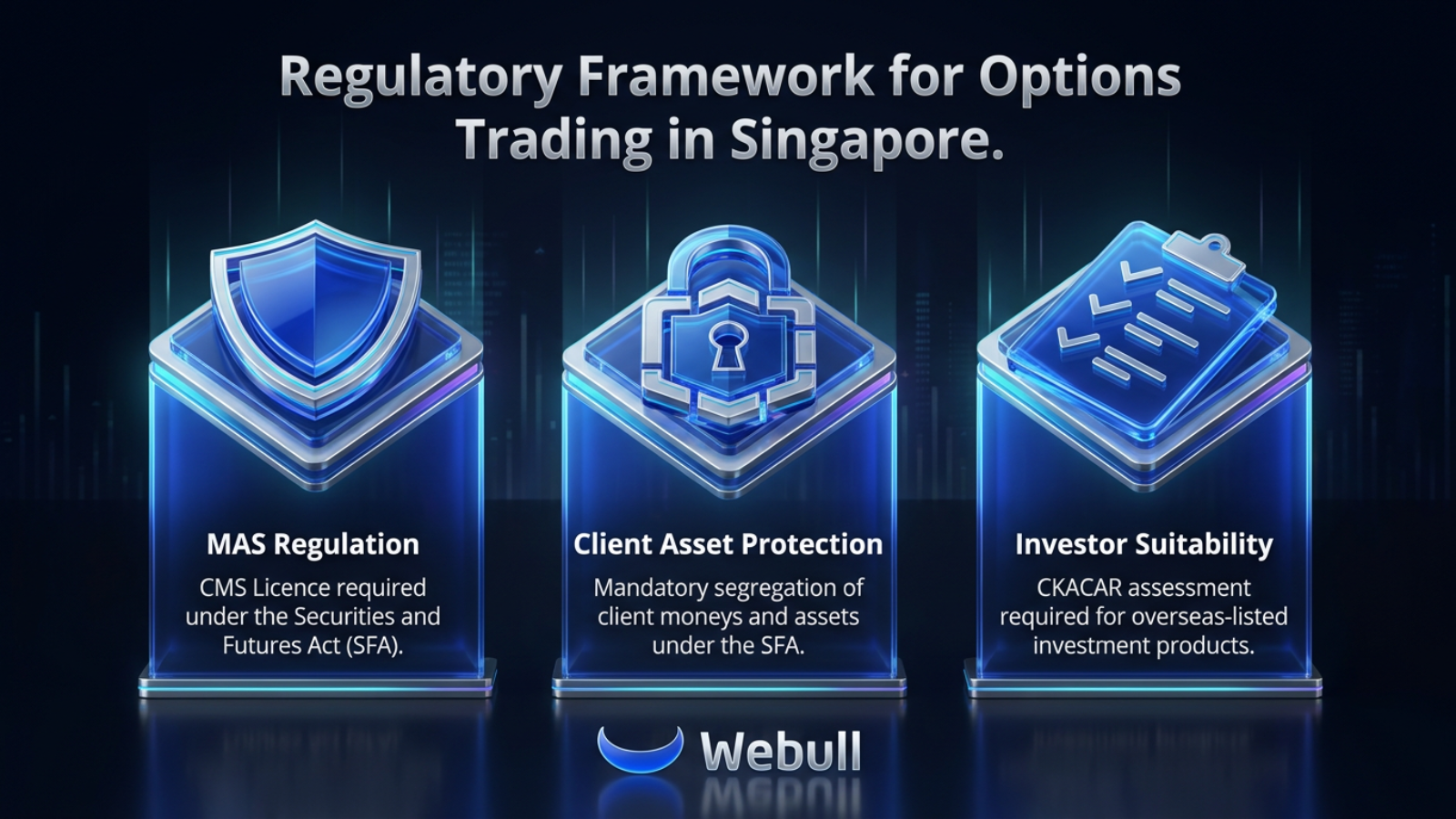
In Singapore, any entity that deals in or advises on capital markets products including options, must hold a Capital Markets Services (CMS) Licence issued by the Monetary Authority of Singapore (MAS) under the Securities and Futures Act (SFA). Investors should verify that their chosen broker holds a valid CMS Licence before opening an account.
MAS licensing status can be verified directly on the MAS Financial Institutions Directory.
Important: MAS licensing does not constitute an endorsement of any broker's products, services, or investment outcomes. It confirms that the licensee meets MAS's regulatory requirements, including capital adequacy, conduct standards, and operational safeguards.
2.2 Client Asset Protection Under the SFA
Singapore does not operate an investor compensation scheme equivalent to the US Securities Investor Protection Corporation (SIPC). Client asset protection in Singapore is achieved through MAS-mandated segregation of client moneys and assets under the Securities and Futures Act (SFA) and through custodial or CDP safekeeping arrangements.
Under these requirements, MAS-licensed brokers must:
Keep client funds in segregated trust accounts, separate from the firm's own assets.
Maintain proper custody records for client securities.
Comply with MAS Notices governing the handling of client assets.
Investors should not interpret MAS licensing as a guarantee that their assets are protected against all losses, including market losses or broker insolvency beyond the scope of segregation requirements.
2.3 Suitability Requirements: CKACAR and Risk Warning Statements
Before trading overseas-listed investment products, including US equity options, Singapore investors are required to complete a Customer Knowledge Assessment (CKA) or Customer Account Review (CAR) to demonstrate adequate knowledge or experience.
Additionally, investors must acknowledge a Risk Warning Statement (RWS) confirming they understand that overseas-listed products are subject to a different regulatory regime and legal system than SGX-listed products, and that these differences may affect the level of investor protection available.
Investors who do not meet the knowledge or experience criteria may still be permitted to trade, subject to additional safeguards imposed by the broker.
Part 3: Options Trading Strategies — From Beginner to Advanced
3.1 Beginner Strategies: Building a Foundation
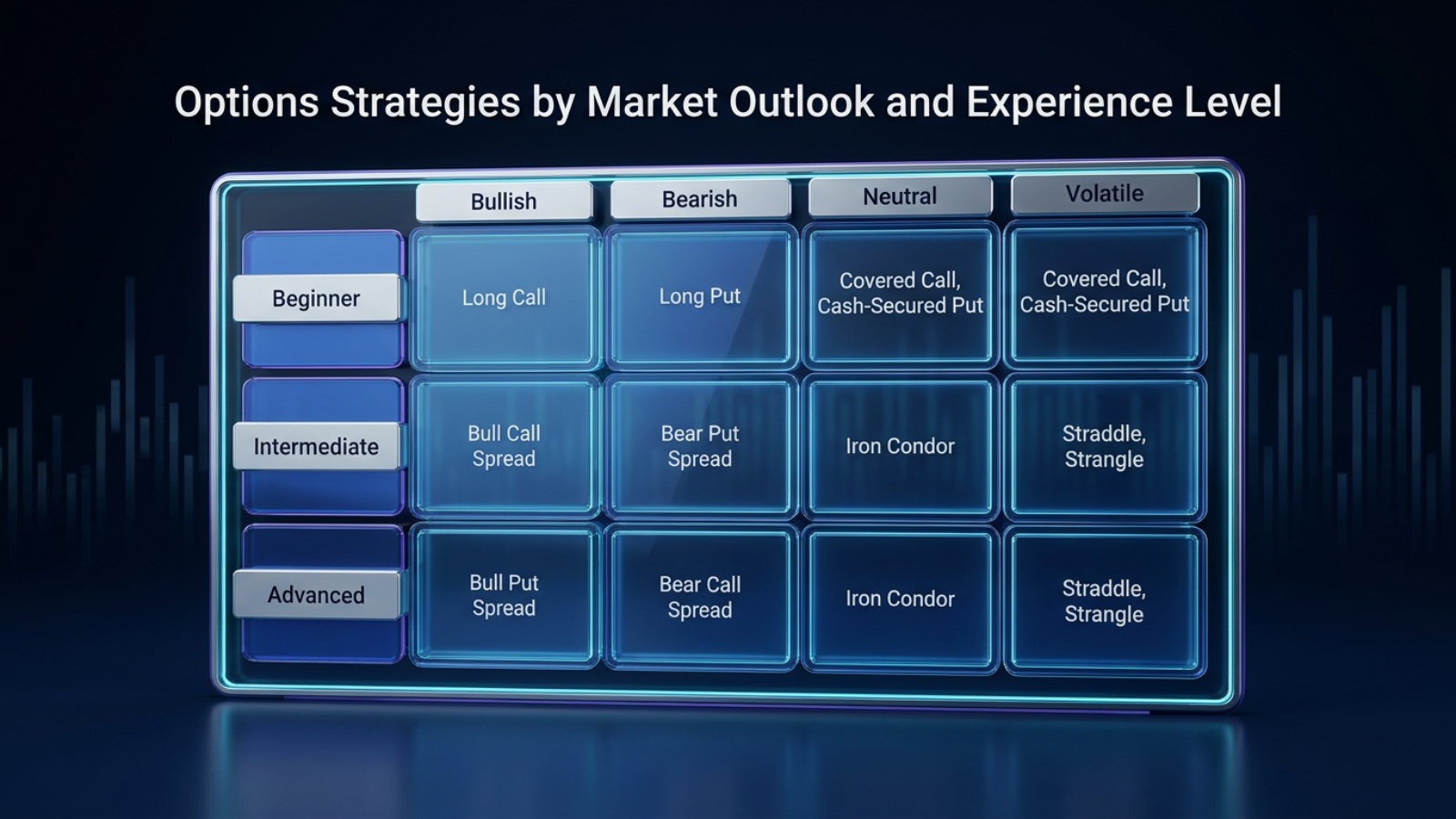
Long Call
A long call involves purchasing a call option when you expect the underlying stock's price to rise. The maximum loss is limited to the premium paid, while the potential gain is theoretically unlimited if the stock rises significantly. However, time decay works against the buyer. If the stock does not move sufficiently before expiration, the option may expire worthless.
Breakeven point = Strike Price + Premium Per Share
Long Put
A long put involves purchasing a put option when you expect the underlying stock's price to fall, or to hedge an existing long position. The maximum loss is the premium paid; the maximum potential gain is substantial (limited only by the stock falling to zero).
Breakeven point = Strike Price − Premium Per Share
Covered Call
A covered call involves holding a long stock position while simultaneously selling (writing) a call option against those shares. This strategy generates premium income in neutral to moderately bullish markets. However, it caps the upside potential of the stock position if the price rises above the strike price. This is a Level 1 strategy on Webull Singapore.
Cash-Secured Put
Selling a cash-secured put involves writing a put option while holding sufficient cash to purchase the underlying shares if assigned. This strategy may be used to acquire shares at a desired lower price while collecting a premium. It is suitable for neutral to moderately bullish outlooks.
3.2 Intermediate Strategies: Defined Risk and Reward
Bull Call Spread
A bull call spread involves buying a call option at a lower strike price and simultaneously selling a call option at a higher strike price on the same underlying asset and expiration date. The premium received from the sold call partially offsets the cost of the purchased call, creating a defined-risk, defined-reward profile for moderately bullish outlooks.
Bear Put Spread
The bearish equivalent of the bull call spread. An investor buys a put at a higher strike price and sells a put at a lower strike price. Both maximum profit and maximum loss are defined at the outset.
Collars and Protective Puts
A protective put involves buying a put option against an existing long stock position to limit downside risk, functioning similarly to insurance. A collar combines a protective put with a covered call, capping both downside and upside within a defined range.
3.3 Advanced Strategies: Multi-Leg and Volatility Plays
Iron Condor
An iron condor combines a bull put spread and a bear call spread, selling out-of-the-money puts and calls while buying further out-of-the-money options for protection. Maximum profit is achieved when the underlying asset remains within a specific price range at expiration. This strategy is suited to low-volatility, range-bound markets.
Straddle and Strangle
A long straddle involves simultaneously buying a call and a put at the same strike price and expiration, profiting from significant price movement in either direction. A strangle uses out-of-the-money options, reducing the upfront cost but requiring a larger price move to be profitable. Both strategies are suited to anticipated high-volatility events such as earnings announcements.
Spreads: Butterflies, Condors, and Ratio Spreads
More advanced multi-leg strategiesm including long and short butterflies, iron butterflies, back ratio spreads, and front ratio spreads, allow experienced traders to construct positions with highly specific risk/reward profiles. These strategies require a thorough understanding of options pricing, margin requirements, and execution mechanics before use.
Risk reminder: Advanced multi-leg strategies involve complex interactions between multiple positions. Losses can accumulate rapidly if market conditions move contrary to expectations. Never execute a strategy you do not fully understand.
Part 4: How to Start Options Trading in Singapore with Webull
4.1 Webull Singapore: Platform Overview
Webull Singapore is a MAS-regulated broker offering access to US equity options through its mobile and desktop trading platforms. Webull Singapore provides options trading across four strategy levels, with access determined by account type, suitability assessment outcomes, and account balance requirements.
Webull's options offering stands out for its breadth of supported strategies, spanning from straightforward covered calls and long calls at Level 1 and Level 2, through to advanced naked equity and index strategies at Level 4. This tiered structure allows investors to progress as their knowledge and experience develop.
Webull Singapore options trading levels:
Level | Strategies Available |
|---|---|
Level 1 | Covered Calls, Cash-Secured Puts |
Level 2 | Long Calls, Long Puts, Collars, Protective Puts, Protective Calls, Covered Puts, Long Straddles, Long Strangles |
Level 3 | Credit Spreads, Debit Spreads, Long & Short Butterflies, Long & Short Iron Butterflies, Long & Short Condors, Long & Short Iron Condors, Back Ratio Call Spread, Back Ratio Put Spread |
Level 4 | Naked Equity Call/Put, Naked Index Call/Put, Front Call/Put Ratio Spread |
Note: Cash accounts on Webull Singapore are only permitted to trade Long Call and Long Put strategies. All other strategies require a margin account with US options trading permission enabled.
4.2 Account Requirements and Eligibility
To trade options on Webull Singapore, investors must:
Hold an eligible Webull Singapore brokerage account (individual or joint).
Complete the Customer Knowledge Assessment (CKA) or Customer Account Review (CAR) .
Submit an options trading application through the Webull platform and receive approval.
For spread strategies (Level 3 and above): hold a margin account with US options trading permission enabled and maintain a minimum account balance of USD 2,000.
Acknowledge the relevant risk disclosures, including the Characteristics and Risks of Standardised Options.
Level 4 strategies, including naked equity and index options, are only supported for stocks in the S&P 500, indices, and certain index ETFs.
Rates vary by service provider; please refer to the latest pricing on the official website. US options commissions are typically quoted in USD. For the most current fee schedule, visit https://www.webull.com.sg.
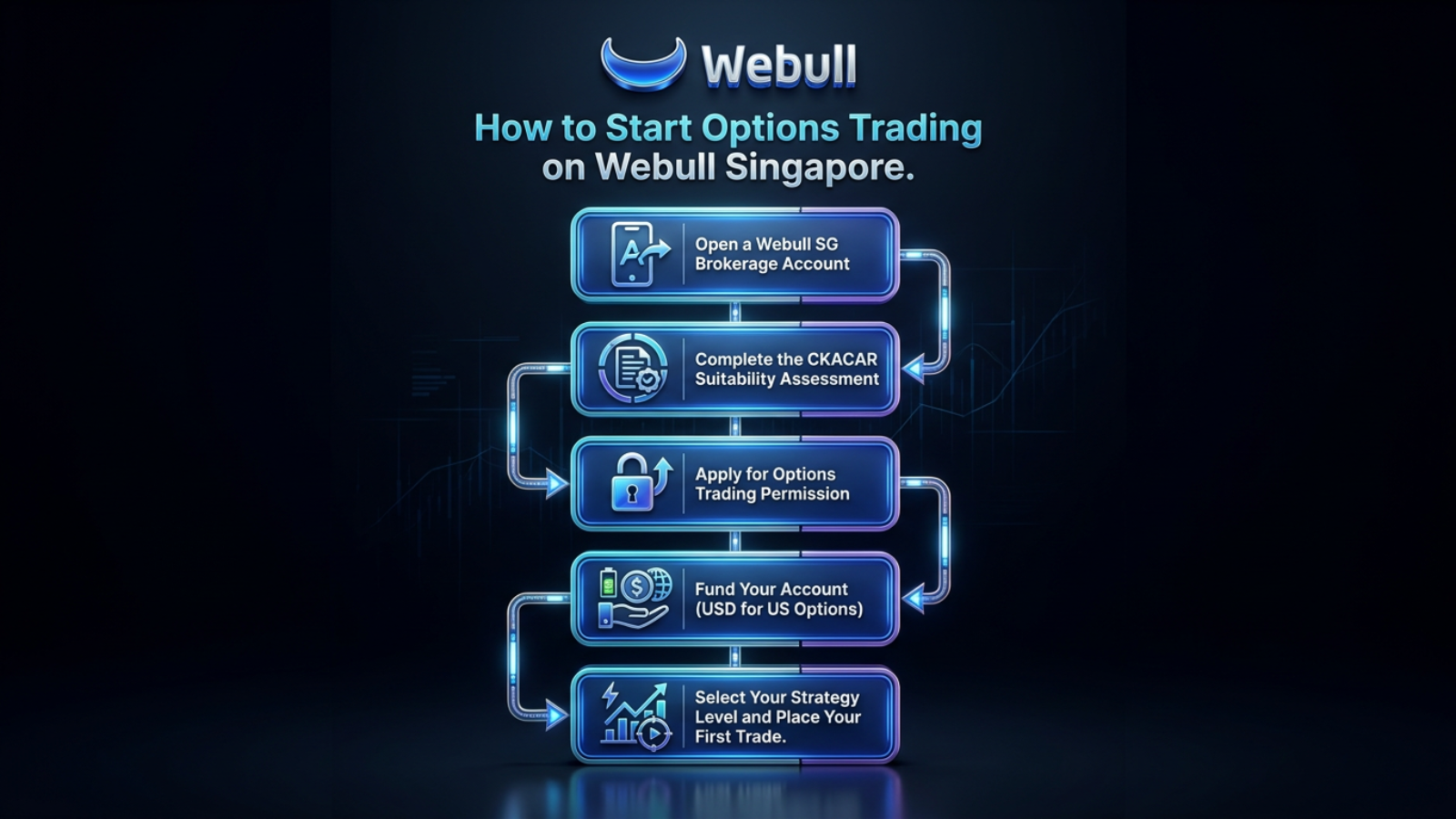
4.3 Step-by-Step: Opening an Options Account on Webull Singapore
Step 1 — Open a Webull Singapore brokerage account
Download the Webull app or visit webull.com.sg and complete the account opening process, including identity verification (MyInfo/SingPass or manual submission).
Step 2 — Complete the CKACAR suitability assessment
Answer the knowledge and experience questions required under MAS regulations. This step is mandatory before trading overseas-listed investment products, including US options.
Step 3 — Apply for options trading permission
Navigate to the options section within the Webull app and submit your options trading application. Approval is subject to Webull's internal assessment criteria.
Step 4 — Fund your account
Deposit funds via bank transfer. US options are denominated in USD; ensure your account holds sufficient USD balance or that your account supports currency conversion. Note that foreign exchange conversion charges may apply. Rates vary by service provider; please refer to the latest pricing on the official website.
Step 5 — Select your strategy and place your trade
Once approved, navigate to the options chain for your chosen underlying asset, select your strategy, review the premium, strike price, and expiration date, and submit your order.
4.4 Expiration, Exercise, and Key Obligations
Webull Singapore clients should be aware of the following obligations when holding options positions:
In-the-money options will be automatically exercised after market close on the expiration date unless a Do Not Exercise (DNE) request has been submitted via the Webull mobile app. The cut-off time for DNE instructions is the close of trading on the expiration date.
Early exercise requests must be submitted at least one business day prior to the expiration date, no later than 30 minutes after market close. Requests submitted after this time will be processed on a best-effort basis.
Clients are expected to close near-the-money, at-the-money, or in-the-money positions prior to the close on expiration date if they do not intend to exercise them or do not have sufficient equity to support exercise. Open positions may be liquidated by Webull if there is insufficient overnight buying power to support exercise.
For Long Puts in a cash account, options may not be exercised unless there are underlying long shares to offset the entire exercise.
Calendar spreads and diagonal spreads are not available for VIX on the Webull platform.
Webull Singapore — https://www.webull.com.sg
Part 5: Risk Management and Tax Considerations for Singapore Options Traders
5.1 Core Risk Management Principles
Options trading requires disciplined risk management. The following principles are widely recognised as foundational:
Position sizing: Allocate a defined percentage of your portfolio to options positions rather than concentrating capital in a single trade. Options can expire worthless, resulting in a total loss of the premium invested.
Understand time decay (theta): Options lose value as expiration approaches, with decay accelerating in the final weeks. Being correct about direction is not sufficient, timing matters.
Monitor implied volatility: Elevated implied volatility increases option premiums. Buying options when implied volatility is high means paying more for the same exposure. Conversely, selling options when implied volatility is low may reduce the income generated.
Define your exit before entry: Establish profit targets and maximum loss thresholds before placing any trade. Avoid holding losing positions in the hope of recovery, particularly as expiration approaches.
Avoid overleveraging: The leverage inherent in options amplifies both gains and losses relative to the capital deployed. Resist the temptation to over-allocate to leveraged positions.
Never trade strategies you do not understand: Multi-leg strategies such as iron condors, butterflies, and ratio spreads involve complex interactions. Ensure you understand the full risk/reward profile, including maximum loss scenarios, before executing.
For further guidance on risk management frameworks, investors may refer to educational resources available on Webull Singapore's platform.
5.2 Tax Treatment of Options in Singapore
Singapore does not impose capital gains tax. Gains from the sale or exercise of options held as personal investments are generally not taxable for individual investors in Singapore. However, if options trading is conducted as a business or trade, profits may be subject to income tax.
Important: This content does not constitute tax advice. Individual tax outcomes depend on personal circumstances, including the frequency of trading, the nature of the activity, and other factors assessed by IRAS. Investors should refer to IRAS guidance or consult a licensed tax professional for their specific situation.
5.3 Overseas-Listed Products: Regulatory Considerations
US equity options are overseas-listed investment products. Singapore investors trading these instruments should be aware that:
US options markets are regulated by the US Securities and Exchange Commission (SEC) and the Financial Industry Regulatory Authority (FINRA), not MAS.
The regulatory protections applicable to US-listed products differ from those applicable to SGX-listed products.
Currency risk applies: US options are denominated in USD, and fluctuations in the SGD/USD exchange rate may affect the SGD value of positions and returns.
Third-party regulatory and transaction charges apply when trading US options, including Options Regulatory Fees, OCC Clearing Fees, SEC Fees, and Trading Activity Fees (charged on sell orders). These are in addition to any platform or commission fees charged by your broker.
Rates vary by service provider; please refer to the latest pricing on the official website.
The Bottom Line
Options trading in Singapore offers investors a versatile set of tools — from income-generating covered calls to multi-leg volatility strategies — accessible through MAS-regulated platforms such as Webull Singapore. However, options carry significant risk, including total loss of premium, and are not suitable for all investors. Ensure you understand your chosen strategy fully, complete the required suitability assessments, and seek professional advice where appropriate before trading.
Disclosure
All investments involve risks and are not suitable for every investor. The information provided is generated with the assistance of artificial intelligence based on publicly available sources and is for informational purposes only.
The content provided above is for educational purposes only and does not constitute financial, investment, or professional advice. No information herein should be relied upon for making financial or investment decisions. No content should be construed as investment advice or recommendation, or an offer or solicitation, to deal in any investment product. Investors may wish to seek advice from a financial adviser before investing. In the event that investors choose not to seek advice from a financial adviser, they should consider whether the investment is suitable for them. For more information, please refer to our website at https://www.webull.com.sg.
This advertisement has not been reviewed by the Monetary Authority of Singapore.
