' fill='white'%3e %3cg id='%e7%bc%96%e7%bb%84-7' transform='translate(0.000000%2c 86.000000)'%3e %3cg id='%e7%bc%96%e7%bb%84-2' transform='translate(80.533981%2c 22.000000)'%3e %3cpath d='M41.7832962%2c0 C41.9459106%2c0 42.0882746%2c0.0866854658 42.1666825%2c0.216359069 C43.8289923%2c2.66540836 44.7676281%2c5.46271319 44.7676281%2c8.43208061 C44.7676281%2c18.1345746 34.7460532%2c26 22.383814%2c26 C10.0215749%2c26 0%2c18.1345746 0%2c8.43208061 C0%2c5.46716016 0.935826425%2c2.67378733 2.58829888%2c0.223985685 C2.67109477%2c0.0916264068 2.81687473%2c0 2.9840593%2c0 C3.23130408%2c0 3.43173558%2c0.200393004 3.43173558%2c0.447590303 C3.43173558%2c0.475056669 3.42926112%2c0.501945205 3.42452292%2c0.528045226 L3.41810883%2c0.550292077 C3.37800671%2c0.861741908 3.3575721%2c1.17661276 3.3575721%2c1.49443092 C3.3575721%2c7.98336 11.2132389%2c12.5742305 22.383814%2c12.5742305 C33.5543891%2c12.5742305 41.410056%2c7.98336 41.410056%2c1.49443092 C41.410056%2c1.17865223 41.3898828%2c0.865783153 41.3502888%2c0.556288325 C41.3402868%2c0.521941442 41.3356199%2c0.48531078 41.3356199%2c0.447590303 C41.3356199%2c0.200393004 41.5360514%2c0 41.7832962%2c0 Z' id='logo%e5%a4%87%e4%bb%bd-6'%3e%3c/path%3e %3cpath d='M75.1559425%2c3.74404927 C75.7071421%2c3.74404927 76.2394493%2c3.66184338 76.7416414%2c3.50883715 L74.281987%2c20.8666902 C74.0430787%2c22.5662954 73.2732628%2c23.0518969 71.8929033%2c23.0518969 L70.459453%2c23.0518969 C69.2649111%2c23.0518969 68.6278221%2c22.458384 68.2561868%2c20.893668 L66.1591022%2c11.9909739 C66.1060114%2c11.7481731 66.1060114%2c11.6942174 65.9998299%2c11.6942174 C65.8936484%2c11.6942174 65.867103%2c11.7481731 65.8140123%2c11.9909739 L63.7169276%2c20.893668 C63.3452924%2c22.458384 62.7082033%2c23.0518969 61.5136614%2c23.0518969 L60.0802112%2c23.0518969 C58.6998516%2c23.0518969 57.9300358%2c22.5662954 57.6911274%2c20.8666902 L55.2123917%2c3.37406084 C55.8253692%2c3.61307396 56.491017%2c3.74404927 57.1867652%2c3.74404927 C57.7974457%2c3.74404927 58.3849364%2c3.64314414 58.9339751%2c3.4568446 L60.8234817%2c19.3829078 C60.8500271%2c19.6257086 60.8500271%2c19.7875757 60.9562086%2c19.7875757 C61.0623901%2c19.7875757 61.0623901%2c19.6257086 61.1154808%2c19.3829078 L63.3983831%2c9.91367858 C63.5576554%2c9.26620991 63.9292906%2c8.69967483 65.0707418%2c8.69967483 L66.9023727%2c8.69967483 C68.0438238%2c8.69967483 68.4154591%2c9.26620991 68.5747313%2c9.91367858 L70.8576336%2c19.3829078 C70.9107244%2c19.6257086 70.9107244%2c19.7875757 71.0169059%2c19.7875757 C71.1230874%2c19.7875757 71.1230874%2c19.6257086 71.1496327%2c19.3829078 L73.0551401%2c3.32292288 C73.7026096%2c3.59432921 74.4120718%2c3.74404927 75.1559425%2c3.74404927 Z' id='Combined-Shape'%3e%3c/path%3e %3cpath d='M85.0594095%2c7.43171536 C89.1473973%2c7.43171536 91.3772089%2c10.2643908 91.3772089%2c14.2840921 L91.3772089%2c15.7948523 C91.3772089%2c16.2264981 91.2179366%2c16.4692988 90.8463013%2c16.4692988 L82.1925089%2c16.4692988 L82.1925089%2c16.5502324 C82.1925089%2c18.1149484 82.829598%2c19.9764208 85.377954%2c19.9764208 C87.3157664%2c19.9764208 89.1473973%2c19.8145536 90.2623031%2c19.7066422 L90.3419392%2c19.7066422 C90.607393%2c19.7066422 90.819756%2c19.8415315 90.819756%2c20.1113101 L90.819756%2c21.8918489 C90.819756%2c22.3234947 90.7401198%2c22.5123397 90.2623031%2c22.5932733 C88.5368537%2c22.9170076 87.501584%2c23.0518969 85.1125002%2c23.0518969 C82.4579627%2c23.0518969 78.6885194%2c21.5950924 78.6885194%2c16.2804538 L78.6885194%2c14.2840921 C78.6885194%2c10.0755457 80.997967%2c7.43171536 85.0594095%2c7.43171536 Z M85.0594095%2c10.5071915 C83.4135962%2c10.5071915 82.2190543%2c11.6942174 82.2190543%2c13.8254684 L82.2190543%2c13.9333799 L87.8466739%2c13.9333799 L87.8466739%2c13.8254684 C87.8466739%2c11.7211953 86.7052228%2c10.5071915 85.0594095%2c10.5071915 Z' id='Combined-Shape'%3e%3c/path%3e %3cpath d='M97.88151%2c2.98826245 L97.8808258%2c7.62056039 C98.8630047%2c7.48567108 99.7920929%2c7.43171536 100.429182%2c7.43171536 C104.702987%2c7.43171536 106.773527%2c9.99461216 106.773527%2c14.2031585 L106.773527%2c16.2804538 C106.773527%2c20.4890001 104.702987%2c23.0518969 100.429182%2c23.0518969 C98.7302779%2c23.0518969 96.7393747%2c22.7821183 95.0935614%2c22.3504725 C94.4830178%2c22.1886054 94.3768363%2c22.0267382 94.3768363%2c21.6220703 L94.3758373%2c3.08694115 C94.884566%2c3.24434375 95.4244809%2c3.32900525 95.9838525%2c3.32900525 C96.6506785%2c3.32900525 97.2898545%2c3.20869291 97.88151%2c2.98826245 Z M100.429182%2c10.3453244 C99.7920929%2c10.3453244 98.6240964%2c10.4262579 97.8808258%2c10.5341694 L97.8808258%2c19.9494429 C98.385188%2c20.0573544 99.4735484%2c20.1382879 100.429182%2c20.1382879 C102.712084%2c20.1382879 103.269537%2c18.4926384 103.269537%2c16.2804538 L103.269537%2c14.2031585 C103.269537%2c11.9909739 102.712084%2c10.3453244 100.429182%2c10.3453244 Z' id='Combined-Shape'%3e%3c/path%3e %3cpath d='M111.502687%2c8.72457747 C112.045508%2c8.72457747 112.570006%2c8.64485191 113.065463%2c8.49629404 L113.064781%2c16.5232546 C113.064781%2c19.3289521 114.073505%2c19.9764208 115.613137%2c19.9764208 L115.772409%2c19.9764208 C117.312041%2c19.9764208 118.320765%2c19.3289521 118.320765%2c16.5232546 L118.320226%2c8.4334735 C118.872544%2c8.62226395 119.463958%2c8.72457747 120.078886%2c8.72457747 C120.689352%2c8.72457747 121.276644%2c8.62374317 121.825517%2c8.43756894 L121.824755%2c16.5232546 C121.824755%2c22.4044283 117.338586%2c23.0518969 115.772409%2c23.0518969 L115.526483%2c23.0512514 C113.88817%2c23.0271041 109.560791%2c22.2994073 109.560791%2c16.5232546 L109.560465%2c8.36700801 C110.164542%2c8.59813531 110.819085%2c8.72457747 111.502687%2c8.72457747 Z' id='Combined-Shape'%3e%3c/path%3e %3cpath d='M128.780182%2c3.03790128 L128.779643%2c22.269539 C128.779643%2c22.5662954 128.56728%2c22.836074 128.275281%2c22.836074 L125.806561%2c22.836074 C125.514562%2c22.836074 125.275653%2c22.5662954 125.275653%2c22.269539 L125.275475%2c3.04219481 C125.82418%2c3.22824247 126.411273%2c3.32900525 127.021522%2c3.32900525 C127.63645%2c3.32900525 128.227864%2c3.22669173 128.780182%2c3.03790128 Z' id='Combined-Shape'%3e%3c/path%3e %3cpath d='M134.372549%2c3.32900525 C134.939348%2c3.32900525 135.48617%2c3.24208064 136.000812%2c3.08063296 L135.999985%2c22.269539 C135.999985%2c22.5662954 135.787622%2c22.836074 135.495623%2c22.836074 L133.026903%2c22.836074 C132.734904%2c22.836074 132.495995%2c22.5662954 132.495995%2c22.269539 L132.495929%2c2.99605058 C133.081688%2c3.21152525 133.713619%2c3.32900525 134.372549%2c3.32900525 Z' id='Combined-Shape'%3e%3c/path%3e %3c/g%3e %3c/g%3e %3c/g%3e %3c/g%3e%3c/svg%3e)



Singapore investors seeking local equity exposure will find SGX stocks at the heart of most portfolio strategies. Whether you are buying blue-chip shares directly, investing in STI ETFs, understading how the Singapore Exchange works and how to access it through a MAS-rgulated broker is an essential first step.
Key Takeaways
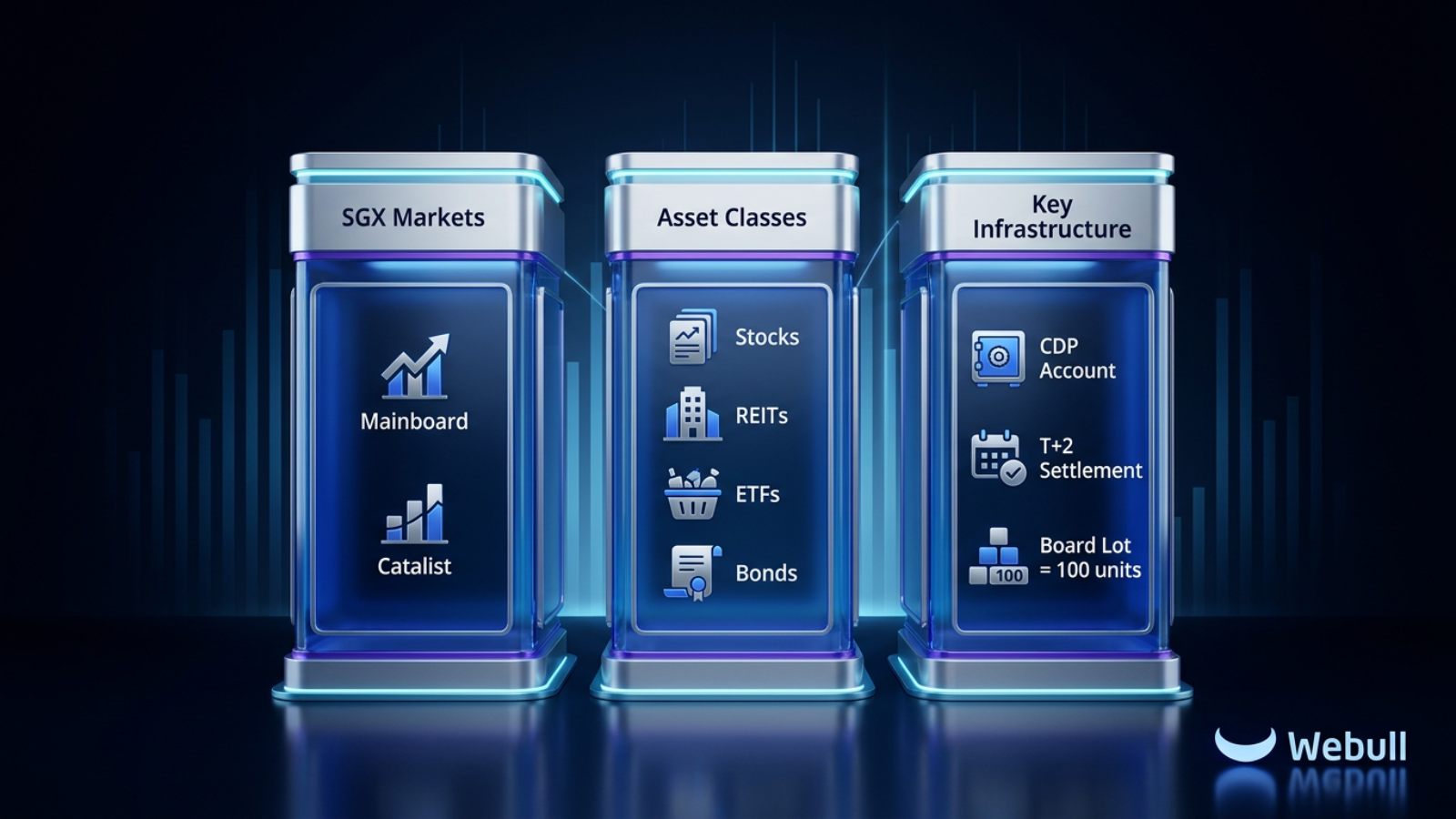
The Singapore Exchange (SGX) lists equities, REITs, ETFs, and bonds across its Mainboard and Catalist boards
SGX trades settle on a T+2 basis; the standard board lot size is 100 units
Shares can be held via a CDP-linked account (direct ownership) or a custodian account (nominee structure)
STI ETFs (ES3, G3B, GAB) offer low-cost, diversified exposure to Singapore's 30 largest listed companies
Webull Singapore is a MAS-regulated broker offering access to SGX, US, Hong Kong, and other markets through a single platform
Singapore does not levy capital gains tax on personal investment gains; individual tax outcomes vary, refer to IRAS or a qualified tax professional
Part 1: What Are SGX Stocks and How Does the Singapore Exchange Work?
1.1 The Singapore Exchange at a Glance
The Singapore Exchange (SGX) is Singapore's sole securities and derivatives exchange, listed on its own market under the ticker S68. It operates the securities market, where retail investors buy and sell stocks, REITs, ETFs, and bonds, as well as a derivatives market for futures and options, and the Central Depository (CDP), which safekeeps securities on behalf of investors.
SGX is regulated by the Monetary Authority of Singapore (MAS) and is one of Asia's major international exchanges, hosting companies from Singapore, China, Southeast Asia, and beyond. For retail investors in Singapore, SGX is most relevant as the marketplace where locally listed securities are traded through a licensed broker.
1.2 SGX Trading Hours and Market Structure
SGX operates on weekdays (excluding Singapore public holidays) according to the following schedule:
Session | Time (SGT) | Notes |
|---|---|---|
Pre-open | 8:30 am – 8:59 am | Orders queued; opening price set via auction at 9:00 am |
Morning session | 9:00 am – 12:00 pm | Active trading; typically highest volume |
Lunch break | 12:00 pm – 1:00 pm | Trading paused |
Afternoon session | 1:00 pm – 5:00 pm | Active trading resumes |
Pre-close | 5:00 pm – 5:04 pm | Orders queued for closing auction |
Closing auction | ~5:06 pm | Closing prices determined; exact time has a random element |
After-hours | 5:10 pm – 6:15 pm | Trades at day's closing price only; lower liquidity |
SGX equity trades settle on a T+2 basis, meaning two business days after the trade date. For example, a sale completed on Monday would normally settle on Wednesday, assuming there are no public holidays. The standard board lot size on SGX is 100 units, although lot sizes may vary for certain securities, including ETFs. Investors can also trade quantities below one board lot through SGX's Unit Share Market.
SGX — https://www.sgx.com
1.3 Mainboard vs. Catalist
SGX operates two distinct listing boards:
Mainboard: The primary board for established, larger companies. Entry requirements include minimum market capitalisation, profitability track record, and shareholder spread. This is where Singapore's blue-chip names are listed, including DBS, OCBC, UOB, Singtel, and the 30 constituents of the Straits Times Index (STI).
Catalist: A sponsor-supervised market for smaller, growth-stage companies. Lower entry requirements and more flexible listing criteria. Companies are sponsored by approved full sponsors. Catalist stocks generally carry a higher risk profile than Mainboard securities.
1.4 CDP Account vs. Custodian Account
Definition block
CDP (Central Depository) account: A securities account held directly in your name at Singapore's Central Depository, a subsidiary of SGX. Units are registered in your name; you receive full shareholder rights including AGM invitations and voting privileges. All holdings across different brokerages are consolidated under a single CDP number.
Custodian account: Your securities are held in the broker's nominee account on your behalf. Legal ownership sits with the broker, though you retain the financial benefit. You do not receive direct shareholder rights such as voting or AGM invitations. Custodian accounts typically carry lower minimum commissions and are the default structure for most digital brokers.
For long-term investors who want direct ownership records and automatic dividend crediting via CDP's Direct Crediting Service (DCS), a CDP-linked account is the conventional choice. Custodian accounts may suit cost-sensitive investors comfortable with the nominee structure.
Client asset protection in Singapore is achieved through MAS-mandated segregation of client moneys and assets under the Securities and Futures Act (SFA), and through custodial and CDP safekeeping arrangements. Singapore does not operate an investor compensation scheme equivalent to the US SIPC.
Part 2: The Straits Times Index (STI) — Singapore's Benchmark
2.1 What Is the STI?
The Straits Times Index (STI) is Singapore's headline equity benchmark, tracking the 30 largest and most liquid companies listed on SGX by free-float market capitalisation. It is calculated and maintained jointly by FTSE Russell and SPH Media Trust, and is reviewed quarterly in March, June, September, and December. The STI represents approximately 75–80% of total SGX market capitalisation, making it the most widely used measure of Singapore's stock market performance.
SGX — https://www.sgx.com/indices/products/sti
2.2 STI Constituents and Sector Breakdown
The three local banks, DBS, OCBC, and UOB, collectively account for approximately 50% of the STI's total weight, making the index particularly sensitive to interest rate movements and regional credit cycles. The remaining constituents span real estate (including S-REITs), industrials, telecommunications, consumer, aviation, and hospitality sectors.
2.3 STI ETFs: ES3, G3B, and GAB
Rather than purchasing all 30 STI constituent stocks individually, investors can gain exposure through one of three SGX-listed ETFs that track the FTSE Straits Times Index:
Feature | ES3 (SPDR STI ETF) | G3B (Amova S$D, Distributing) | GAB (Amova S$A, Accumulating) |
|---|---|---|---|
Manager | State Street Global Advisors Singapore | Amova Asset Management Asia | Amova Asset Management Asia |
Inception | April 2002 | February 2009 | September 2025 |
Expense Ratio (TER) | 0.28% p.a. | ~0.24–0.26% p.a. | ~0.24–0.25% p.a. (stated cap) |
Distribution | Semi-annual cash (not guaranteed) | Semi-annual cash (not guaranteed) | None — dividends retained in NAV |
CPFIS-OA eligible | Yes | Yes | Verify with broker |
SRS eligible | Yes | Yes | Verify with broker |
Domicile | Singapore | Singapore | Singapore |
TER figures sourced from fund factsheets; verify current rates with the respective fund managers before investing. Past performance is not indicative of future results.
ES3 is the oldest and most liquid STI ETF, with a track record dating back to 2002. G3B offers a marginally lower expense ratio and pays semi-annual cash distributions. GAB, launched in September 2025, is an accumulating share class of the same Amova Singapore STI ETF. It reinvests atrributable income and gains within the fund, with the effects reflected in its NAV, allowing investors to compund returns without manually reinvesting cash distributions. However, GAB has a considerably shorter trading history and lower trading actively than ES3 and G3B.
Singapore does not impose dividend withholding tax on distributions from Singapore-domiciled ETFs for Singapore-resident investors, and there is no capital gains tax on profits from selling ETF units. Individual tax outcomes depend on personal circumstances; this does not constitute tax advice. Refer to IRAS guidance or a qualified tax professional for your specific situation.
IRAS — https://www.iras.gov.sg
Part 3: How to Buy SGX Stocks in Singapore — Step-by-Step
3.1 Step 1 — Choose Your Account Type
Decide between a CDP-linked account (direct ownership, full shareholder rights, suitable for long-term investors) and a custodian account (nominee structure, typically lower minimum commissions, suitable for cost-focused or frequent traders). Your choice will determine which brokerages are available to you and how your shares are held.
3.2 Step 2 — Open a CDP Account (if required)
A CDP account is free to open and takes approximately 15 minutes online via the SGX website using Singpass MyInfo. Eligibility requirements:
At least 18 years old
Not an undischarged bankrupt
Hold an account with a designated bank (DBS/POSB, OCBC, UOB, Citibank, HSBC, Maybank, or Standard Chartered) to enable the Direct Crediting Service (DCS) for automatic dividend and corporate action crediting
Singapore Citizens and PRs applying via MyInfo will need their NRIC number, bank account details, and a scanned signature. Foreign residents additionally require their country of tax residency and Tax Identification Number. CDP sends a confirmation letter by post after submission.
SGX CDP — https://www.sgx.com
3.3 Step 3 — Select a MAS-Regulated Broker
To trade SGX-listed stocks, you need a broker holding a Capital Markets Services (CMS) Licence issued by MAS. Several platforms offer SGX access, with varying commission structures and account types.
Webull Singapore stands out for its combination of competitive SGX commissions, multi-market access, and a feature-rich platform designed for both new and experienced investors. Webull holds a CMS Licence(CMS101150) and is regulated by MAS. You can open an account and access SGX stocks, US markets, Hong Kong stocks, and more through a single platform.
3.4 Step 4 — Fund Your Account
Transfer SGD to your brokerage account via PayNow, FAST, eDDA Deposit or Bank/Telegraphic transfer. Most digital brokers credit funds within minutes. For a first purchase of one board lot (100 shares) of an STI ETF, budget approximately S$300–S$380 depending on current prices, plus applicable commissions and SGX fees. There is no minimum balance requirement on the CDP account itself.
3.5 Step 5 — Search and Place Your Order
On your brokerage platform, search for the ticker of the stock or ETF you wish to buy (e.g., ES3, G3B, D05 for DBS). You have two primary order types:
Market order: Executes immediately at the best available price. Fast and certain, but you have no control over the exact fill price.
Limit order: You specify the maximum price you are willing to pay. The order sits in the queue until a seller matches your price.
3.6 Step 6 — Monitor Settlement and Dividends
After a successful trade, settlement occurs at T+2, your shares appear in your CDP or custodian account two business days later. If the settlement date falls on a public holiday, it is postponed accordingly. Dividends from distributing ETFs (ES3, G3B) are credited semi-annually to your CDP-linked DCS bank account. Amounts are not guaranteed and may vary.
Part 4: Investing in SGX Stocks Using CPF and SRS
4.1 CPF Investment Scheme (CPFIS)
Singapore investors can use their CPF Ordinary Account (OA) savings to invest in approved SGX-listed securities, including ES3 and G3B, under the CPF Investment Scheme (CPFIS). Key conditions:
You must maintain a minimum of S$20,000 in your OA before investing any surplus; this floor cannot be invested
CPF Special Account (SA) funds cannot be used for equity ETF investments
CPF OA currently earns a guaranteed 2.5% per annum. Investing in STI ETFs means accepting equity market volatility in exchange for the potential of higher long-term returns. Investors with shorter time horizons or lower risk tolerance should weigh this trade-off carefully. Past performance is not indicative of future results.
4.2 Supplementary Retirement Scheme (SRS)
The Supplementary Retirement Scheme (SRS) allows Singapore residents to make voluntary contributions from their own savings, receive a dollar-for-dollar income tax deduction on contributions, and invest those funds in approved securities, including SGX-listed stocks and ETFs, with gains and dividends growing tax-deferred until withdrawal.
Annual SRS contribution limits (as of 2026):
Singapore Citizens and PRs: S$15,300 per year
Foreigners: S$35,700 per year
SRS withdrawals at the statutory retirement age (currently 63) benefit from a 50% concession, only half the amount withdrawn is added to assessable income. Spread over 10 years, many retirees may pay minimal or zero tax on SRS withdrawals. Individual tax outcomes depend on personal circumstances; this does not constitute tax advice. Refer to IRAS guidance or a qualified tax professional for your specific situation.
IRAS — https://www.iras.gov.sg
4.3 Regular Savings Plans (RSP) for SGX ETFs
For investors who prefer systematic, automated investing, several platforms offer Regular Savings Plans (RSPs) that allow monthly purchases of STI ETFs from as little as S$100 per month:
DBS Invest-Saver: Monthly purchases of G3B from S$100/month; commission 0.82% (cash) or 0.50% (SRS)
POEMS Share Builders Plan: Monthly investment from S$100 across CPF, SRS, or cash; commission 0.3% p.a. of total portfolio value (min S$1/month)
OCBC Blue Chip Investment Plan: Monthly STI ETF purchases from S$100/month; 0.30% commission (min S$5)
FSMOne Regular Savings Plan: From S$50/month; 0.08% or min S$1 (check current promotions on the official website)
Rates vary by service provider; please refer to the latest pricing on the official website.
Part 5: Webull Singapore — Accessing SGX and Global Markets
5.1 Platform Overview and MAS Regulation
Webull Singapore is a MAS-regulated broker holding a Capital Markets Services (CMS) Licence, offering retail investors access to SGX-listed securities as well as markets in the United States, Hong Kong, and beyond — all through a single integrated platform. Webull is designed to serve both investors focused on Singapore's local market and those seeking cross-border exposure to US equities, Hong Kong stocks, and other international markets.
Explore Webull Singapore's platform
5.2 SGX Market Access on Webull
Webull provides access to the full range of SGX-listed securities, including:
Mainboard stocks: Singapore blue chips, including STI constituents such as DBS, OCBC, UOB, Singtel, and S-REITs
Catalist stocks: Smaller and growth-stage companies
SGX-listed ETFs: Including STI ETFs (ES3, G3B, GAB), sector ETFs, and bond ETFs
S-REITs: Singapore's extensive real estate investment trust market, covering retail, industrial, office, logistics, hospitality, healthcare, and data centre sectors
For SGX trades, Webull operates a custodian account structure, holding securities in a nominee account on behalf of clients. Client assets are segregated in accordance with MAS requirements under the Securities and Futures Act (SFA).
5.3 Commission Structure and Fees
Webull Singapore offers a competitive commission structure for SGX trades:
Minimum commission: S$0.80 per trade
Commission rate: 0.025% of trade value
Rates vary by service provider; please refer to the latest pricing on the official website at www.webull.com.sg. SGX clearing fee (0.0325%) and SGX access fee (0.0075%) apply to all SGX trades, plus 9% GST on brokerage commission.
For US stock trading, commissions are typically quoted in USD. Please refer to Webull's official fee schedule for current rates across all markets.
5.4 Multi-Market Access for Singapore Investors
One of Webull's notable features for Singapore-based investors is the ability to access multiple markets through a single account:
SGX: Singapore stocks, REITs, and ETFs
US markets: NYSE and NASDAQ-listed stocks and ETFs
Hong Kong (HKEX): Hong Kong-listed stocks and ETFs
Additional markets as available on the platform
Singapore investors trading overseas-listed products should note that such products are subject to a different regulatory regime and legal system than SGX-listed products. This is consistent with the Risk Warning Statement requirement under MAS Notice SFA04-N12. Investors should review the relevant risk disclosures before trading foreign-listed securities.
5.5 Platform Features
Webull's platform is designed to support informed investment decision-making. Features available on the platform include:
Real-time market data: Live quotes, charts, and market depth for SGX and international markets
Advanced charting tools: Technical analysis indicators and customisable chart layouts
Screeners and watchlists: Tools to filter and monitor stocks across markets
News and research feeds: Market news and company announcements
Paper trading: A simulated trading environment for investors to practise without real capital at risk
Mobile and desktop access: Available on iOS, Android, and web browser
5.6 Account Opening Process
Opening a Webull Singapore account is a fully digital process:
Step 1: Visit www.webull.com.sg or download the Webull app
Step 2: Complete the online application with your personal details and identity verification (NRIC for Singapore Citizens/PRs; passport for foreigners)
Step 3: Complete the Customer Knowledge Assessment (CKA) or Customer Account Review (CAR) as required under MAS regulations for trading in specified investment products
Step 4: Fund your account via FAST transfer or bank transfer in SGD
Step 5: Begin trading SGX stocks, ETFs, US stocks, and other available markets
5.7 Pros and Cons of Webull Singapore
Strengths:
Competitive SGX commission (S$0.80 minimum, 0.025% rate)
Multi-market access (SGX, US, HK) through a single account
Feature-rich platform with real-time data and charting tools
MAS-regulated with CMS Licence; client assets segregated under SFA requirements
Fully digital account opening process
Considerations:
Custodian account structure — investors do not receive direct CDP ownership or full shareholder rights (e.g., AGM voting)
Investors who require CDP-linked accounts for direct ownership will need to use a CDP-linked broker for that purpose
As with all equity investments, trading involves risk and the value of investments may fall as well as rise
The Bottom Line
SGX stocks offer Singapore investors direct access to the country's largest listed companies, S-REITs, and low-cost ETFs — all within a well-regulated, MAS-supervised market. Webull Singapore provides a competitive, CMS-licensed platform for accessing SGX alongside US, Hong Kong, and other international markets. Whether you are building a long-term portfolio or exploring cross-border investing, understanding the SGX infrastructure is the foundation of informed decision-making.
Start investing with Webull Singapore
Past performance is not indicative of future results. Investing involves risk, including the possible loss of principal. This article is for general informational purposes only and does not constitute investment, financial, or tax advice. Individual circumstances vary; consult a licensed financial adviser or tax professional for advice specific to your situation.
Disclosure:
All investments involve risks and are not suitable for every investor. The information provided is generated with the assistance of artificial intelligence based on publicly available sources and is for informational purposes only.
The content provided above is for educational purposes only and does not constitute financial, investment, or professional advice. No content should be construed as investment advice or recommendation, or an offer or solicitation, to deal in any investment product. Investors may wish to seek advice from a financial adviser before investing. In the event that investors choose not to seek advice from a financial adviser, they should consider whether the investment is suitable for them. For more information, please refer to our website at https://www.webull.com.sg.
This advertisement has not been reviewed by the Monetary Authority of Singapore.
